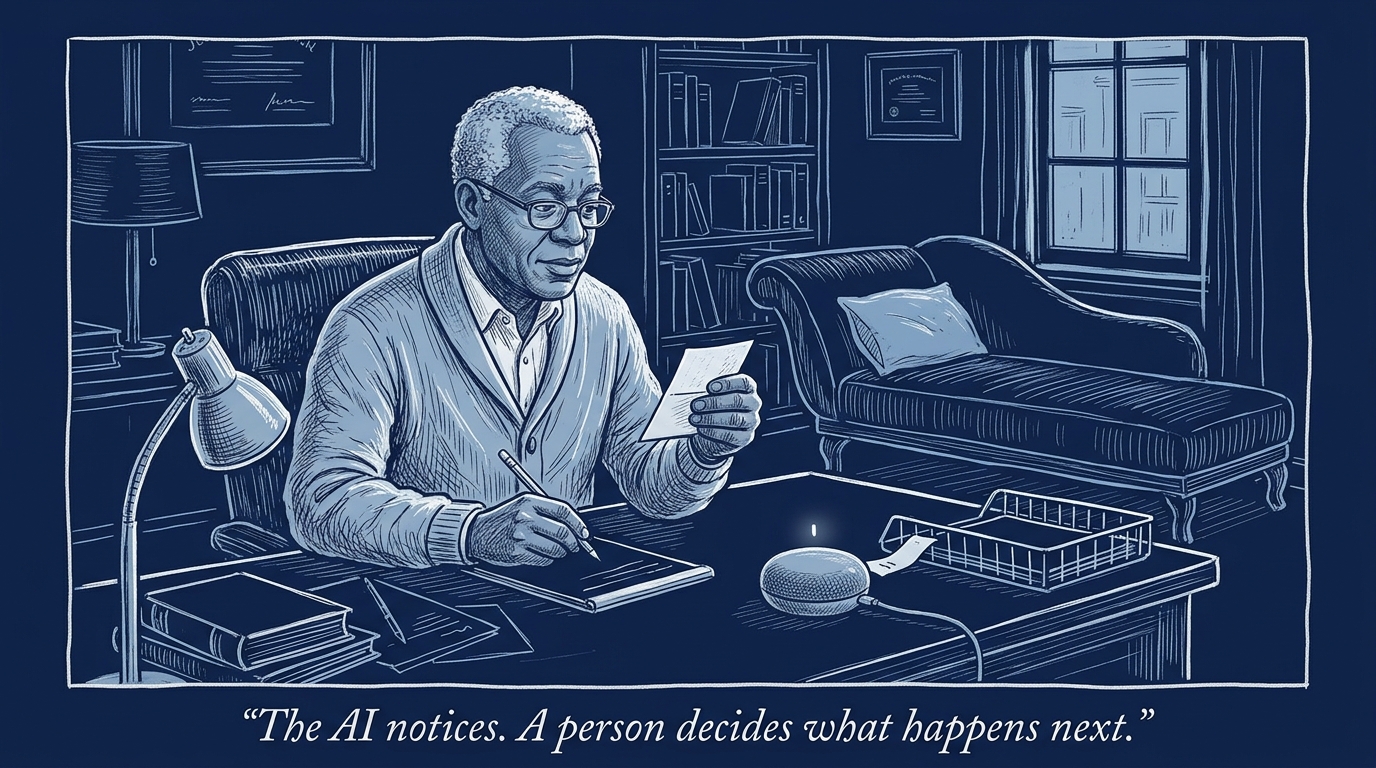
Dr. Holo, HoloMD's AI agent, checks in on psychiatric patients between office visits -- not to provide therapy, and not to handle a crisis, but to surface patterns of possible decline for a human to look at. The company was founded by Bruce Alan Kehr, M.D., a Rockville, Maryland psychiatrist -- a licensed physician, not only a mental-health-trained provider -- who has run Potomac Psychiatry since June 1982. The actual design question worth asking about any AI system in behavioral health isn't whether AI is involved -- it's who stays accountable for what it notices and what happens next.
Psychiatry is one of the most state-regulated fields in medicine, and telehealth crossed a legal line in most of it before 2020
Before COVID-19, a psychiatrist needed a medical license in the state where the patient was physically located, not just the state where the psychiatrist practiced -- treating a patient across state lines without one was the unauthorized practice of medicine, a licensing violation criminally enforceable in nearly every state.[5] When the COVID-19 public health emergency began in March 2020, all 50 states and the District of Columbia used emergency authority to waive some part of that requirement -- which is what allowed telehealth to substitute for in-person mental health care at real scale for the first time. Mental health visits delivered by telehealth peaked at more than 51% of the total that April, briefly overtaking in-person care nationally.[6] Those emergency waivers have since expired; as of December 2023, at least 30 states now ban or severely restrict a telehealth appointment with a doctor who isn't licensed in the patient's own state.[7] HoloMD manages that entire stack by never being the regulated party in the first place -- its customer is the psychiatric practice, not the patient. HoloMD's own materials describe the product as building "an accretive revenue stream for their treating physicians," not a service patients buy directly.[1] The practice buys the platform; the practice's own already-licensed psychiatrist keeps the treating relationship and the license in the patient's state; Dr. Holo supplies monitoring software underneath a relationship that was already legal before HoloMD existed. Routing through "a participating psychiatric practice" isn't a workaround forced on HoloMD by the licensing law above -- it's the business model. Sell to the entity that already carries the license, and the license question never has to be HoloMD's to solve.
Prescribing adds a second, separate layer of regulation on top of licensure. The Ryan Haight Online Pharmacy Consumer Protection Act of 2008 requires a practitioner to conduct at least one in-person medical evaluation before prescribing a controlled substance through telemedicine, with narrow exceptions that don't cover the home-based telehealth model in common use today.[8] That lands squarely on psychiatry, where a large share of the medication supply -- benzodiazepines, stimulants prescribed for ADHD -- is itself controlled. The DEA has kept suspending that in-person requirement through a series of temporary COVID-era flexibilities rather than repealing it, most recently extending the exception again in a fourth temporary extension published in the Federal Register in December 2025.[9] The same customer logic resolves this layer too: because the treating physician is the practice's own psychiatrist, not a stranger Dr. Holo introduces, the in-person evaluation Ryan Haight requires was very likely already satisfied by ordinary in-office care before the patient was ever enrolled in remote monitoring. Nothing about telepsychiatry's legal footing is permanent yet -- it runs on a stack of emergency waivers and repeated short-term extensions that federal regulators keep renewing rather than resolving -- but that instability is the practice's exposure to carry, not HoloMD's, precisely because HoloMD was never the one holding the license or writing the prescription.
What Dr. Holo is, and what it explicitly is not
A participating psychiatric practice decides whether a patient is appropriate, obtains consent, and enrolls them -- Dr. Holo is not a standalone app a consumer downloads and relies on directly. Through structured digital check-ins on scheduled service days, the platform gathers patient-reported information over time; AI helps organize those interactions and flag changes that may warrant attention, and trained staff review that information under defined protocols before escalating qualifying concerns to the patient's treating provider. The provider -- not the AI -- decides whether a follow-up or intervention is warranted.[1]
The boundaries are explicit, not fine print. Dr. Holo does not provide psychotherapy or counseling, does not diagnose or prescribe, and does not replace a treating clinician. Human review is not continuous or real-time -- the platform surfaces patterns over defined service periods, not urgent psychiatric events, and patients are directed to call 911, go to an emergency department, or contact 988 for anything urgent rather than wait on a response from the platform.[1]
491Provider escalations from HoloMD's human-supervised review, reported by the company
Jan 2022Original RTM billing codes take effect
Jan 2023Cognitive-behavioral monitoring code (98978) takes effect
HoloMD reports that this workflow has produced 491 instances in which an alert was escalated to a treating provider for evaluation. That figure is an operational measure of escalations, not a count of unique patients, emergencies, or proven prevented outcomes -- a distinction that sharpens the point rather than undercuts it: in each of those 491 instances, a human-supervised process moved potentially important information from a between-visit check-in into a provider's field of view, and a person, not the AI, decided what happened with it.[1]
The billing mechanism, precisely
Remote Therapeutic Monitoring is what makes this reimbursable, and the timeline is more specific than "AI got a green light" -- the original RTM code family became payable under Medicare on January 1, 2022, and the code specific to cognitive-behavioral monitoring, 98978, took effect a year later, January 1, 2023.[2] HoloMD-supported workflows draw on several codes: 98975 for setup and patient education; 98978 (and a 2026-added 98986) for qualifying monitoring-device supply at different data-day thresholds; and 98980/98981, with a 2026-added 98979, for qualifying provider management time.[1] In HoloMD's own claims experience, qualifying RTM services have generally been paid by Original Medicare, Medicare Advantage, and commercial payers including Aetna, some Blue Cross Blue Shield plans, and Humana; payment success has generally been lower with Cigna, and Medicaid coverage varies by state.[1] Reimbursement sustains the human review this model depends on -- it isn't regulatory approval or proof of clinical efficacy, and a billing code doesn't create the human oversight; that's a design choice on top of it.[1]
The contrast that actually matters: who's accountable when there's no clinician in the loop
Character.AI is the clearest case of the same broad technology -- conversational AI offering something like emotional support -- running with no treating relationship and no clinician reviewing what it produces. In Garcia v. Character Technologies, a Florida family alleged that months of interaction with a Character.AI persona contributed to 14-year-old Sewell Setzer III's death by suicide in February 2024. A federal court allowed most of the claims to proceed past the pleading stage in 2025, but did not rule on causation or liability; the parties settled in January 2026 and the case was dismissed.[3] Separately, in September 2025, the FTC issued information orders to seven companies offering consumer AI companion chatbots, seeking detail on safety testing and effects on minors -- described by the agency as an industry study, not a finding that any company had broken the law.[4]
The lesson isn't that every consumer chatbot is dangerous, or that every clinically-supervised system is automatically safe. It's that two products aren't clinically equivalent just because both use a conversational interface -- intended use, who has access, whether there's a real treating relationship, human review, and a defined escalation pathway all change the actual risk.
Why does this matter? The useful question about any AI system touching mental health was never simply "does it use AI." It's what the system is actually intended to do; whether it operates inside an established care relationship; who reviews its signals, on what schedule, under what protocol; what triggers escalation; who is empowered to act on it; and who ultimately retains clinical judgment. Human supervision doesn't make an AI system infallible -- it can't eliminate every false alert or missed signal. What it changes is the structure around the technology: accountability, and a defined path from a flagged pattern to a person qualified to decide what it means.
 Oluwadi