 Oluwadi
Investigating the Overlooked
Region
What
Who For
Analysis
Oluwadi
Investigating the Overlooked
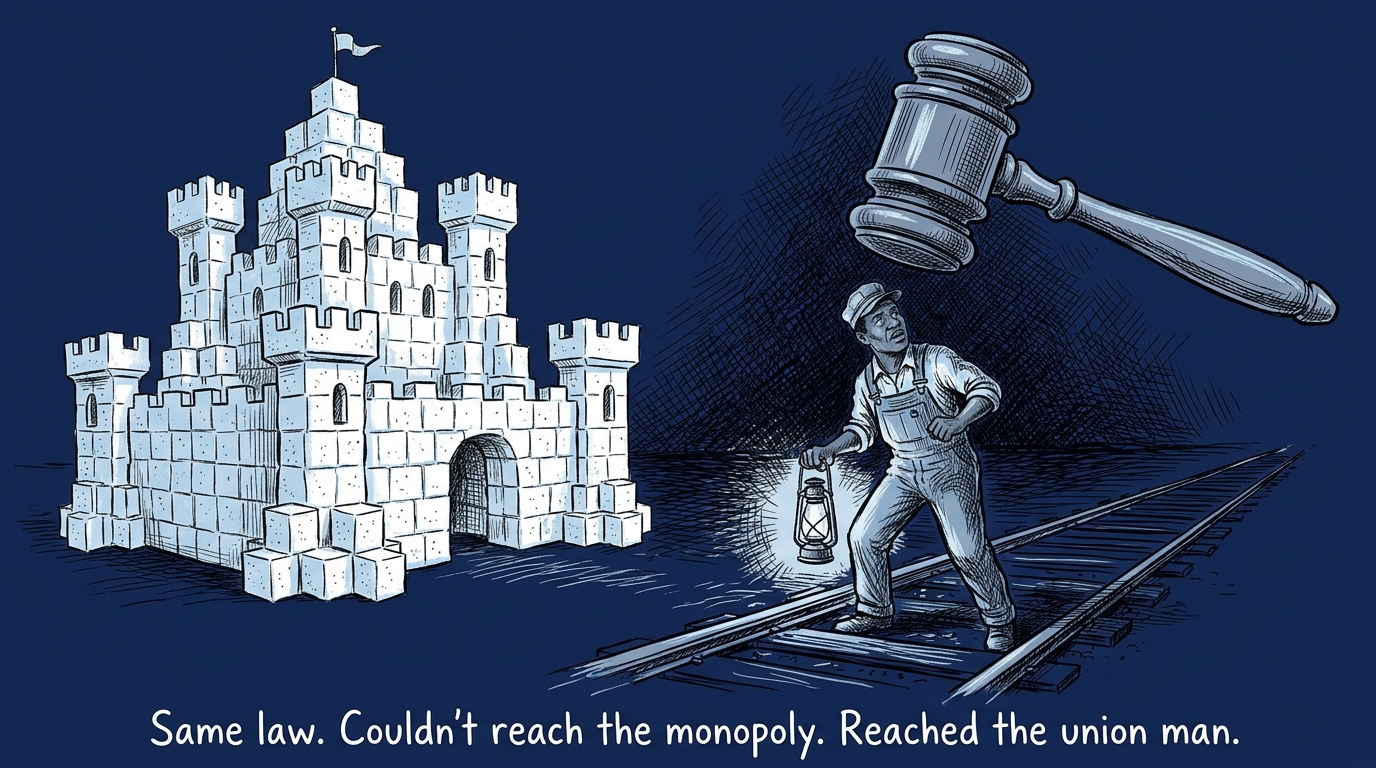
In 1895, the Supreme Court ruled on the Sherman Antitrust Act twice, and it's the same law reaching two opposite verdicts within months of each other. In United States v. E.C. Knight Co., the Court ruled 8-1 that the year-old law could not touch the American Sugar Refining Company -- a combine that had just bought up every sugar refinery in Philadelphia to control 98 percent of sugar manufacturing in the country -- because manufacturing wasn't "commerce" under the Constitution's Commerce Clause. The ruling gutted the Sherman Act against real trusts for a decade.[1] That same year, in In re Debs, the Court unanimously upheld using that identical statute to jail Eugene Debs for six months, for defying a federal injunction during the Pullman Strike -- an injunction obtained in part by invoking the Sherman Act against his American Railway Union.[2] The law that couldn't reach a 98-percent monopoly reached a union leader without difficulty. That's Debs' first collision with federal power, 23 years before the 1918 Sedition Act conviction already documented on this site -- two different statutes, two different decades, the same man on the losing end both times.
It took Theodore Roosevelt's administration to find an angle that worked -- not manufacturing, but the railroad holding companies E.C. Knight had left untouched. Roosevelt's Justice Department sued Northern Securities, a J.P. Morgan-backed combine controlling the Northwest's major railroads, and won -- barely. The Supreme Court's March 1904 ruling was 5-4.[3] Standard Oil took even longer: Roosevelt authorized the suit in 1906, and it wasn't decided until 1911, under his successor Taft, when the Court finally ordered John D. Rockefeller's 90-percent oil monopoly broken into 34 separate companies.[4] Neither case was fast, and neither was close to unanimous consensus. The law working against concentrated capital was never automatic -- it required a specific administration willing to spend years pursuing it, and it still came down to a single vote.
In re Debs wasn't an isolated case -- it set the template. For the next several decades, the Sherman Act became a primary tool used against organized labor, an era labor historians call "government by injunction."[2] Congress tried to fix the asymmetry in 1914: the Clayton Antitrust Act declared that human labor "is not a commodity or article of commerce" and restricted injunctions against peaceful strikes and boycotts. AFL president Samuel Gompers called it "the Magna Carta of labor."[5] The relief didn't last -- courts spent the years after 1914 narrowing the exemption back down through interpretation, without Congress repealing a word of it.[5]
Robert Bork's 1978 argument that antitrust law should judge mergers only by price effects, not market concentration, became the operative US standard for the next 40 years -- already traced on this site through the airline industry's consolidation from eight major carriers to four. AT&T's breakup landed right at that hinge: the government's 1974 suit ended in a January 1982 settlement, with the Bell System split into seven regional "Baby Bells" by January 1984 -- one of the last major structural breakups before the new, friendlier standard took hold.[6]
In the same narrow window, the other side of the mirror moved in the opposite direction. On August 5, 1981, President Reagan fired 11,345 striking air traffic controllers who defied a return-to-work order, permanently barring them from federal employment. That October, the Federal Labor Relations Authority decertified their union, PATCO -- the first federal union decertification in US history.[7] Historians consider it one of the most consequential events in late-20th-century American labor history: not a court ruling this time, just direct executive power, deployed at almost exactly the moment the legal standard for corporate combination was loosening. Concentration among businesses was becoming harder to challenge in court. Concentration among workers was broken by presidential order, without needing a court at all.
The corporate side's modern pattern repeats the Roosevelt-era shape almost exactly: a real trial win, followed by a retreat on the remedy. The DOJ won a full liability finding against Microsoft in 2000, plus a trial-court order to break the company in two -- the DC Circuit Court of Appeals overturned the breakup on appeal in 2001, and the DOJ settled for behavioral rules instead.[8] Twenty-four years later, Google lost its own search-monopoly case, and in September 2025 the court again rejected a breakup -- no Chrome or Android divestiture, only shorter default contracts and mandated data-sharing with rivals. Both Google and the DOJ are now appealing that ruling.[9] The FTC's parallel case against Meta went further than either: in November 2025, a federal judge ruled Meta doesn't even currently hold monopoly power, citing competition from TikTok and YouTube, rejecting the FTC's push to unwind the Instagram and WhatsApp acquisitions outright. The FTC is appealing.[10]
The labor side's current chapter is not a fight so much as a body that can't currently function. On January 27, 2025, President Trump removed NLRB Board member Gwynne Wilcox -- the agency that adjudicates union-organizing and unfair-labor-practice disputes -- despite a 90-year-old Supreme Court precedent meant to shield board members from at-will removal. The Supreme Court declined to reinstate her in May 2025, and as of this writing the NLRB still lacks the quorum it needs to decide cases at all.[11] The same year, private-sector union membership fell to 5.9 percent -- the lowest rate ever recorded.[12]
Why does this matter? This was never really a story about whether the law lets people combine. It's a story about which combinations the law has been willing to make a fight of, and which it has simply let win by default. Capital combining into monopoly has always gotten a real contest -- narrow, slow, frequently unsuccessful, but a contest, from a 5-4 vote in 1904 to an ongoing appeal in 2026. Labor combining into a union got the opposite treatment from the same legal system, in the same years, usually without needing a trial at all: an injunction in 1894, a firing in 1981, a fired board member in 2025 leaving the referee unable to take the field. Both stories are still being written. Only one of them currently has anyone showing up to argue the other side.