 Oluwadi
Investigating the Overlooked
Region
What
Who For
Analysis
Oluwadi
Investigating the Overlooked
Under Armour's founding and its first move to Baltimore's waterfront are already part of this site's account of what got built on the city's reclaimed Inner Harbor -- Kevin Plank founded the company in 1996, and it moved its global headquarters into a converted soap factory at Tide Point, directly on the harbor, in 2002.[1] What happened to the company and its Baltimore ambitions since is a separate, much harder story that the earlier account doesn't cover.
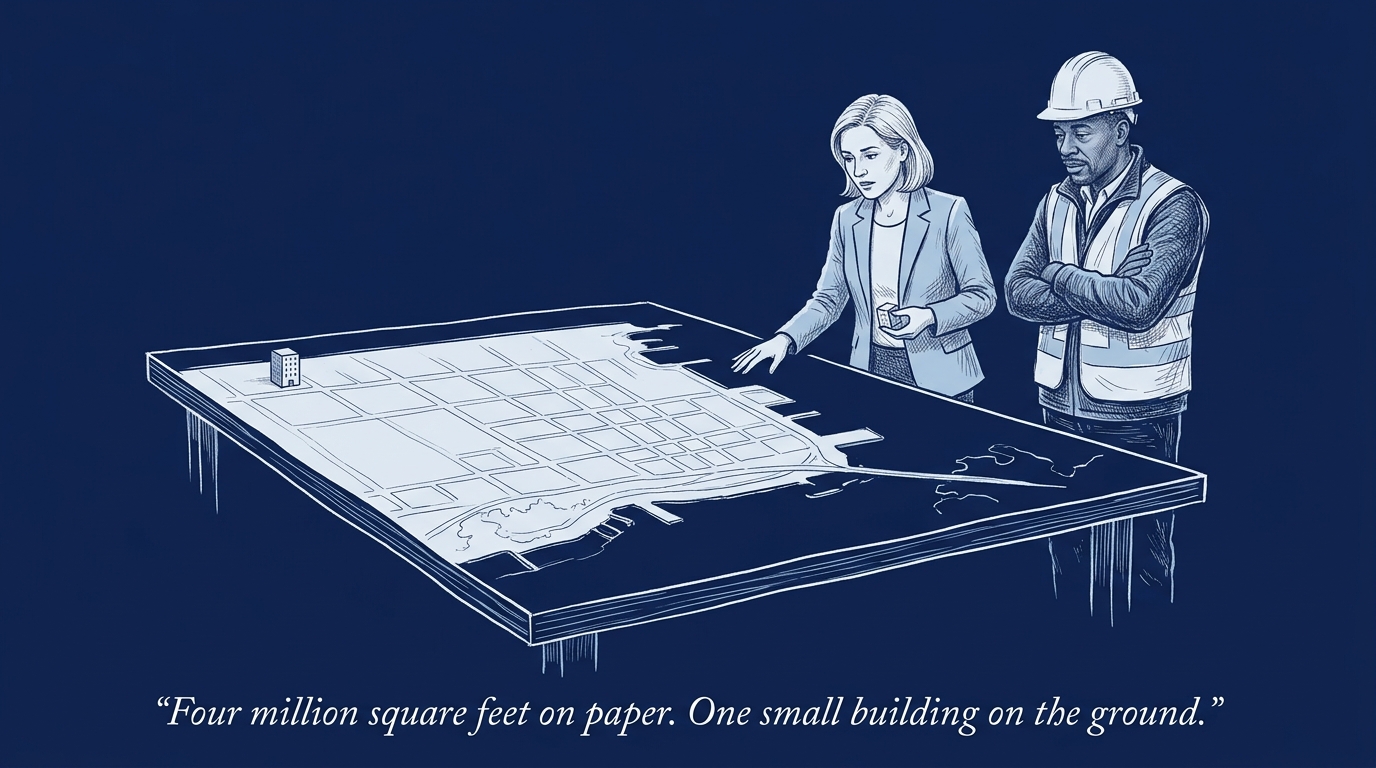
In 2021, Under Armour unveiled a genuinely enormous vision for its next Baltimore headquarters: 4 million square feet of new construction at Port Covington, a from-scratch campus on the peninsula south of the Inner Harbor.[2] The pandemic's shift toward hybrid work forced a real scale-down almost immediately -- the plan that actually broke ground consolidates the company's roughly 1,700 Baltimore-based employees into a single five-story, 284,000-square-foot building, a small fraction of the original footprint, with an NCAA-regulation track and testing fields attached for product development rather than the sprawling corporate campus first announced.[3]
The company's own performance during the same stretch got considerably worse than the headquarters plan did. Kevin Plank stepped back as CEO in 2019 as sales already struggled, returning to the role in March 2024 after his successor, Stephanie Linnartz, had held the job for just over a year.[4] The numbers he came back to were severe: fiscal 2024 fourth-quarter profit fell more than 96% year over year, full-year revenue dropped to $5.7 billion, and net income fell 38% to $232 million.[4] The company's board approved a restructuring plan in May 2024 projected to cost $70-90 million, covering layoffs and severance.[4] Fiscal 2025 guidance was worse still -- North American sales projected down 15-17%, adjusted earnings per share guided to 18-21 cents against analyst expectations of 59 cents -- and by the first quarter of fiscal 2026, the company was still reporting a 4-5% revenue decline amid what it called a "strategic reset," compounded by new tariff uncertainty.[5]
By December 2025, Plank had gone further than scaling back the building -- he stepped away from the site's future entirely. Reporting that month confirmed that Plank and Sagamore, his separate real estate development company, would no longer be involved in future development at Baltimore Peninsula (the broader redevelopment area including Port Covington), described as part of a wider pattern of Plank cutting back ventures outside Under Armour itself and liquidating other assets to focus on the company he'd just returned to run.[6]
Why does this matter? The version of this story already told on this site -- Under Armour as one of the real anchors built on Baltimore's reclaimed waterfront -- is true and worth keeping. It's also only the first half. The company that once planned to build 4 million square feet of new Baltimore waterfront now occupies a fraction of that footprint, is run again by the founder who had to come back and cut deeply to steady it, and has formally exited its own ambitions for the land around it. A headquarters this size, planned this large and built this much smaller, is itself a precise measure of how far the company's own ambitions retreated in four years -- separate from and sharper than any revenue chart alone.