 Oluwadi
Investigating the Overlooked
Region
What
Who For
Analysis
Oluwadi
Investigating the Overlooked
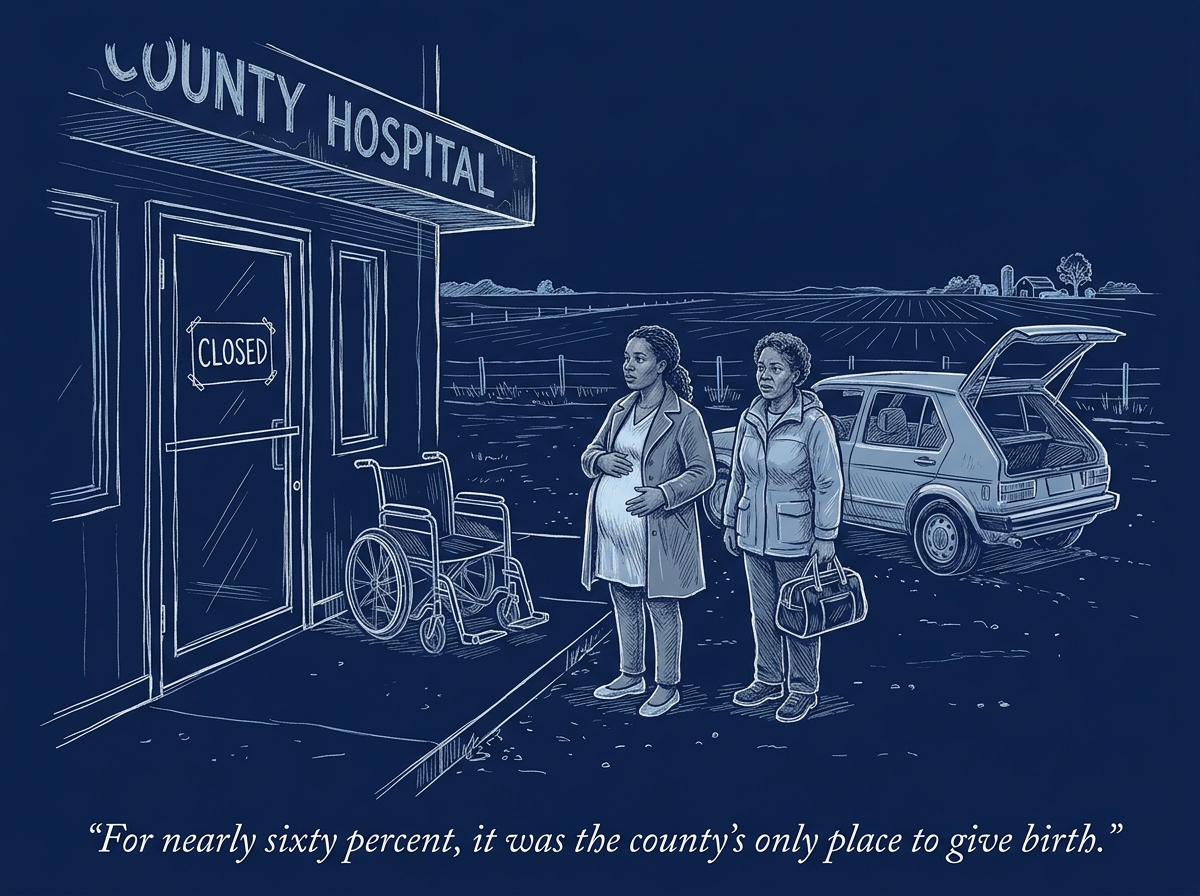
More than a third of US counties -- 34.6% of them -- are now what March of Dimes formally classifies as maternity care deserts: places with no hospital offering obstetric care, no birth center, and no obstetric clinician at all.[1] Those counties are home to 2.4 million women of reproductive age, and roughly 149,000 babies are born inside them every year regardless.[1] Between January 2024 and May 2026, at least 96 labor-and-delivery units closed across 35 states -- and in nearly 60% of the affected counties, the unit that closed was the only place in the entire county to give birth.[1]
A separate national accounting from the Center for Healthcare Quality and Payment Reform counts 139 rural hospitals that have stopped delivering babies, or announced plans to, since the end of 2020 -- a 13% reduction in rural labor-and-delivery capacity in under six years. Only 41% of rural hospitals nationally still offer labor and delivery services at all.[2]
Out of roughly 3,142 counties nationally, more than half already lack a hospital offering labor and delivery at all, meaning fewer than 1,571 counties currently have it.[1] Of the 96 units that closed between January 2024 and May 2026, nearly 60% were their county's only birthing facility -- roughly 58 counties that had at least one hospital delivering babies and now have none, in just over two years.[1] And yet March of Dimes' own topline share of counties classified as full maternity care deserts has held remarkably steady, 34-36%, across every report back to 2016 and again in 2022, even as this most recent wave of closures accelerated sharply.[1] That stability is worth naming honestly rather than glossing over: it likely reflects a reporting lag, where the most recent closures haven't fully worked through the classification yet, rather than evidence the underlying access problem has stopped getting worse.
A labor-and-delivery unit has to be staffed with specialized clinicians and stocked with dedicated equipment every single day of the year, but a hospital is only reimbursed when an actual delivery happens -- and Medicaid, which pays for about 4 in 10 births nationally, typically reimburses well below what it costs a hospital to keep that unit running.[2] That structural mismatch predates the 2025 reconciliation law's Medicaid cuts; the law is expected to accelerate it by reducing hospital payments further and cutting Medicaid enrollment through new work requirements.[2] Obstetric clinician shortages compound the closures directly: nearly 58% of rural counties lack an obstetric clinician of any kind, compared with about 19% of urban counties.[1]
Closures have already added an average of 25 minutes to the drive to reach maternity care in affected communities.[1] In the fourteen states hit hardest, the median drive time for a Medicaid patient to reach the nearest hospital offering inpatient maternity care runs 43 minutes in rural areas, versus 13 minutes in urban ones -- more than three times as long, for the population with the least ability to absorb a 43-minute drive in active labor.[2]
Forty-nine states must balance their budgets every year by constitutional or statutory requirement -- the federal government carries no equivalent constraint.[3] That means when a federal Medicaid cut reduces what a state's hospitals are paid, the state can't simply borrow to cover the difference the way Washington borrowed to create it. It has to cut spending elsewhere, raise revenue, or let the program itself shrink, in the same budget year -- and a maternity unit, structurally the easiest department to drop for the reasons above, is exactly where that in-year pressure tends to land first.
Why does this matter? Maternity care is one of the first services a financially strained hospital cuts, not because it matters less, but because it's structurally the easiest line item to drop -- a department that has to be fully staffed year-round against a reimbursement rate that doesn't cover the cost of keeping it open. The same Medicaid cuts reshaping rural hospitals generally are hitting this specific, physically time-sensitive service hardest of all, and the burden lands precisely on the rural, lower-income patients who rely on Medicaid to give birth in the first place. It's the sharpest edge of a much broader crisis: 700 rural hospitals nationally are now at risk of closing entirely, not just their maternity wards.