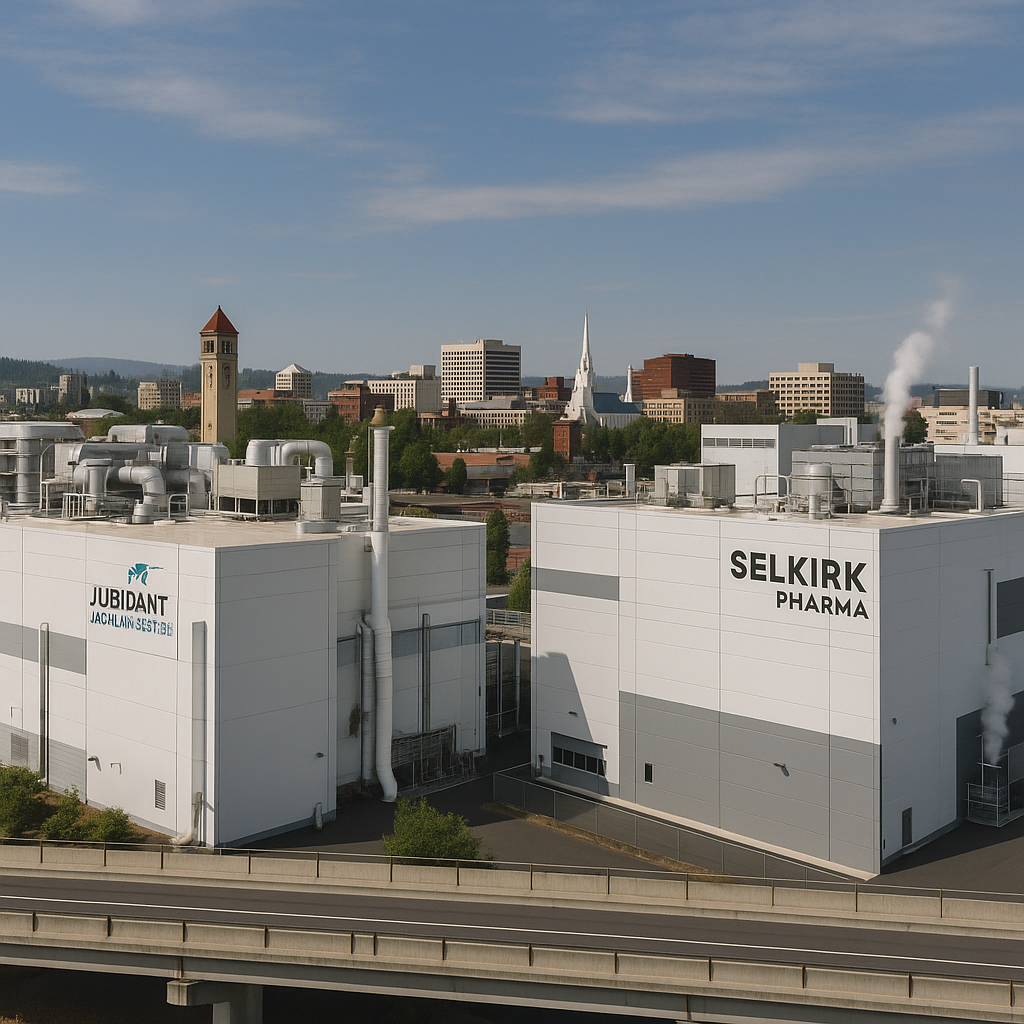
American hospitals have been short on basic injectable drugs -- saline, chemotherapy agents, antibiotics -- for years, and the shortages that hit hardest last the longest. Injectable drugs made up half of all U.S. drug shortages between 2018 and 2023, and the median injectable shortage lasted 4.6 years, nearly three times as long as a shortage of a pill. Three years in, 65 percent of injectable shortages are still unresolved.[1] Spokane, Washington -- not a city anyone associates with pharmaceutical manufacturing -- sits in the middle of the industry trying to fix that. In the same few years, it produced one clear winner and one outright collapse, chasing the identical opportunity.
Why the shortage exists, and why Spokane is positioned for it
Sterile injectable manufacturing consolidated hard over the past two decades: FDA's own 2020 root-cause analysis found 62 percent of drug shortages trace to manufacturing or quality problems, roughly 40 percent of generic drug markets have only a single remaining manufacturer, and about half of finished-dose facilities sit outside the United States.[1] The fragility is concrete, not theoretical: Akorn Pharmaceuticals, a major generic sterile-injectable maker, went bankrupt in February 2023 after years of thin-margin operation, directly worsening shortages of albuterol and other drugs.[2] Baxter's North Cove, North Carolina plant -- which supplied roughly 60 percent of the country's medical-grade IV fluids -- got knocked offline by Hurricane Helene in September 2024, triggering a nationwide saline shortage the FDA didn't declare over until August 2025.[3] Every one of these is the same lesson: when sterile-injectable capacity concentrates into a handful of facilities, losing any one of them is a national event.
The company that caught the wave
Jubilant HollisterStier traces back to 1921, when chemist Guy Hollister and pathologist Dr. Robert Stier founded it in Spokane to make allergy extracts. It survived a sale to Bayer in 1974, a management buyout in 1999, and an acquisition by India's Jubilant Organosys -- and it is now in the middle of a $285 million, multi-phase expansion (2021-2026) explicitly built to double its sterile-injectable capacity, serving what the company describes as more than 300 million patients annually. The expansion is adding 400 new jobs on top of an existing workforce of more than 1,100, with a dedicated workforce-training partnership with Spokane's community colleges. In 2026, the Spokane Journal named it the region's Large Business of the Year.[4][5]
The company that bet on the same wave and lost
Selkirk Pharma looked, on paper, like the more credentialed bet. Founded in Spokane in 2018 by Patrick Haffey, it built a sterile fill/finish facility -- reported at roughly $150 million total -- designed to both EU and U.S. standards, and in September 2023 raised $24.1 million in seed funding at a valuation reported above $275 million. Colleen Dixon, who had led AstraZeneca's Operation Warp Speed vaccine manufacturing effort, joined as an executive and became CEO in July 2024.[6][7]
The company did not survive intact. Haffey was terminated by Selkirk's board on May 6, 2024. He sued, alleging wrongful termination and that board members blocked capital raises and cut off his investor communications specifically to devalue the company ahead of a sale -- allegations the defendants have not been shown in this piece to have admitted, and which remain contested in ongoing litigation. What is not contested: Selkirk's own reported valuation fell from more than $275 million in September 2023 to $75 million by April 2025. By June 2025, the company's Google listing read "permanently closed." On October 1, 2025, a Washington state court placed Selkirk into receivership, appointing an outside receiver to run what remained of the company.[8][9]
Same trend, same city, opposite outcomes
Neither company misjudged the opportunity. The shortage HollisterStier is expanding into and the shortage Selkirk built its entire facility to serve are the same shortage, verified by the same FDA data. HollisterStier had a century of institutional continuity behind it and a buyer, Jubilant, willing to keep funding expansion through ordinary market cycles. Selkirk had a founder, a board, and a lender relationship that broke down before the company's bet on the market had time to pay off -- and once it broke down, no amount of being right about the underlying trend could hold the company together. The opportunity was real for both. Only one of them still owns the building.
 Oluwadi