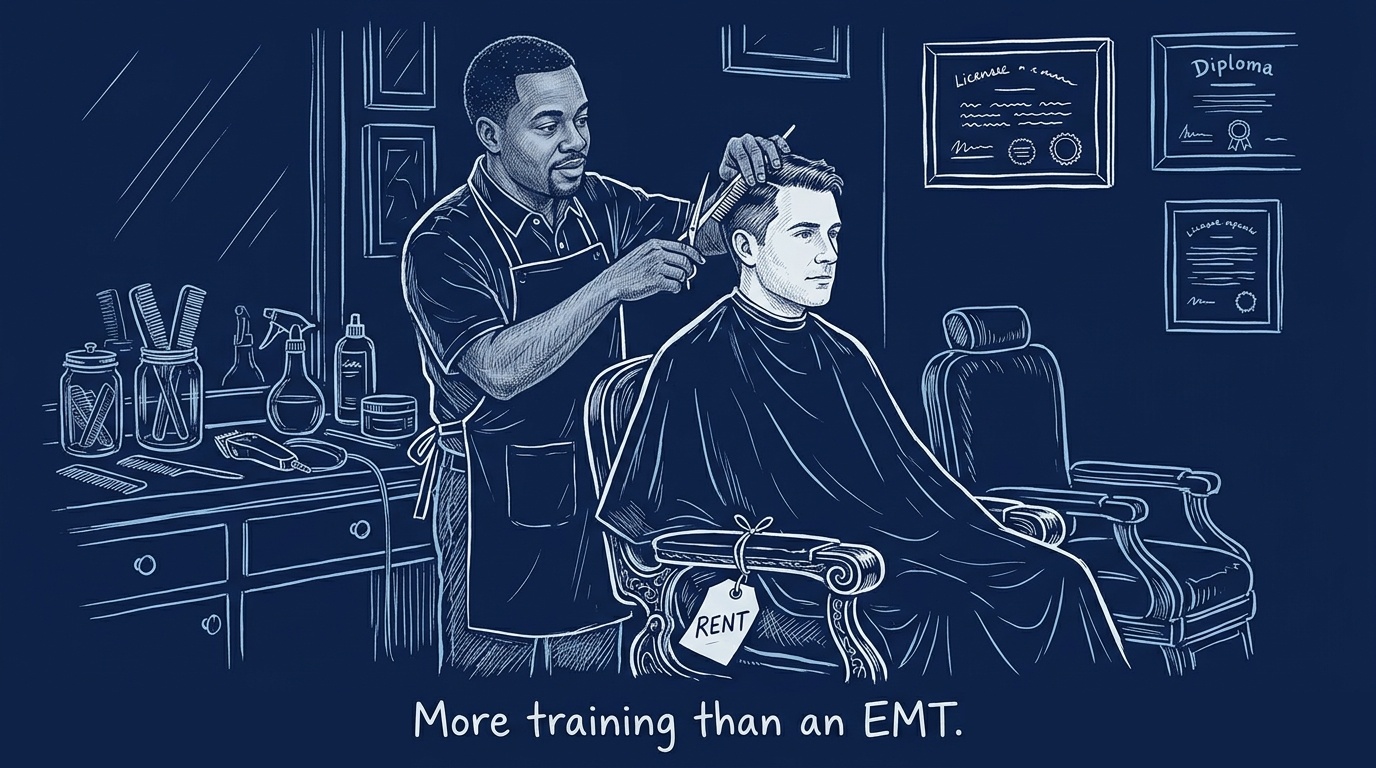
Cutting hair for money is regulated in every state in the country, and the training bar is higher than people generally assume. Barbering and cosmetology require a license in all 50 states plus DC — doing either for pay without one is illegal everywhere. Nationally, a cosmetology license takes an average of 342 days of required education and experience to earn -- nearly ten times the 36-day national average for an EMT -- per the Institute for Justice's own 2022 licensing-burden survey. A barber license averages 319 days of training, about two exams, and $167 in fees.[1]
Virginia just moved its own version of that bar, and moved it down. Effective December 1, 2025, the state's Board for Barbers and Cosmetology cut the formal-school hour requirement for a barber license from 1,100 clock hours to 750 — a roughly one-third reduction, by regulation, not by market pressure or a court ruling.[2] Cosmetology's own requirement sits at 1,500 hours in a formal program, which is where a commonly cited 12-to-14-month full-time, 15-to-18-month part-time timeline actually comes from — roughly 30 hours a week full-time, roughly 20 part-time, against that 1,500-hour bar.[2]
The same license, two different ways to earn it
What a college degree doesn't offer, this licensing system does: a real second path. Virginia recognizes a registered-apprenticeship route as a full alternative to formal school — 2,000 hours of supervised, on-the-job training in a licensed barbershop, working under a licensed barber, instead of sitting in a classroom.[2] Cosmetology's apprenticeship alternative runs 3,000 hours. Both tracks end at the identical license, issued by the identical state board — the state cares that you cleared the bar, not which door you walked through to clear it.
The mechanism, named plainly. Occupational licensing in a trade like this is measured in hours, not years, and hours are a lever a state legislature or licensing board can move directly — which is exactly what Virginia just did. That's a meaningfully different kind of barrier than a four-year degree, where the unit is fixed by convention rather than by a number a regulator can adjust in a single rule change. A trade license is also, unusually among skilled work, structurally two-doored: school or apprenticeship, tuition or wages-while-you-train, and the state treats both as equally valid proof of competence.
50 states + DCrequire a license to cut hair for pay — no exceptions
1,100 → 750Virginia's barber school-hour requirement, cut by regulation effective Dec. 1, 2025
342 daysaverage national cosmetology training time -- vs. just 36 days for an EMT, the same IJ survey
Clearing the license answers almost nothing about who you work for
Getting licensed determines whether you're allowed to cut hair for money at all. It says nothing about who employs you once you can. Most working barbers and cosmetologists aren't on a shop's payroll — they rent the chair. A practitioner pays the shop owner a weekly or monthly fee for the right to work in that space, keeps everything they earn beyond the rent, and operates as an independent contractor rather than an employee: no shop-set schedule, no wage floor from the shop, no shop-provided benefits, and no shop liability for how much or how little the chair earns in a given week.[3]
That structure — pay for access to the tools and the space, keep what you make, carry your own risk — is functionally the same arrangement a lot of platform-based work runs on today. It's just considerably older than the vocabulary. The term "gig economy" itself wasn't coined until 2009, by journalist Tina Brown, specifically to describe workers piecing together freelance projects through digital marketplaces.[4] Booth and chair rental in barbering and cosmetology was already a standard, normalized way to run a shop well before that term existed or a ride-share app was a possibility — an independent-contractor labor structure that predates the framework built to explain it.
Two separate mechanisms, doing two separate jobs
It's worth holding these as distinct claims rather than one blurred story. Licensing hours control who gets to start — a real, state-set, regulator-adjustable barrier, currently getting slightly lower in Virginia. Chair rental controls what happens after someone clears that barrier — a private contract between a worker and whoever owns the space, governed by landlord-tenant logic more than employment law, and answerable to neither the state licensing board nor, in most cases, a W-2. The public, regulated, hour-denominated test is the visible part. What happens to a person once they pass it is almost entirely private.
 Oluwadi