 Oluwadi
Investigating the Overlooked
Region
What
Who For
Analysis
Oluwadi
Investigating the Overlooked
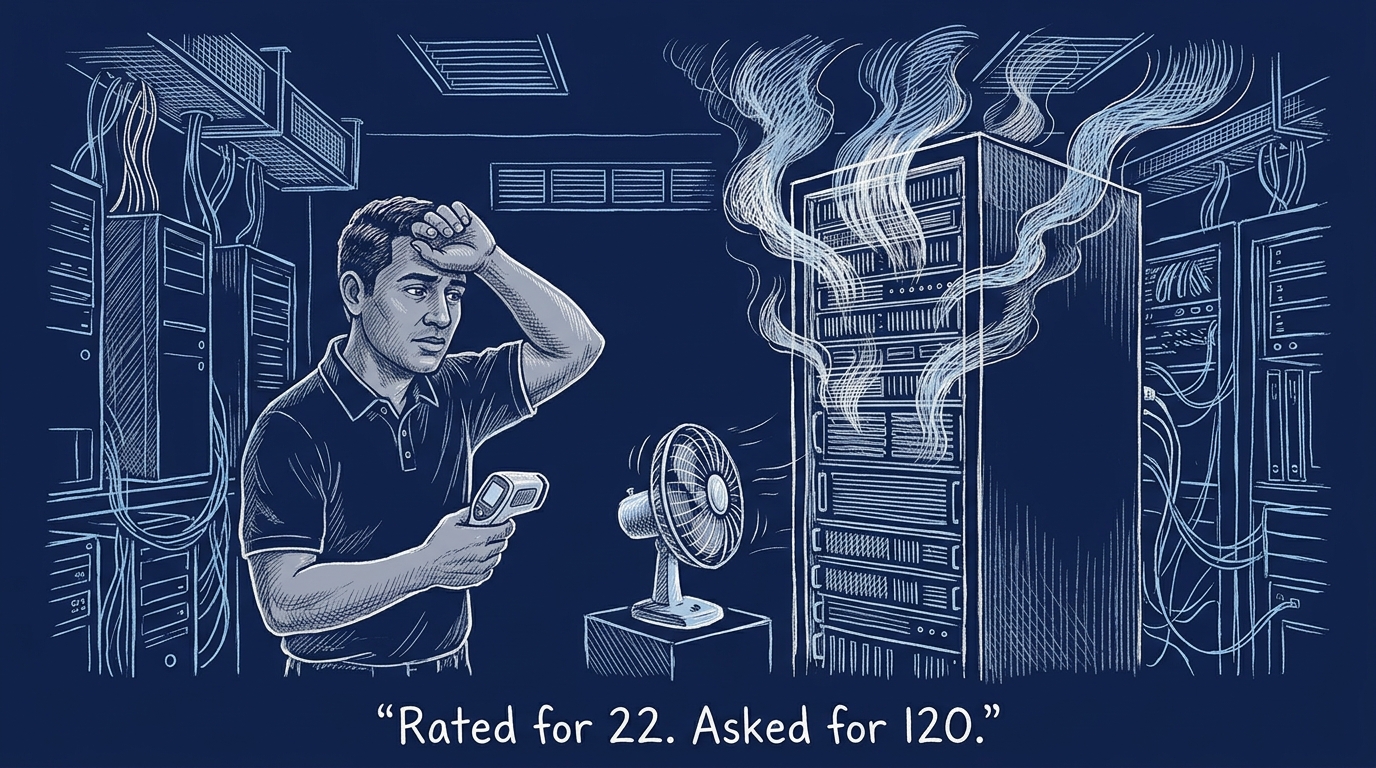
Ashburn, Virginia is "Data Center Alley" — the single densest concentration of data center capacity anywhere in the world, and NTT's own campus there runs 224 megawatts of critical IT load across a 78-acre site. It's about as good as colocation gets. And when CirrusSeven tried to deploy real AI compute inside VA1, the ceiling wasn't a contract limit or a budget — it was physics. Nothing beyond a single consumer-class GPU, an RTX 5090, was viable. Even running that required leaving two rack units of empty space above and below it, just to keep enough air moving to avoid overheating.[1] That's not a story about one facility falling behind. It's what happens almost everywhere that wasn't purpose-built in roughly the last eighteen months.
CirrusSeven was in VA1 while it still carried its original name: RagingWire, an independent, founder-led data center company started in 2000 that opened VA1 in July 2012 as its first Ashburn facility.[7] NTT didn't design VA1 at all — it bought its way in afterward, acquiring an 80% stake in 2014 and full ownership by 2018, and didn't formally rebrand RagingWire as NTT until September 2019.[8] The 22-kilowatt ceiling CirrusSeven ran into wasn't an NTT decision. It was a 2012 engineering assumption, made years before anyone was designing for GPU clusters, that outlived the company that made it and the acquisition that followed.
NTT's own VA1 — the building CirrusSeven was in, and the kind of facility most colocation customers have used for a decade — is rated for up to 22 kilowatts per rack, the same ceiling as its sister building VA2.[2] A single rack of Nvidia's current flagship AI system, the GB200 NVL72, draws 120 to 140 kilowatts, with sustained full-load readings as high as 130-132 kilowatts — roughly ten to fifteen times what a traditional enterprise server rack pulls.[3] There is no configuration in which a legacy 22kW-rated rack accepts a 120kW+ system. The gap isn't a matter of degree. It's the difference between what the room was built for and what the hardware requires.
Even a facility that could somehow route enough power still couldn't cool it with air. Air cooling stops being viable well below 120kW of rack density — direct liquid cooling becomes mandatory, and even the intermediate step most operators reached for first, rear-door heat exchangers, tops out around 30 to 40kW per rack.[3] That's the mechanism behind CirrusSeven's empty rack units: air-cooled colocation buys thermal headroom by leaving space, because it has no other lever to pull. A liquid-cooled system doesn't need the empty space — it needs plumbing most colocation halls were never built with.
A fully populated 100kW-class rack weighs 6,000 to 8,000 pounds, concentrated in roughly 10 square feet.[4] Legacy raised-floor data centers are typically rated around 1,250 pounds per square foot for static load at best, and standard raised floor tiles — rated closer to 250 pounds per square foot — simply fail under that concentration.[4] New AI-ready facilities are being built with 1,000+ PSF reinforced concrete slabs 12 to 18 inches thick, roughly double the thickness of a traditional data center floor. A building can have the power and the cooling and still not be able to physically hold the rack.
Liquid cooling needs water to move the heat somewhere, and Loudoun County saw this coming over a decade before the AI buildout made it urgent. Loudoun Water started building a reclaimed-water pipeline in 2010 specifically to supply data centers' cooling and irrigation needs without drawing on the drinking-water supply — it now runs 20 miles of dedicated pipe and delivered more than 750 million gallons of reclaimed water to data center customers in 2025 alone.[9] It's real, purpose-built infrastructure, unmatched almost anywhere else data centers cluster. And it still isn't enough: data centers' potable water use in the region kept climbing regardless, roughly tripling over four years to nearly 952 million gallons in 2025. Some facilities now run three separate water sources — onsite well, reclaimed, and utility potable — each sized to carry the full cooling load alone, because no single source can be trusted to.
And the reach hasn't extended to where the siting is actually happening. Only about 40 of Loudoun County's 200-plus data centers are on the reclaimed-water system at all — the other roughly 160 draw straight from the potable supply, fifteen years of dedicated pipeline notwithstanding.[9] And as demand pushes development past Loudoun's own borders, it's landing somewhere with none of that infrastructure at all: Prince William County, just south, approved a 2,100-acre expansion in December 2023 — the "Digital Gateway" — projected to use more energy than the entirety of Data Center Alley uses today, with no comparable reclaimed-water buildout behind it. The runoff from its roughly 80 million square feet of new concrete drains toward the Occoquan Reservoir, one of two main drinking-water sources for the county it's being built in.[10] The infrastructure that took Loudoun fifteen years to build didn't move with the demand. It stayed exactly where it was built.
The clearest evidence isn't a competitor's failure — it's NTT's own product line, on the same Ashburn campus CirrusSeven's gear sat on. VA7, opening this same month, is rated to handle more than 100kW per rack, with a dedicated chiller plant and a closed-loop water cooling system built in from the start.[5] NTT didn't retrofit VA1 to get there. It built an entirely new building next door.
| Facility | Per-rack power | Cooling |
|---|---|---|
| NTT Ashburn VA1 (CirrusSeven's building) | up to 22kW | Air-cooled |
| NTT Ashburn VA7 (opens Sept. 2026) | 100kW+ | Dedicated chiller plant, closed-loop water |
| Nvidia GB200 NVL72 (per rack) | 120–140kW | Mandatory direct liquid cooling |
That's the real shape of the problem: even NTT's newest, most advanced Ashburn building falls short of a single fully-loaded GB200 NVL72 rack. The industry isn't one retrofit cycle behind. It's building new capacity as fast as it can and still not quite catching the hardware.
None of this is abstract — it's the same wall that's pushing developers toward sites nobody would have considered data-center real estate five years ago: former mills, former military bases, decommissioned industrial plants built with the floor loading, power, and often water infrastructure AI now needs, for reasons that had nothing to do with AI. A former paper mill in Jay, Maine became central enough to that fight that Governor Janet Mills vetoed a first-in-the-nation data-center moratorium specifically to protect the conversion project underway there.[6] Climate is part of the same calculation: colder ambient air means far more hours a year of free cooling instead of running mechanical chillers, which is why northern siting — old mill towns, former bases, anywhere the winters are long — keeps showing up in the same conversations as floor loading, power, and water. Ashburn built the fiber, the power grid, and even a dedicated reclaimed-water system the internet needed for two decades. It still wasn't built for this.