 Oluwadi
Investigating the Overlooked
Region
What
Who For
Analysis
Oluwadi
Investigating the Overlooked
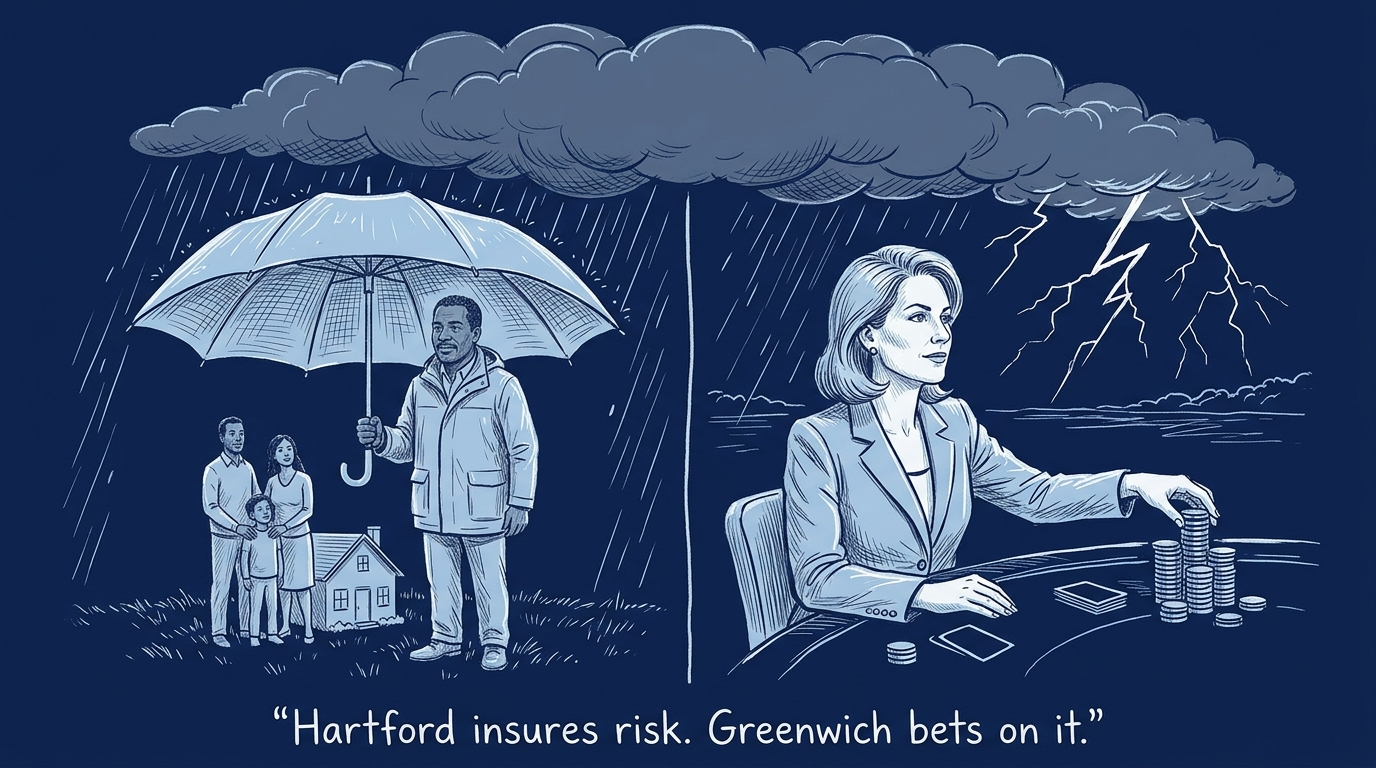
Hartford's insurance business traces to February 1794, when merchant Jeremiah Wadsworth and a group of associates began informally underwriting fire risk for ships and warehouses along the Connecticut River. In 1810, a group of investors formalized that arrangement into the Hartford Fire Insurance Company with $15,000 in working capital.[1]
The company's actual founding moment as an institution people trusted came 25 years later, in December 1835, when a fire tore through New York's financial district and destroyed the buildings that held Hartford Fire's New York policies. Company president Eliphalet Terry personally traveled to New York, stood in front of the ruins, and told policyholders their claims would be paid in full -- pledging to cover the losses out of his own personal wealth if the company's reserves came up short. They did not come up short, but the promise was the point: Hartford Fire Insurance became known as a company that paid when disaster actually struck, at the exact moment every other insurer's word was being tested at once. Other insurers moved to the same city over the rest of the 19th century, and Hartford became known as the Insurance Capital of the World.[2]
That reputation is still measurable today. Greater Hartford now hosts roughly 65,420 direct insurance carrier jobs, the highest concentration per capita of any metro area in the United States. Connecticut's 147 domestically domiciled insurers collectively wrote $212 billion in premiums, and Connecticut-based carriers generate more than $22 billion in gross state product a year. Including indirect and related employment, the industry supports roughly 238,203 jobs statewide -- about 13 percent of all Connecticut employment. Connecticut still holds the title of the number-one insurance location in North America, though industry reporting has flagged a real, rising challenge from Midwest states building their own insurance clusters from scratch.[3]
Greenwich, Stamford, and Westport now host one of the largest concentrations of hedge fund capital on earth -- Connecticut ranks second in the country by assets under management, behind only New York City itself. Ray Dalio founded Bridgewater Associates from his two-bedroom Manhattan apartment in 1975 and eventually moved it to Westport; it is now the world's largest hedge fund, managing roughly $90 to $120 billion depending on the reporting date. AQR Capital, founded by Cliff Asness and headquartered in Greenwich, has managed close to $100 billion. Paul Tudor Jones founded Tudor Investment Corporation in Greenwich in 1980 (the firm relocated to Stamford in 2018). Steve Cohen's Point72 runs its operations out of Stamford.[4][5]
The jobs this cluster produces are far fewer than Hartford's insurance sector, but far more concentrated in pay: hedge fund and financial-services roles in lower Fairfield County have averaged around $266,000 a year, more than three times the roughly $85,000 regional average. The strategy these firms run is the structural opposite of an insurer's: rather than pooling risk across thousands of policyholders to smooth it out, a hedge fund concentrates capital into a comparatively small number of individual, high-conviction bets, seeking outsized returns instead of stability.[6]
Both industries are, at bottom, in the same business: pricing and holding risk on other people's behalf. Hartford's insurers do it by spreading a known risk -- fire, death, liability -- across as many policyholders as possible, so no single loss threatens the whole pool; Terry's 1835 promise was the founding proof that the pool would actually hold under stress. Greenwich's hedge funds do the reverse: they concentrate capital into a small number of specific, actively managed bets, accepting far more individual volatility in exchange for the chance at returns an insurance pool structurally cannot offer. Connecticut did not choose between these two models. It built the institutions for both, forty miles apart, and has run them side by side for the better part of two centuries -- proof that "manage other people's risk professionally" is not one business, but at least two genuinely different ones, and a single small state built world-class infrastructure for both.
Hartford's model is now the one facing real competitive pressure -- not from Greenwich, forty miles away, but from states like Iowa building their own insurance clusters from a much lower cost base. Greenwich's model faces no equivalent regional challenger; hedge fund capital simply follows wherever the best-performing managers choose to live, and right now that is still overwhelmingly New York and Connecticut. Two centuries after Eliphalet Terry made his promise, the state's older bet is the one that has to keep proving itself. Its newer one, so far, does not.