 Oluwadi
Investigating the Overlooked
Region
What
Who For
Analysis
Oluwadi
Investigating the Overlooked
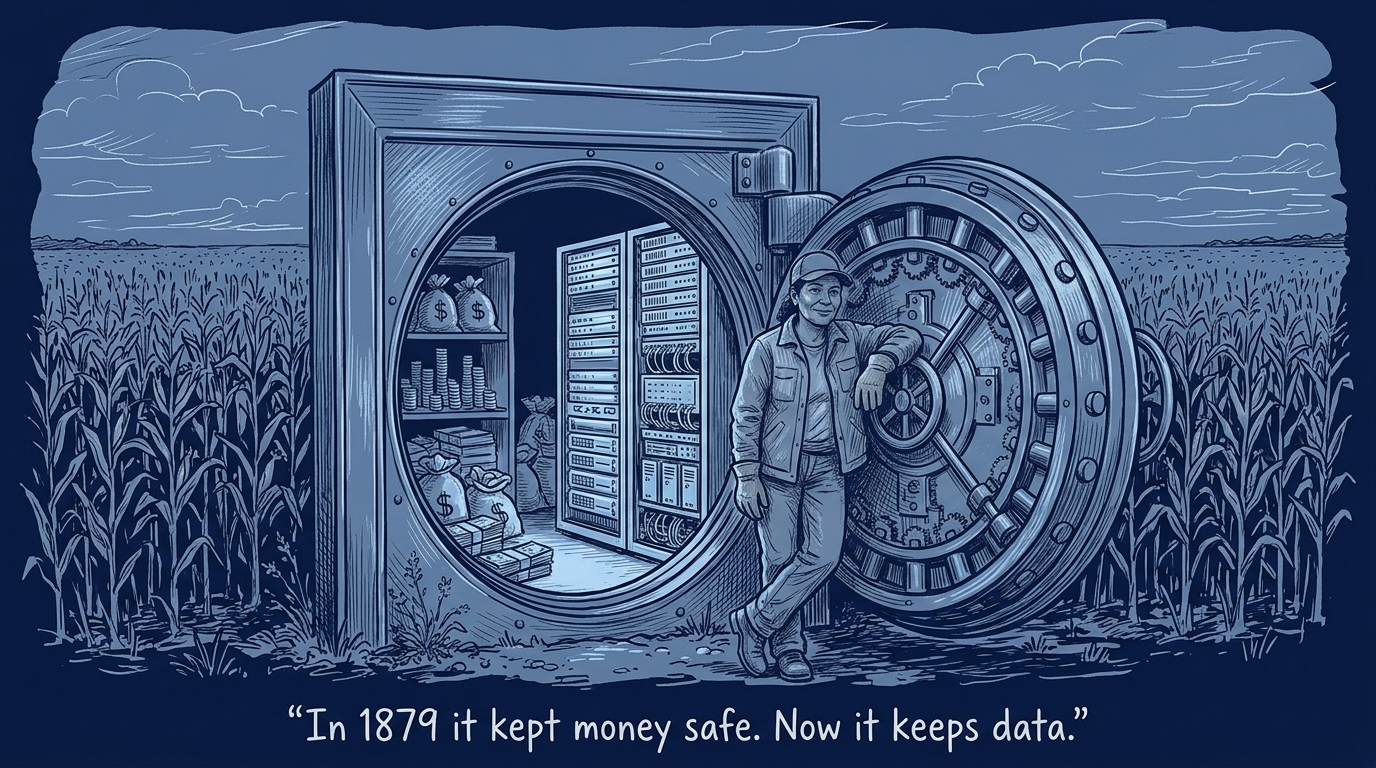
Des Moines, Iowa is a metro of roughly 758,000 people, more often associated with corn futures and presidential caucuses than with finance or computing.[1] It has nonetheless built two separate, genuinely national industries out of the identical underlying pitch, a century and a half apart: this is the cheapest, most reliable place in America to keep something valuable safe. First it was money. Now it is data.
Edward A. Temple was a banker in Chariton, Iowa, distrustful of the eastern insurance companies that dominated the market and convinced they overcharged. Inspired by a mutual-aid plan a group of ministers had already set up for each other, he built a similar low-cost mutual life insurance system for bankers and their employees, founding the Bankers Life Association in 1879. The plan grew fast enough that by 1889, with $29 million of life insurance in force, the company relocated to Des Moines. It kept growing -- $400 million of life insurance in force by the time Temple died -- and eventually became Principal Financial Group, still headquartered in Des Moines nearly 150 years later.[2]
Temple did not just found one company. He proved a mechanism: an Iowa-based insurer could underprice and outlast the coastal incumbents by pooling risk more cheaply, and that mechanism kept attracting more insurers to the same city long after Temple was gone. Des Moines is now home to the headquarters of nearly 70 insurance companies and the regional offices of roughly 100 more. Insurance accounts for about 20.4 percent of the metro's $38.87 billion economy, and roughly one in every 24 Des Moines-area residents draws a paycheck from the industry -- a higher ratio than Hartford, Connecticut, the city most synonymous with American insurance, where the figure is closer to one in 30.[1] Principal itself now reports $781 billion in assets under management and roughly 20,000 employees worldwide.[3]
The same metro is now the site of one of the largest concentrations of hyperscale data center investment in the country. Microsoft has built or committed to six separate data center campuses in West Des Moines since 2014, with its cumulative investment there now exceeding $6 billion.[4][5] Meta has built its Altoona campus, just east of Des Moines, into more than 5 million square feet of data center space representing over $2.5 billion in investment.[6] Apple's campus in Waukee, just west of Des Moines, represents roughly $1.3 to $1.4 billion, with plans for up to six buildings spanning nearly 2 million square feet.[7] Combined, the three companies have committed roughly $10 billion to the Des Moines metro alone.
None of this happened by accident. Iowa built a specific policy architecture to attract it: state sales-and-use tax exemptions for qualifying data center investment, which currently cost the state roughly $150 million a year in forgone revenue, plus MidAmerican Energy's own renewable-generation buildout, which the utility markets directly to data center operators as a way to run near-100-percent-renewable power at industrial scale.[8][9] Cheap farmland, an existing fiber network, and a relative lack of hurricanes, wildfires, and earthquakes did the rest.[4]
What connects Temple's 1879 mutual insurance pitch to Microsoft's 2024 site-selection decision is not sentiment or coincidence. It is the same generator mechanism, run in two different centuries against two different kinds of risk. In 1879, the risk was actuarial -- the chance a policyholder dies too soon -- and Iowa's advantage was a cheaper, more efficient way to pool it than the eastern insurers offered. In the 2010s and 2020s, the risk is operational -- the chance a server goes down, a region loses power, a facility becomes too expensive to run at scale -- and Iowa's advantage is the same in kind: a state that deliberately built the cheapest, most reliable infrastructure available for the specific thing changing hands. Both eras required a specific, deliberate act to convert a Midwestern cost advantage into a durable industry: Temple's decision to formalize a mutual-aid instinct into an underwriting company in 1879, and the Iowa legislature's decision to write a tax code that made data centers cheaper to run in Iowa than almost anywhere else. Neither industry arrived because Des Moines was already famous for it. Both arrived because someone built the specific mechanism that made staying there the rational choice.
The build-out has not been friction-free. More than a dozen Iowa counties -- including Woodbury, Plymouth, Sioux, Linn, Dubuque, Johnson, Madison, Shelby, and Clarke -- have passed moratoriums on new data center projects since 2025, and residents in towns like Salix have pushed back on specific proposals sited close to homes with little advance notice.[10] The concerns center on water and power draw: Microsoft's West Des Moines campuses account for an estimated 2 to 7 percent of the city's water use, and Meta's Altoona campus has used up to 16 percent of that city's water supply, with its 2023 electricity consumption alone comparable to powering roughly 100,000 homes for a year.[11] State legislators have responded with bills such as HF 2447, which would require data centers to report water and energy use quarterly and would push regulators to create a separate utility rate class so grid-upgrade costs are not passed on to residential ratepayers.[12] Not every concern raised has held up under scrutiny -- a 2025 central-Iowa water-use restriction that residents initially blamed on data centers was later reported to trace to other causes[13] -- but the underlying tension between cheap infrastructure for hyperscalers and the water and power a growing metro needs for its own residents is real, unresolved, and expected to be a central issue in Iowa's 2027 legislative session.
Iowa is not acting alone, and the timing is not a coincidence. Virginia -- home to Loudoun County's "Data Center Alley," the highest concentration of data centers on the planet -- ran 61 separate data-center bills through its legislature in a single 2026 session, fifteen of which passed with real teeth: stricter emissions standards on backup generators, a requirement that large power users pay for the grid capacity their own growth demands instead of spreading the cost to residential ratepayers, and a rule letting utilities delay service to the biggest new customers to protect system reliability. Maryland, Florida, and a growing list of counties nationwide are running the same fight in parallel. Iowa's county-by-county moratorium wave and HF 2447 are a smaller-scale, still-earlier-stage version of the identical pattern already playing out in the state most economically entangled with this industry: the places actually hosting hyperscale infrastructure are the ones pulling back on it first, not outside critics.
Des Moines never marketed itself as an insurance town or a data-center town before either industry actually arrived -- both times, the infrastructure came first and the identity followed. That ordering is the real lesson, not the specific industries: a metro with cheap land, a stable grid, and a legal or tax framework built to reward whoever shows up next is positioned to catch industries nobody would have predicted for it, repeatedly, as long as the underlying mechanism -- cheaper, safer infrastructure for storing something valuable -- keeps getting reapplied to whatever the next valuable thing turns out to be.