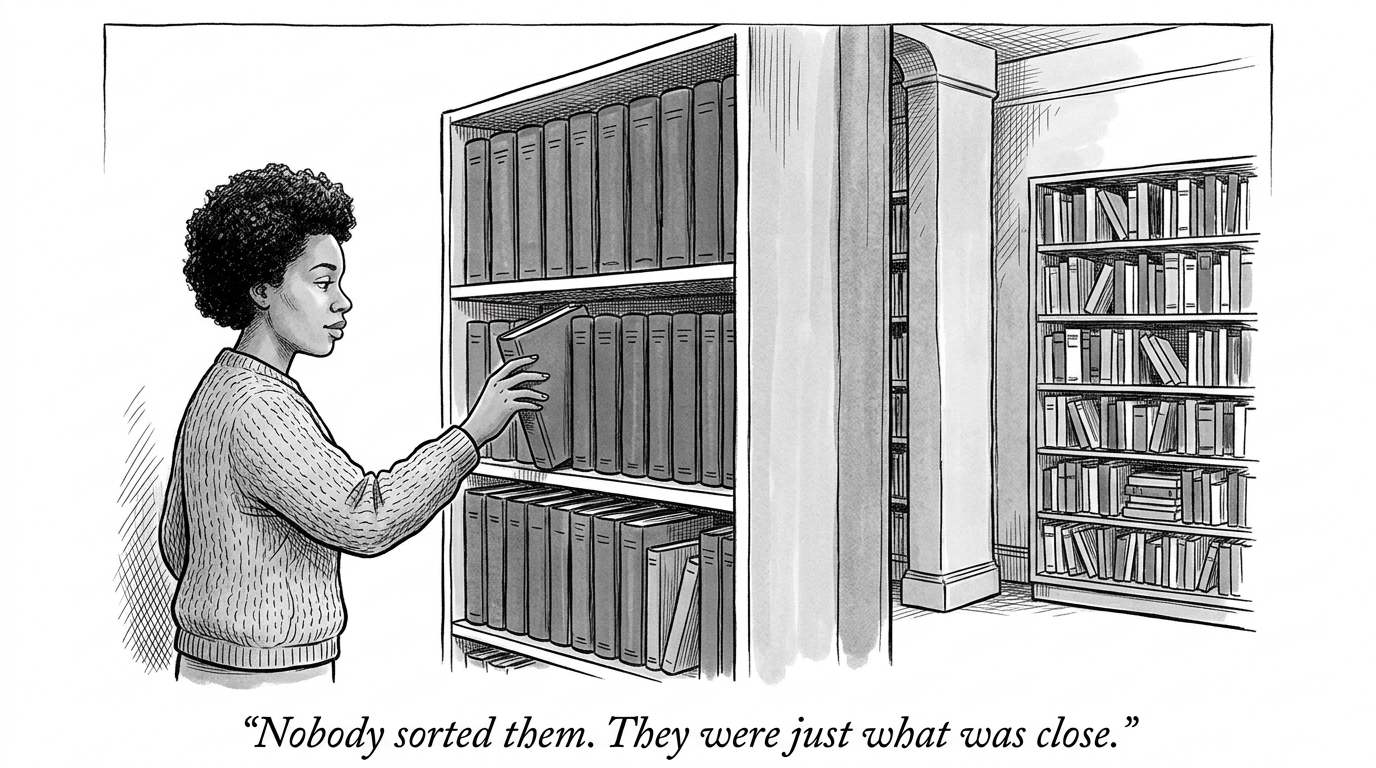
A hand reaches for a book because it happens to be sitting next to another one -- not because of any plan, any recommendation, any search. That's a trivial event by itself. It's also, structurally, the identical event as a friendship forming across a zip-code line, a VC hearing about a startup outside their usual circle, or a kid growing up hearing civil-rights sermons and labor economics in the same undifferentiated stream. In every case, something entered a mind or a network for one reason only: it was already close by. Nothing sorted it out first.
Sorting doesn't have to be built. It's the default
Sociologists named this mechanism decades ago. "Birds of a Feather," the field's most-cited review of homophily in social networks, states the finding plainly: similarity breeds connection, and it structures nearly every kind of tie a person forms -- marriage, friendship, work, advice, information.[1] The mechanism doesn't require prejudice, malice, or even a decision. Restrict exposure to whatever is already nearby -- geographically, socially, professionally -- and a sorted network is simply what falls out the other end, every time, without anyone arranging it.
Segregation without segregation -- building a sort while calling it something else
The mechanism has a real, national-scale case study, and it explains why an invisible sort does more damage than an obvious one. Between 1935 and 1940, the Home Owners' Loan Corporation ran a "City Survey," grading neighborhoods in more than 200 American cities A through D on mortgage-lending risk. The lowest grade, D, was colored red on the map -- "hazardous."[2] Nothing in the grading criteria said "keep Black families out." The criteria didn't have to. Race and poverty drove the scores directly enough that the maps sorted by both without ever naming either -- segregation accomplished through a spreadsheet of risk categories instead of a law, which made it far harder to see, name, or resist in the moment than an explicit ordinance would have been.
The federal government stopped drawing these maps in 1940. The Fair Housing Act banned the practice outright in 1968. Neither undid the sort. As of the 2020 Census, 8.25 million Americans still live in neighborhoods graded "hazardous" eighty years ago -- more than three-quarters of them people of color, the average redlined tract now 32% Black and 30% Hispanic, against the highest-graded tracts from the same maps, which are still disproportionately White today.[3] Nobody had to keep enforcing it. Once the exposure restriction was built into who could get a mortgage where, the sort just kept reproducing itself -- the exact mechanism this piece opened with, run at the scale of an entire country, for nearly a century.
Two real American neighborhoods show what that reproduction actually looked like on the ground. By 1960, decades of redlining had already sorted Newark's Central Ward -- Avon Avenue runs through the middle of it -- into exactly the population with the least political power to stop a highway route; Route 280 and Route 78 were carved through it anyway, one piece of 17 separate urban renewal projects the city ran between 1952 and 1967. Detroit shows the same sort operating inside a single employer: Ford hired Black workers into its Detroit plants at a scale its competitors refused, and still funneled them disproportionately into the foundry and blast furnace, the plant's most dangerous jobs, with a de facto ceiling on promotion the rest of the workforce didn't face.[4] Redlining didn't just deny mortgages. It decided, decades in advance, which neighborhoods would have no leverage left when the next decision -- a highway, a plant assignment -- came looking for the path of least resistance.
The stakes turn out to be exactly who escapes poverty
In 2022, economist Raj Chetty and coauthors published the largest empirical test of this mechanism ever run: an analysis of 21 billion Facebook friendships among 72.2 million US users.[5] The finding was direct -- children who grow up in communities where people of low and high socioeconomic status actually interact have substantially better odds of rising out of poverty than children in communities sorted apart, even at similar income levels. Economic connectedness -- friendship across class lines -- is among the strongest predictors of upward mobility economists have identified.
Exposure alone doesn't fully break the sort, and the same study proves it. Chetty's team found social disconnection across class lines comes from two separate forces, not one: unequal exposure to people of different backgrounds in the first place, and what they call "friending bias" -- people who are exposed to a wider range of others still disproportionately choosing to connect within their own group anyway. Passive proximity gets a wider range of people or ideas within reach. It doesn't guarantee anyone actually reaches for them. Something else has to be doing that second part of the work.
21BFacebook friendships analyzed in Chetty's 2022 economic-connectedness study
72.2MUS users, ages 25-44, whose social ties were mapped by zip code
2Separate causes of class disconnection the study found: unequal exposure, and bias even under exposure
What actually breaks it: unsorted exposure, not more information
If sorting is the free, default outcome of restricted exposure, the fix was never "give people more data about the group they're sorted away from." It's removing the sort itself -- building the room, the shelf, or the feed so that a genuinely wide range of people, places, and ideas sit within the same effortless reach, with nothing pre-labeling which parts are "for" which kind of reader. But "built with intent" isn't automatically the fix, and it's worth being precise about why. A library can be built on purpose to hand over access without checking anyone's background -- or built on just as much purpose to narrow it: a seminary library curated toward one doctrine, a censored state collection, a homeschool curriculum built to produce a specific kind of reader and screen out the rest. Intent alone doesn't determine which library breaks the sort and which one enforces it. What matters is the direction the intent points -- whether the design widens what sits in reach with no hierarchy imposed on it, or narrows it toward a predetermined outcome. A shelf that happens to put a 2002 book on human-computer interaction next to a stack of intelligence-community trade journals, with no plan behind it at all, still lands on the widening side purely by accident -- proof the mechanism runs on what's actually in reach, not on whether a designer meant it to.
One more distinction worth holding exactly: breaking the sort is not the same thing as having no point of view. A library built wide on purpose -- books arguing against each other shelved together, with no hierarchy deciding which account gets to be the only one that reaches a reader -- doesn't produce a blank mind. It produces someone's mind, pointed somewhere specific, because a real person chose every book on that shelf and is doing the reading. Breadth is what keeps any single account from being the only one available. It was never a claim to neutrality, and it doesn't erase whose library it is.
What breaks a sort was also never strictly a question of size. Marc Andreessen grew up in New Lisbon, Wisconsin -- no bookstore in town, one small public library. At eight years old he taught himself the BASIC programming language from a book he borrowed there.[6] New Lisbon's own shelf was genuinely limited, not wide by design the way a deliberately mixed library or a research university's stacks are. It broke the sort anyway, because it was open access with nothing pre-sorting who could reach for what was on it. Andreessen went on to co-found Netscape and then Andreessen Horowitz -- the same firm that backed Adam Neumann's second act twice.[7] A small-town library with almost nothing in it, and Silicon Valley's most consequential venture firm, turn out to be running the identical mechanism at opposite ends of the resource scale: what mattered wasn't how much sat on the shelf. It was whether anything on it was reachable without first being sorted.
Why does this matter? Most people don't have a Chetty-scale social network engineered for cross-class exposure, and most people don't have a library that happens to mix everything with no shelf between lanes. What they have, by default, is whatever already sits close -- which sorts them without anyone deciding to. The only known fix isn't smarter filtering. It's building something wide enough, on purpose, that the sort never gets a chance to run.
 Oluwadi