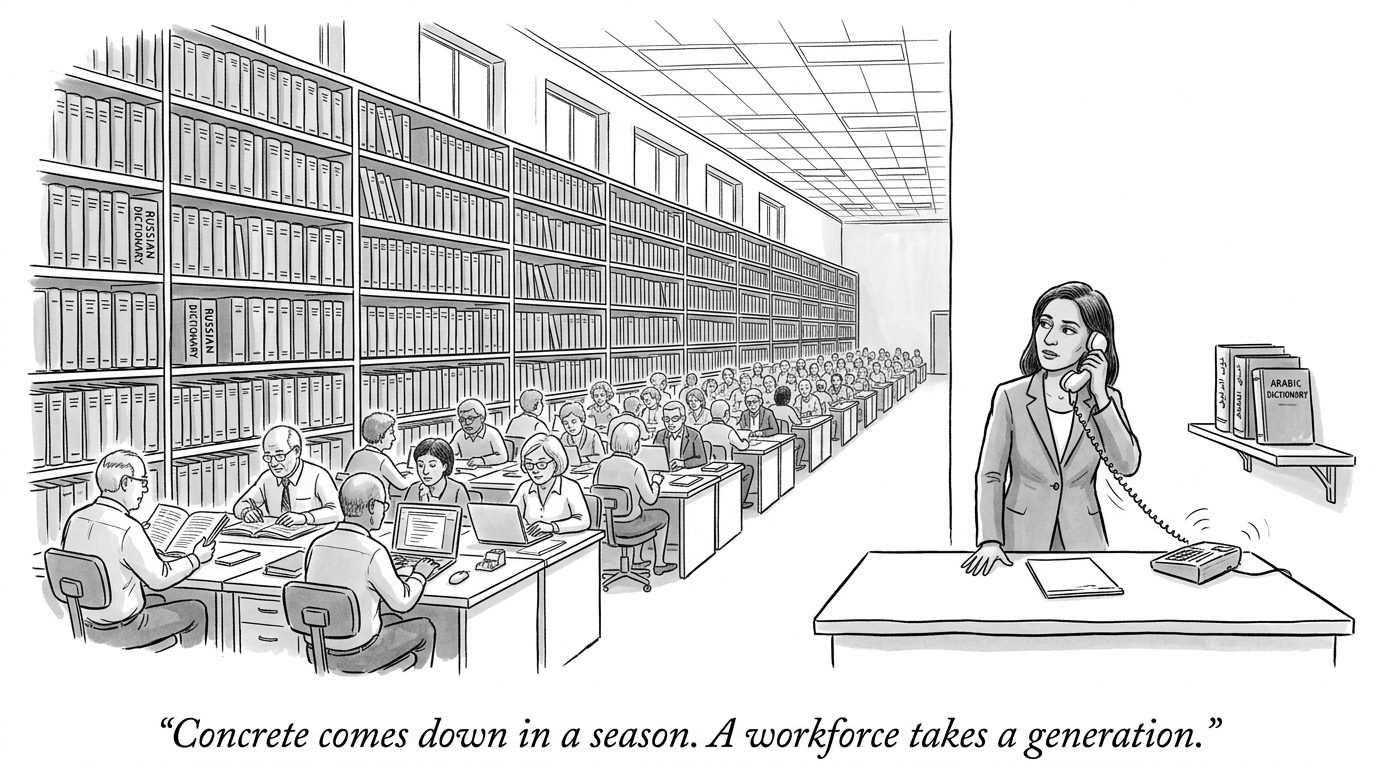
In 1958, four months after Sputnik, Congress passed the National Defense Education Act -- federal money aimed explicitly at producing "trained manpower of sufficient quality and quantity to meet the national defense needs of the United States," funding science, math, and foreign-language study at a national scale for the first time.[1] Russian was the language that mattered, because the Soviet Union was the threat, and the pipeline that decision started ran for decades: recruiting, training, and promoting linguists, analysts, and case officers around one language and one adversary. By the time the Cold War ended in 1991, that pipeline was not a policy on paper. It was the actual shape of the intelligence community's workforce -- who had been hired, who had been promoted, what a career track rewarded.
The Maginot Line, but for people, not concrete
"Fighting the last war" is usually told as a story about hardware or doctrine -- France spent the 1930s building the Maginot Line to refight World War I's static trench warfare, and Germany went around it with blitzkrieg in six weeks.[2] That version of the cliché is about a wrong bet on tactics. The Cold War-to-9/11 case is a different, slower-moving failure: not a bet anyone consciously made and lost, but a workforce that took decades to build around one specific expertise, and that does not un-build itself just because the threat that justified it disappeared. Concrete can be torn down in a season. A career track, a promotion ladder, and a generation of hiring cannot.
By September 10, 2001, the pipeline was still Russian
The intelligence community's own later self-assessment: an apparatus "laden with Russian speakers and disastrously short of Arabic speakers," still moving at what one account called glacial speed to adapt to an asymmetric, non-Soviet threat a full decade after the USSR dissolved.[3] The 9/11 Commission's own finding gave that gap a body count: the FBI had so few qualified Arabic translators that 35 percent of its Arabic-language national-security wiretaps went untranslated, and on September 10, 2001, the NSA intercepted Al-Qaeda operatives saying "tomorrow is zero hour" -- intelligence that existed, in the government's own hands, the day before the attack, and wasn't translated until days after it.[4]
1958NDEA passes, funding the Cold War's Russian-language pipeline at national scale
70 → 269FBI Arabic translators, September 2001 to July 2006 -- a 300%+ increase
33 of 12,000FBI special agents with any Arabic capability, five years after the attack
Rebuilding took longer than the crisis that forced it
The government's own audit confirmed the mechanism within a year: a 2002 GAO report found federal agencies needed a fundamentally different human-capital approach to fix foreign-language staffing and proficiency shortfalls, not an incremental one.[5] Four years after that, the numbers show exactly how slow "fundamentally different" turned out to be in practice: FBI Arabic translators grew from 70 in September 2001 to 269 by July 2006, better than a threefold increase. And yet, in that same year, only 33 of the FBI's roughly 12,000 special agents had any Arabic capability at all, and none of them worked in the units coordinating international terrorism investigations. The Bureau received 40,000 applications for translator positions after 9/11 and hired about 200 -- the rest failed language testing, security screening, or both.[6]
Workforce and expertise pipelines are the single slowest-moving institutional variable an organization has. A linguist pipeline, a regional-expertise career ladder, a promotion structure built around one skill set -- these take a decade or more to build, and just as long to unwind, regardless of how fast the actual threat landscape moves. That means whatever capability an institution is proud of today was very likely built in response to a threat that has already passed, and whatever capability the next crisis actually needs is very likely not yet being built, right now, for the identical structural reason: nobody in the current pipeline has a career incentive to build it.
The same clock is running again, right now
In October 2023, the GAO audited U.S. Special Operations Forces on foreign-language proficiency and found the identical shape of gap opening in the language now named the government's own top priority: Mandarin Chinese.[7] SOF personnel get six months of initial Chinese training to reach only elementary proficiency, are expected to log 120 hours a year to maintain it, and are supposed to hit an 80 percent proficiency-goal rate -- but the GAO found planning officials couldn't clearly explain how language needs were even matched to missions, and fewer than half of SOF personnel had completed any language-sustainment training at all.[7] This is not a retrospective finding about a mistake made decades ago. It is a live audit, two years old as of this writing, describing a pipeline gap opening in the exact language the government has named as its own next priority -- while the workforce built around the last two decades of counterterrorism and Middle East expertise is still the dominant shape of the force.
A faster version of the same mechanism: institutional knowledge can be destroyed on a timeline rebuilding it can't match
Everything above describes a pipeline eroding by neglect -- a career track nobody redirected in time. A live, ongoing case shows the identical vulnerability running in the opposite direction, on purpose. Army Secretary Dan Driscoll resigned on September 1, 2026, after repeated clashes with Defense Secretary Pete Hegseth, including over Hegseth's removal of senior Army leaders -- among them Army Chief of Staff Gen. Randy George, fired that April.[13] Independent tallies from CBS News and a Guardian investigation put the number of generals, admirals, and senior civilian defense officials fired, forced into retirement, or sidelined since January 2025 at 20 to 24 as of mid-2026, with multiple major outlets -- including Military.com -- describing the pace as faster than any defense secretary has removed senior military leadership in recent history.[14][15] With Driscoll's resignation, the Army was left without Senate-confirmed civilian or uniformed leadership at the top at the same time.
This is not the same failure mode as the Cold War-to-9/11 case, and the difference matters. A pipeline that erodes by neglect takes decades to notice and just as long to rebuild once someone finally does. A pipeline that gets actively dismantled can lose the identical decades of accumulated judgment in a single news cycle -- and still faces the exact same rebuilding constraint on the other side, because promoting a general takes the same career-length runway whether the vacancy was created by drift or by decision. Removing experience is fast. Replacing it was never fast, and isn't now.
It isn't just intelligence work
The same mechanism shows up somewhere with nothing to do with spies or translators. At least a dozen US states -- including New Jersey, California, Iowa, Kansas, Rhode Island, Connecticut, Alaska, and Colorado -- still ran their unemployment-benefits systems on COBOL, a programming language older than the Cold War-era Russian-linguist pipeline itself, when COVID-19 hit in 2020 and unemployment claims spiked to levels those systems had never handled.[8] New Jersey's governor had to put out a public call for programmers who still knew COBOL. The workforce problem was structurally identical to the Arabic case: COBOL programmers by 2020 skewed 45 to 55 years old on average, and by some counts there were more retired COBOL programmers than working ones -- a pipeline built for a computing era that had already ended, decades before anyone needed it to handle a pandemic.[9] Different domain, same clock: a technology or a threat moved on, and the workforce built around the old one didn't move with it, because nothing in how that workforce was built or promoted ever pointed it toward what came next.
Why the US can afford to stay reactive
There's a specific reason this pattern is survivable for the United States and not obviously survivable for most other governments: it isn't that the risk goes unnoticed, it's that the actual cost of staying reactive is low. The US dollar's status as the world's reserve currency -- what French finance minister Valéry Giscard d'Estaing called America's "exorbitant privilege" in the 1960s -- lets the federal government borrow more cheaply and in far greater volume than any other country on earth, worth an estimated $100 billion or more a year in reduced interest costs alone.[10]
That advantage actually rests on two separate levers of trust, not one. The first is internal and prior to the second: the dollar has been a fiat currency since August 15, 1971, when Nixon closed the "gold window" and ended direct dollar-to-gold convertibility -- a dollar is worth something today only because people believe the US government will honor it, not because it can be redeemed for a fixed weight of metal.[12] The second lever is that same belief, extended globally: reserve-currency status is what happens when the rest of the world holds that identical trust in the US government, at scale, and keeps buying dollar-denominated debt because of it. Both levers have to hold at once. Fiat trust without global reserve status still lets a government issue currency, but not borrow cheaply from the rest of the world on demand; reserve status without fiat trust in the underlying government isn't a position any currency could hold in the first place. It is the combination -- belief in the government, extended worldwide -- that is doing the actual work here.
That combined advantage is what makes the reactive fix affordable when a workforce gap finally becomes a crisis: an emergency hiring surge, a supplemental appropriation, a governor's public call for COBOL coders. None of it requires having raised the money years in advance. It requires being able to raise it fast, after the fact, at a price the credit markets will still accept -- which is precisely what a country with the deepest, most liquid bond market in the world can do and most cannot.[11] The workforce pipeline stays reactive not because the risk is invisible. It stays reactive because nothing in the credit markets currently forces it to be anything else.
Why does this matter? The comfortable version of "institutions fight the last war" treats it as a mistake made once, by people who should have known better. The workforce version is not that kind of mistake. It is the predictable output of how expertise actually gets built -- slowly, around whatever the previous threat was, by people whose careers now depend on that expertise staying relevant -- combined with a credit market that makes waiting for the crisis cheaper than building ahead of it. The GAO's own 2023 finding on Mandarin says this isn't a closed historical case. The clock that took most of two decades to produce a 9/11-shaped gap in Arabic is very plausibly running again right now, in a different language, underwritten by the same bond market that has always made the reactive fix affordable enough not to bother with the proactive one.
The identical clock, running at household instead of institutional scale: "A Native English Speaker Needs About 2,200 Classroom Hours to Reach Fluency in Mandarin."
 Oluwadi