After the Florida Department of Transportation revoked every state permit for automated license plate readers on state roads and ordered them removed within 30 days, Miami Beach Mayor Steven Meiner proposed spending up to $50,000 to install new readers on private property instead -- with owners' permission, routing around a state ban that only covers state roads. Seven Miami-Dade mayors signed a joint letter asking Governor DeSantis to pause the order entirely.[1] The cameras at the center of the fight, in Miami Beach and in the state order itself, are largely made by one company: Flock Safety.[2]
The company behind almost all of it
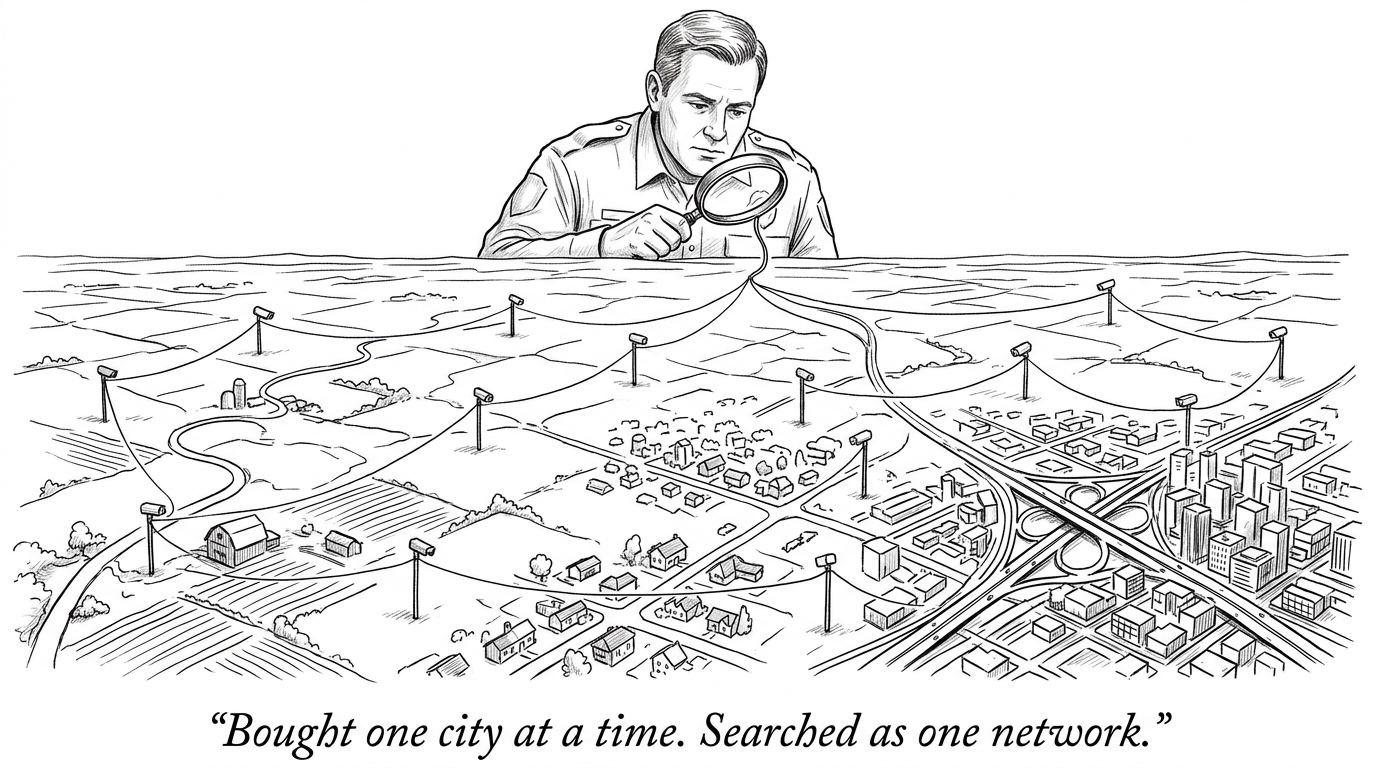
Of roughly 119,000 automated license plate readers mapped across the United States, Flock Safety accounts for about 83% of them -- some 100,000 cameras, deployed in more than 2,000 cities across at least 42 states, with a stated corporate goal of reaching "every city in the United States."[3][4] What makes Flock structurally different from a city buying its own traffic cameras is the network: individual police departments each buy their own cameras for local reasons -- Miami Beach cites spring-break enforcement -- but Flock links them into a single, nationally searchable system, so a query filed in one state can search cameras purchased and paid for by a city thousands of miles away.[4]
What a nationwide search network actually made possible
In 2025, a Johnson County, Texas sheriff's deputy filed a nationwide Flock search across 83,000 cameras in 6,809 separate law enforcement networks -- including networks in Illinois and Washington, states where abortion is legal -- looking for a woman whose family reported she'd had a self-administered abortion. The reason logged in the search system: "had an abortion, search for female."[5] A suburban Chicago department, Mount Prospect, had shared the plate-reader data that made the search possible, in direct violation of an Illinois law that specifically bars sharing the state's license-plate data with agencies pursuing someone for seeking reproductive care or over immigration status. Illinois' Secretary of State opened an investigation into the department.[6] Flock's response afterward was to block 62 out-of-state agencies that had sought abortion- or immigration-related data and add a filter that flags those search terms for denial going forward.[6]
100,000+Flock Safety cameras deployed, ~83% of all mapped US license plate readers
83,000Cameras a single Texas search queried nationwide, looking for a woman who'd had an abortion
80+US cities that had canceled or deactivated Flock contracts by May 2026
The abortion case is not an isolated misuse story -- it's the direct, predictable consequence of the network's own design. Federal immigration enforcement found the identical structural opening: more than 4,000 lookups were run at the behest of federal agencies via local departments' access, and one audit found U.S. Customs and Border Protection had a "pilot program" granting it access to Illinois' cameras that, according to Flock, the company's own leadership didn't know existed.[7] Dayton, Ohio's police department ran more than 7,000 searches explicitly banned under its own department policy. San Francisco is now facing a class-action lawsuit alleging out-of-state and federal agencies queried its Flock cameras more than 1.6 million times in seven months.[7] None of these required a new law, a new camera, or a new company. They required exactly what the network was built to do: let one agency's search reach data collected by cameras that agency never bought and that residents never knew were part of a national system.
Ring tried to wire your doorbell directly into that same network
In October 2025, Amazon's Ring -- the dominant video-doorbell brand, owned or primarily used by an estimated 58.9 million Americans -- announced a partnership letting police request footage from Ring owners directly through Flock's search platform, explicitly described at the time as building "a direct bridge between the country's largest consumer doorbell-camera network and one of law enforcement's fastest-growing data-collection platforms."[8] Participation was framed as voluntary, response optional, declines invisible to police. Public backlash was immediate and sustained enough that Ring canceled the Flock integration in February 2026 before it ever went live -- no Ring customer's video was ever actually sent to Flock.[9] Sen. Ed Markey, who had pressed Amazon on the deal, issued a statement welcoming the cancellation.
The cancellation didn't end Ring's push back into police-footage sharing, it just changed the intermediary. Ring's original police-request tool shut down in January 2024 after its own round of backlash; in early 2026, the company revived essentially the same function -- police requesting footage, residents choosing whether to respond -- through a new partnership with Axon, the police body-camera and taser manufacturer, under the name "Community Requests."[10] Ring founder Jamie Siminoff, who returned to Amazon in 2025 to retake control of the brand, has said explicitly that he wants Ring to return "to its founding identity as a crime-prevention tool."[10]
Nothing about this required anyone to build a new surveillance state on purpose. A homeowner buys a doorbell camera to see who's at the door. A city buys license plate readers to catch spring-break carjackers. Neither purchase is, by itself, the thing anyone would call mass surveillance. What turns thousands of individually reasonable purchases into a single, nationally searchable system is the layer added afterward -- a company's decision to network the cameras together, a partnership deal connecting two separate systems, a "pilot program" one company's own leadership says it didn't know about. The buyer votes once, at the point of purchase. The network's actual reach gets decided later, by people the buyer never voted for at all.
Why does this matter? Florida's ban and Miami Beach's $50,000 private-property workaround look, on their own, like a narrow local zoning fight over cameras on a spring-break strip. They're actually a local instance of the same unresolved question running through the Flock abortion-tracking case, the Illinois audit, the Dayton policy violations, and Ring's own cancel-revive-cancel history with police-footage sharing: once individually purchased cameras get networked together, who actually controls what the network can be searched for, and by whom -- and does anyone who bought a camera, or lives near one, get a vote in that decision at all?
The pushback reaches police unions and sitting mayors
By September 2026, the pushback that had come from advocacy groups, residents, and state legislatures reached two groups that hadn't weighed in that directly before: the police who use the cameras, and a sitting mayor whose city is already under contract with Flock. D.C. Police Union President Gregg Pemberton called on the D.C. Council to hold a public hearing and pass legislation regulating how the Metropolitan Police Department uses its roughly 144 Flock cameras, after the union filed misconduct complaints alleging that MPD's own internal affairs unit had used the camera network to investigate officers without the logging, justification, or audit rules Pemberton says the department has never established. A related class grievance is now headed to arbitration.[12]
In Alexandria, Virginia, the objection came not from a union or a resident group but from the city's own mayor, at a public council meeting. "I do not think there's a role for Flock in this community," Mayor Alyia Gaskins said on September 8, 2026, during a City Council review of the city's license-plate-reader program -- a chamber packed with residents holding signs reading "Deflock Alexandria." Alexandria currently runs 61 Flock cameras under a contract dating to 2023, purges the data after 21 days (the maximum Virginia law allows), and can cancel the contract at any time, according to Police Chief Tarrick McGuire, who defended the cameras as essential to solving serious crimes even as the mayor and council pushed to identify alternative vendors.[13]
What's different here isn't the substance of the complaint -- it's who's making it. The abortion-tracking search, the Illinois audit, and the Dayton policy violations were surfaced by journalists, state investigators, and advocacy groups arguing from outside the system. A police union alleging its own department can't account for what its officers search for, and a mayor stating on the record that her city's contract has no future, are the people who bought the cameras and run the department using them now saying, in public, that the network's answer to who controls it -- and who gets a vote -- isn't settled in Flock's favor either.
A Home Depot parking lot in Fairfax County, and what corroborates it
The author heard about one of these private-property workarounds directly: a Facebook post from Patrick Walsh describing a Flock camera he had spotted in a Home Depot parking lot in Reston, Virginia -- not on a public road, exactly the pattern Miami Beach is now proposing with its own $50,000 plan. That specific sighting is Walsh's own account; no news outlet has independently verified a camera at that address. But the pattern around it holds up on its own reporting. Fairfax County, where Reston sits, runs 84 Flock license-plate-reader cameras countywide, credited by the department with 546 stolen-vehicle recoveries, 898 arrests and 57 missing-persons cases since November 2022.[17] One of those recoveries happened at a Reston shopping center: on November 24, 2025, Fairfax County police used a Flock alert to locate a stolen 1999 Toyota Camry there and arrest the man found nearby.[16] And on the private-property question specifically, a Fairfax County resident named Alexandra E. told Northern Virginia Magazine in August 2026 that she had started noticing the same thing Walsh describes: "Home Depot has four of them pointing at the store in the parking lot," cameras she said were turning up "in places where you wouldn't expect them -- like schools and near business."[14] That is a second, independent Fairfax County resident describing Flock cameras in Home Depot lots -- real corroboration of the pattern this piece already named, not confirmation of Walsh's specific Reston sighting, which stays his account alone.
The 2026 cancellation wave, named
The stat panel above already counted more than 80 US cities that had canceled or deactivated Flock contracts by May 2026; the list kept growing afterward, into cities not yet named here. Framingham, Massachusetts shut its system off on June 30, 2026, after more than 700 residents organized against the contract and the police department chose not to renew it.[18] Santa Cruz, California's council voted 6-1 to terminate its Flock contract on January 13, 2026, after learning outside agencies had queried its camera data roughly 4,000 times on behalf of federal law enforcement between June and October 2025.[21] Mountain View, California's council voted unanimously on February 24, 2026 to do the same, after its police chief disclosed that unauthorized agencies had been searching the city's data for more than a year; the cameras had already been switched off since February 2.[20] And in Fort Wayne, Indiana, the city council voted 8-0 on August 25, 2026 to discontinue its cameras, over the objection of its own police department and the county prosecutor's office.[19] By mid-August 2026, Virginia's own Center for Investigative Journalism put the nationwide total at 95 municipalities that had rejected or canceled Flock contracts, citing the tracker kept by the volunteer group DeFlock -- against roughly 6,000 communities still running the system.[15]
Some residents aren't waiting for a council vote
A smaller number of people have stopped petitioning and started removing cameras themselves. Law enforcement sources tallied more than two dozen Flock cameras physically destroyed across five states dating back to April 2025, with incidents accelerating since mid-June 2026: solar panels and poles rammed or clubbed apart in Ashland, Ohio; cameras cut in half and spray-painted along Washington Avenue in Houston, Texas; three poles "sawed clean through" along a rural road in Barrow County, Georgia; and two suspects caught on camera cutting down a freshly installed unit in New Bern, North Carolina. One Virginia activist alone is reported to have destroyed at least 13 cameras.[22] That is real and specifically documented -- named towns, dated incidents, a law-enforcement-sourced running count -- but it is a couple dozen cameras out of roughly 100,000 nationwide, concentrated in a handful of places. It is evidence of a real, sharpening edge to the backlash, not of a broad, organized campaign to physically dismantle the network.
None of this resolves the question this piece opened with -- it sharpens it. A camera in a Home Depot parking lot answers to no public-road ban and no city council vote at all; it exists because a private landowner agreed to host it, a decision residents of Reston, like residents anywhere Flock operates on private property, had no vote in and in most cases will never even know took place. Ninety-five councils voting to cancel, and a much smaller number of residents cutting poles down themselves, are two different answers to the same unresolved question the D.C. police union and Alexandria's mayor are already asking out loud: who actually controls what the network can be searched for, and does anyone who didn't buy the camera -- or just parks near one -- get a vote in that at all?
 Oluwadi