 Oluwadi
Investigating the Overlooked
Region
What
Who For
Analysis
Oluwadi
Investigating the Overlooked
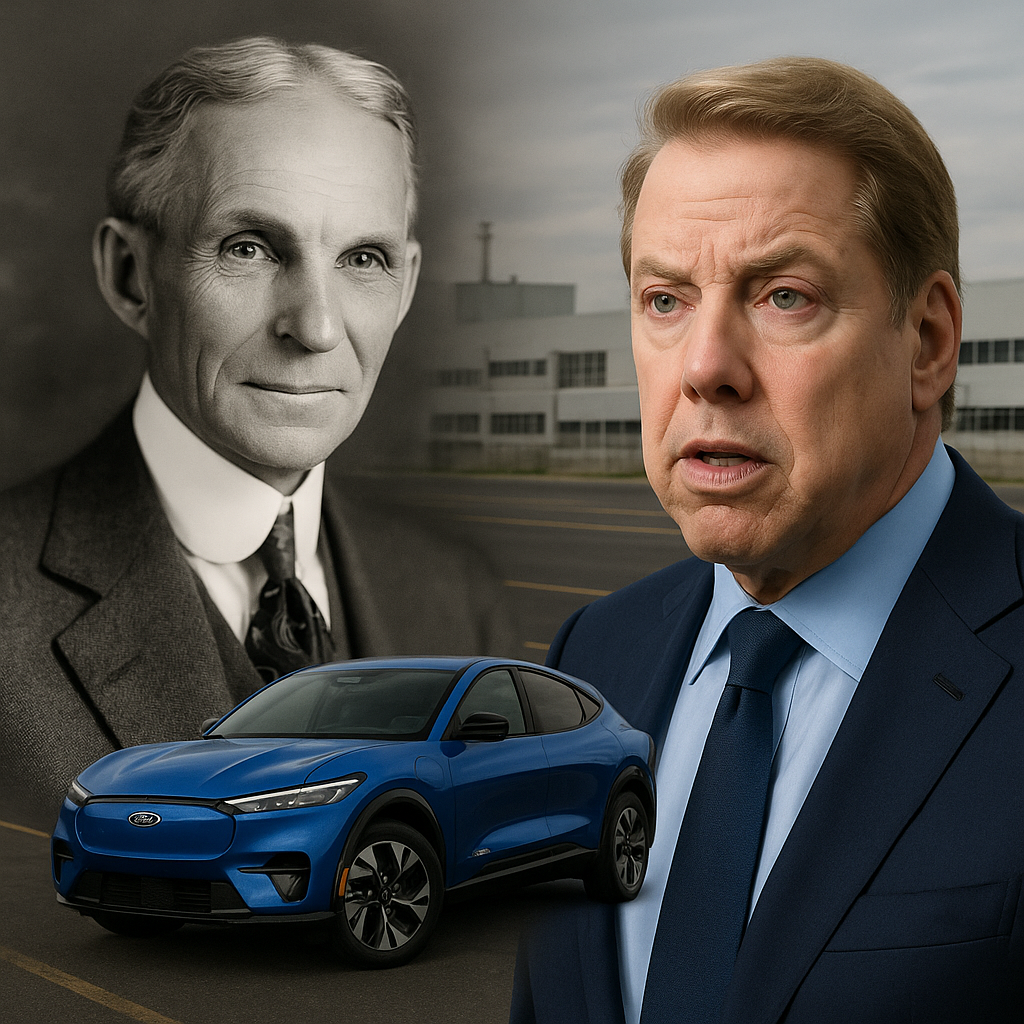
Henry Ford spent eight years in court fighting to avoid paying a licensing fee. His great-great-grandson's company now depends entirely on one. What sits between those two facts is the actual throughline of Ford Motor Company's 120-year history — not the cars, the plants, or the men who ran it, but who got to control the terms, and how hard the company has fought, in both directions, to make sure that answer stayed its own.
In 1903, a group of established automakers calling itself the Association of Licensed Automobile Manufacturers controlled entry into the entire American car industry through a single instrument: George Selden's 1895 patent on the "road engine," which Selden had sold to the Electric Vehicle Company for royalties on every car built. ALAM licensed manufacturers by unanimous vote of a five-member board and collected a cut of every sale.[1] Ford Motor Company applied for a license that same year and was rejected — officially because ALAM's board classified Ford as an "assembler" rather than a true "manufacturer," though the company's thin $28,000 capitalization and Henry Ford's two prior failed ventures didn't help its case.[1]
Ford built and sold cars without a license anyway. On October 22, 1903, the Electric Vehicle Company and Selden sued Ford and one of its dealers for patent infringement.[2] Ford lost at trial in September 1909 — the court read Selden's patent broadly, as covering essentially any gasoline automobile.[3] Most of Ford's fellow holdouts folded at that point; General Motors' Billy Durant alone paid roughly $1 million in back royalties to settle. Ford appealed alone, on a $350,000 bond.[4]
The appeals court ruled in January 1911 — and the actual holding is narrower, and more interesting, than "Ford beat the patent." The court left Selden's patent technically valid. It just found the patent covered only a specific engine design, a Brayton-cycle engine, that essentially no one, including Selden, had ever actually built a car around. Ford's engine, like every other automaker's, ran on the Otto four-stroke cycle — a different design the patent's claims simply didn't reach, and one whose own inventor had already lost his exclusive rights to it a quarter-century earlier. German courts revoked Nikolaus Otto's own patent on the four-stroke cycle in 1886, after finding that a French engineer, Alphonse Beau de Rochas, had described the same principle first, in an obscure 1861 pamphlet — even though Otto had developed his engine independently and was the first to actually build a working one.[20] By the time Ford's case reached the appeals court, the engine that freed him wasn't just architecturally different from Selden's. No one held clean exclusive rights to it at all.[3] ALAM never appealed further and stopped enforcing the patent; the licensing structure that had taxed the industry's entry for eight years effectively dissolved.[1] Ford, afterward, on the man whose patent he'd spent nearly a decade fighting: "We believe that the art would have been just as far advanced to-day if Mr. Selden had never been born."[5]
Three years later, Ford set a different term the rest of the industry hadn't asked for, either. On January 5, 1914, the company announced it would pay $5 for an eight-hour day, effective the following week — roughly double the prevailing wage.[18] It wasn't a straight raise: half of it was structured as a profit-sharing bonus, and collecting it required passing muster with Ford's own Sociological Department, which investigated workers' homes and personal habits and could withhold the money over drinking, debt, or failing to enroll in the company's English and "Americanization" classes.[19] The crisis behind it was real: the new moving assembly line was so punishing that annual turnover had reached 380 percent in 1913; the $5 day cut that to 54 percent within a year and 16 percent within two.[19] Whatever mix of idealism and self-interest actually drove it, the instinct underneath was the same one behind the Selden fight: Ford setting the terms of a relationship on his own conditions, rather than accepting whatever the market or convention handed him — even when, as with the Sociological Department, that meant extending his own control further than anyone had asked him to.
Ford stayed private for another 45 years. When it finally went public in 1956, the Ford family built permanent control directly into the stock itself. Public investors got Class A shares, representing roughly 95 percent of the company's total equity. The Ford family kept a separate class — Class B, available only to family members, their trusts, and their descendants — structured so that no matter how the company's ownership diluted over time, Class B would always carry 40 percent of total voting power.[6] Seventy years later, the arrangement still holds exactly as designed: the Ford family votes 40 percent of the company while owning roughly 5 percent of its economic value.[6] It's not a controlling stake in the ordinary sense — it's a permanent veto, engineered once and never revisited.
That veto sat mostly in reserve, because for most of the company's history a Ford was running it directly. Henry Ford II, the founder's grandson, was president from 1945 and chief executive from 1945 to 1979.[7] In 1979, Philip Caldwell became the first CEO in the company's history who wasn't a Ford — and for the next 22 years, through Caldwell, Donald Petersen, Harold Poling, Alex Trotman, and Jacques Nasser, none of them were.[8]
In 2001, after Nasser was pushed out, William Clay Ford Jr. — the founder's great-grandson, known throughout his career as Bill Ford — became CEO, bringing day-to-day operational involvement back into the family for the first time in over two decades.[8] He stepped down as CEO in 2006, bringing in Alan Mulally, an outsider from Boeing, to run the company through the 2008 financial crisis without a bankruptcy or a bailout. Mulally was followed by Mark Fields, then Jim Hackett, then current CEO Jim Farley — four consecutive non-family chief executives, running today into a fifth year.[9] But Bill Ford never actually left. He moved to executive chairman in 2006 and has held that seat through every CEO since.[8] The operating title has changed hands five times in the last 47 years. The Class B votes that could unmake any of those five, at any point, never moved once.
In February 2023, Ford announced a $3.5 billion battery plant in Marshall, Michigan — the first automaker-owned lithium-iron-phosphate cell plant in the United States, on a roughly 500-acre site.[10] Ford owns the plant, the equipment, and the workforce outright. What it doesn't own is the battery chemistry itself: CATL, the Chinese company that is the world's largest EV battery maker, licenses Ford the manufacturing process and trains the workforce, with no equity stake and no ownership claim on the facility.[11] That structure — license the technology, keep full ownership and control of the physical plant — wasn't incidental. It was built specifically to preserve the plant's eligibility for a federal production tax credit worth up to $45 per kilowatt-hour of battery cells and modules, which newer rules restrict wherever a "foreign entity of concern" holds an ownership or control stake. A pure technology license, with Ford retaining what regulators call "effective control," was designed to fall outside that restriction entirely.[12]
The arrangement was contested almost immediately. In January 2025, the Department of Defense added CATL to its list of companies with alleged Chinese military ties.[13] General Motors, which has no comparable deal of its own, spent a record $8.2 million on federal lobbying in the first quarter of 2025 alone, pushing for stricter rules that would have closed the exact structural loophole Marshall depends on.[14] The House version of the 2025 tax bill would have stripped tax-credit eligibility from any battery built on Chinese technology, which would have hit Marshall directly. After sustained Ford lobbying, the Senate instead adopted the narrower "effective control" standard Ford's structure was already built to satisfy, and the credit survived intact.[15] Locally, a group called Committee for Marshall — Not the Megasite has fought the project's zoning since 2023; a Michigan Court of Appeals panel dismissed its latest challenge in February 2026, and the group has said it will seek another appeal to the state Supreme Court.[16] Michigan's own incentive package, meanwhile, was cut roughly in half after Ford scaled the project back in late 2024 — local property-tax abatements fell from about $825 million to roughly $225 million as the plant's footprint and job count shrank.[17]
None of these four moments are really about cars, batteries, or even money. Each one is Ford answering the same question under different pressure: who gets to control the terms this company operates under. In 1903, the answer was refusal — Ford would rather spend eight years and a small fortune in court than pay someone else for the right to build an engine he considered his own to design. In 1956, the answer was permanence — the family wrote itself a veto into the stock structure that no future dilution, no future CEO, and no future shareholder vote could touch. Between 1979 and today, the company let day-to-day operational involvement move in and out of the family's hands five separate times, because the one thing that actually was control, the 40 percent vote, was never on the table to begin with. And in 2023, faced with a technology it didn't have and couldn't build fast enough on its own, the same company that once fought a patent cartel for eight years simply paid the toll — but only after engineering the deal so it, not the licensor, kept the keys to the building.