 Oluwadi
Investigating the Overlooked
Region
What
Who For
Analysis
Oluwadi
Investigating the Overlooked
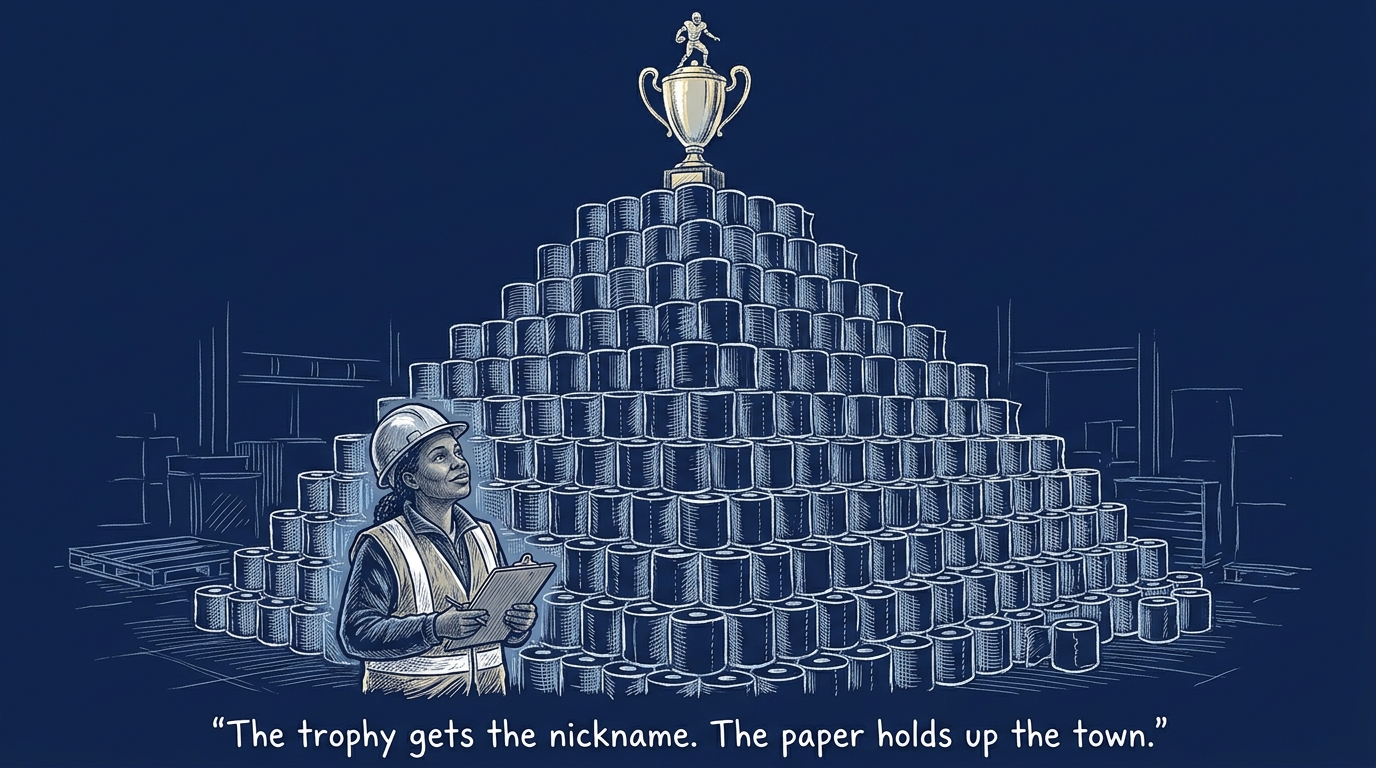
"Titletown" refers to the Green Bay Packers -- 13 league championships, the only team of its kind in professional sports. It says nothing about what has actually kept Green Bay's economy running for more than a century, which has nothing to do with football at all. In 1901, Northern Paper Mills of Green Bay issued the first "sanitary tissue" ever sold under the name Northern Tissue. By 1920, the company was the world's largest producer of bath tissue.[1]
The industry's actual breakthrough is a detail worth stating plainly, because it explains why Green Bay specifically won this race: early tissue paper had splinters in it. Engineers at Northern Paper spent years developing a process called "linenizing" that made tissue both softer and, critically, splinter-free -- the innovation that turned a regional product into a national and then global one.[1] Production of toilet paper doubled between 1925 and 1935, and the industry's strength through that period is part of why Green Bay avoided the worst of the Great Depression that hit most of the industrial Midwest.[1]
The industry didn't fade the way the region's other legacy manufacturing did -- it's still there, still employing thousands, under a different corporate name. Georgia-Pacific now runs Green Bay operations across three facilities -- a paper mill, a converting operation, and a recycled-paper processing plant -- employing roughly 1,600 people between direct manufacturing and business support roles.[2] The Broadway mill is one of the largest wastepaper recycling operations in the world, processing more than 430,000 tons of recovered paper a year into products used in airports, hotels, hospitals, and schools.[2] The company's Day Street plant is the birthplace of Quilted Northern -- a direct corporate descendant of the same Northern Tissue brand Green Bay invented in 1901.[2] Across Wisconsin, Georgia-Pacific runs seven facilities employing nearly 2,100 people, with total compensation and benefits over $400 million.[2]
The team that actually gave the city its nickname has its own overlooked structural fact, and it has nothing to do with wins either. The Packers are the only franchise in the NFL -- and the only major professional sports team in the country -- structured as a nonprofit, publicly held corporation rather than owned by an individual or ownership group.[3] More than 360,000 people hold stock in the team. No single shareholder is allowed to own more than roughly 4% of outstanding shares. The stock pays no dividend, has no real resale market, and can only be passed to a relative -- it's ownership in name and civic identity, not a financial instrument.[3] The NFL's own constitution now prohibits exactly this kind of ownership structure league-wide; the Packers exist as a permanent, grandfathered exception written in specifically to preserve what Green Bay already had before the rule was made.[3]
Why does this matter? A city's nickname tends to freeze at whatever made it famous, and Green Bay's froze on football decades after the industry that actually built and sustained the place was already a world leader. The tissue industry didn't need a winning season to keep running -- it just kept making the same product, better, for well over a hundred years, through a Depression the city mostly avoided and a wave of Midwest manufacturing collapse it never remotely resembled. Titletown's real title, if the word is taken literally, might belong to the industry nobody built a stadium around.