 Oluwadi
Investigating the Overlooked
Region
What
Who For
Analysis
Oluwadi
Investigating the Overlooked
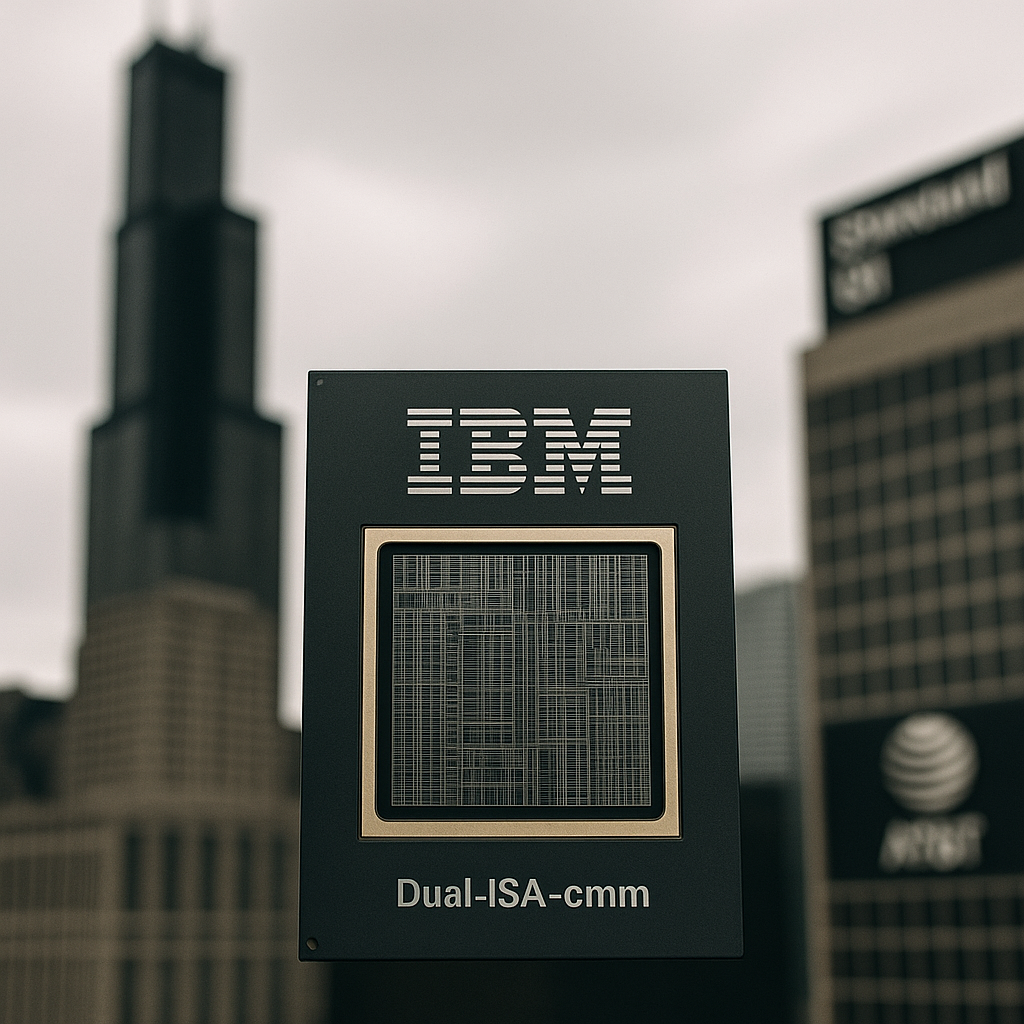
At Hot Chips 2026, IBM unveiled a processor for its Z and LinuxONE mainframes that does something genuinely new: individual cores that natively execute both IBM's own z/Architecture and ARM's AArch64 instruction set — not through emulation, in hardware, switchable in nanoseconds. Paired with it, a separate AI accelerator chip: 96GB of HBM3e memory, 4TB/s of bandwidth, built to let seven decades of mainframe transaction processing run alongside modern AI workloads without either side blinking.[1]
It's a genuinely new piece of engineering. It's also, quietly, a company doing the same thing it's done for over a century: refusing to be only what it was built as.
IBM started in 1911 as the Computing-Tabulating-Recording Company, selling punch-card tabulators, time clocks, and scales. It became International Business Machines in 1924.[2] In 1933 it bought its way into typewriters, acquiring the Electromatic Typewriter Company[3] — the Selectric would later become as central to IBM's identity, for decades, as computers are today. Then mainframes, personal computers in the 1980s, the sale of that entire PC business to Lenovo, a shift into services and cloud — and now silicon built to run a 1960s architecture and a 2020s one in the same core. Almost nothing about what IBM makes has stayed the same. What's stayed the same is IBM.
Most companies that old don't get to say that. Richard Sears started a mail-order watch business in 1886, partnered with Alvah Roebuck by 1893, opened Sears' first physical store in 1925, and built the company into a genuine conglomerate — Allstate Insurance in 1931, the Discover card in 1985.[4] Same rough age as IBM, same original dominance. By October 2018, Sears Holdings was filing for Chapter 11, unable to make a $134 million debt payment.[4]
It's tempting to say IBM survived because it changed and Sears died because it didn't. That's wrong on both counts, and Sears itself is the proof. It mutated successfully, repeatedly, for well over a century — mail-order to department stores to insurance to consumer credit. It didn't die because it stopped adapting. It died after Kmart, which Eddie Lampert's ESL Investments had taken control of through Kmart's own 2002 bankruptcy, acquired Sears in 2005 to form Sears Holdings. Lampert restructured the combined company into roughly 30 internal units, each judged on its own standalone profit rather than the retailer's overall health — a structure that pitted Sears' own divisions against each other and left stores visibly deteriorating while corporate leadership stayed insulated from it.[5]
Coca-Cola, meanwhile, has sold the same product under the same name since the company's 1892 incorporation. In 1985 it tried to change the formula outright — "New Coke" — and reversed course within months under public backlash, reverting to the original.[6] That's not a company that never changed. It's a company where the market itself caught a bad call and forced a correction before the change could even finish happening.
The actual variable is narrower: whether the person or structure holding the power to decide has to live with what the decision does to the company.
Sometimes that's direct. Joe Hardy built 84 Lumber into a national building-materials chain starting in 1956.[7] In 1987 he bought a bankrupt resort property at auction and rebuilt it into what's now Nemacolin Woodlands Resort[8] — pouring the company's money into something he intended to keep, under his own family's control, not to flip. His daughter, Maggie Hardy Knox, has run 84 Lumber since the early 1990s.[7] Same pattern three generations deep at Wawa: what began as an iron foundry in 1803 became a dairy farm in 1890 under George Wood, then a convenience-store chain in 1964 under his grandson Grahame Wood — three total business-model changes, one family's hand on it the entire time.[9]
Sometimes the tether isn't a family, it's an institution strong enough to catch a bad decision before it compounds. IBM's ownership has been diffuse for most of a century — no single controlling shareholder, a board that can and does replace leadership, a market that prices its mistakes. DuPont mutated from a gunpowder manufacturer founded in 1802 into a chemicals and materials-science company[10]; General Electric was itself formed in 1892 when financier J.P. Morgan orchestrated a merger that folded Thomas Edison's own company into a new entity that dropped his name — Edison didn't keep control of the company built on his patents.[11] Both companies mutated their entire core businesses under institutional, not personal, control.
Lampert had neither kind of tether. He had Hardy-level concentrated control with none of Hardy's stake in the outcome — his upside ran through ESL, a vehicle that could profit even as Sears lost. Nothing bound his decisions to the company's fate, and nothing outside him was strong enough to override him either.
The Erie Railroad's stock-watering wars of the 1860s are the Lampert playbook with top hats. Daniel Drew, Jim Fisk, and Jay Gould issued fraudulent Erie shares to fight off Cornelius Vanderbilt's takeover attempt, extracting millions for themselves rather than running the railroad — Vanderbilt alone lost more than $7 million trying to buy his way past them.[12] Erie went bankrupt in 1878 anyway, on its own, no board or regulator required, just the eventual collision with reality. It took the railroad industry as a whole another decade to get a real check: rate discrimination and political corruption had become widespread enough that Congress created the Interstate Commerce Commission in 1887, the country's first federal regulatory agency, because no institutional check inside the industry had been strong enough to catch it.[13]
Standard Oil is the case that sharpens this rather than just repeating it. Rockefeller's incentives were aligned — he built something ruthlessly efficient, not hollow. The problem wasn't extraction from the company, it was extraction from the market: enough concentrated control to dictate prices regardless of competition. The 1911 Supreme Court ruling split the company into 39 independent pieces[14] — Standard Oil of New Jersey and New York eventually becoming Exxon and Mobil, Standard Oil of California becoming Chevron, others feeding into what's now BP, Marathon, and ConocoPhillips.[14] It didn't destroy value the way Sears' collapse did. Rockefeller himself emerged from the breakup as the richest man in the world, his stakes in the newly independent pieces roughly doubling in value once they were freed to compete on their own[14] — which says something about how much the monopoly itself had been costing everyone else.
Not every check preserves what it's checking, cleanly. The Department of Justice sued AT&T in 1974, and MCI — which had been suing AT&T since that same year over being denied access to interconnect its own long-distance circuits[16] — was part of what forced the 1984 divestiture that broke the Bell System into AT&T and seven regional Baby Bells.[15] AT&T kept its long-distance business and Bell Labs. Bell Labs — the transistor, the laser, Unix, the foundations of information theory — had existed because AT&T's monopoly structure could fund decades of speculative research no market-disciplined competitor could justify. Once that structure was gone, research output collapsed along with the patient capital, and AT&T itself was eventually absorbed by SBC, one of its own regional offspring, which then took the AT&T name back.[15]
But the ledger has two columns, not one. The same divestiture that starved Bell Labs is what let MCI, and later Sprint, become real nationwide competitors — the modern competitive telecom market exists because that monopoly was broken, not despite it.[15][16]
Xerox is a related but different case. Xerox PARC, founded in 1970, invented the graphical user interface, the mouse, laser printing, and Ethernet, funded by a copier business that had once controlled nearly 100 percent of the U.S. market. Steve Jobs paid Xerox $1 million in 1979 for a look inside PARC and walked out with the interface that became the Macintosh — Xerox's own management, in his telling, "had no idea what they had."[17] A 1975 FTC consent decree, separately, forced Xerox to license its entire patent portfolio, mostly to Japanese competitors like Canon; within four years, its copier market share fell from near-total dominance to under 14 percent.[17] Unlike Bell Labs, PARC's inventions weren't killed directly by the antitrust action — they were lost to Xerox's own leadership failing to see what it had. The check opened the moat right as the company failed, on its own, to capture its own crown jewels.
Kodak breaks the frame in a different, more useful direction. The company's own lineage runs from the Eastman Dry Plate Company (1881, backed by investor Henry Strong) through a re-incorporation as Eastman Dry Plate and Film Company (1884, the shift to roll film), the "Kodak" trademark and first camera (1888), to its final form as the Eastman Kodak Company (1892)[18] — a normal-looking sequence of mutations, the same shape as IBM's or Wawa's.
Then, in 1975, a Kodak engineer named Steven Sasson built the first digital camera — inside Kodak's own labs. Leadership shelved it, not out of ignorance but a rational-looking bet: the market looked too small to justify cannibalizing a film business still throwing off enormous profits.[18] In 1979, a Kodak executive named Larry Matteson predicted internally that digital photography would fully replace film by around 2010.[18] He was almost exactly right. The company built around the person who saw it coming filed for Chapter 11 in January 2012 anyway.[18]
That's not Lampert's failure. There was no outside raider optimizing for a payout divorced from the company's fate. Kodak's leadership was about as tethered as leadership gets — career people whose own future was bound up in the company's, not an extractive hedge fund. The tether just pointed at the wrong thing: the health of the business Kodak already had, not the survival of the company past it. Alignment usually protects a company. Here it protected exactly the thing that had to die for the company to live, and the people holding the power made the rational-for-today choice anyway — with the right answer sitting in their own building since 1975.
None of this is visible from inside a company while it's happening. Whoever's running the test bench, working the sales floor, or writing the code doesn't see the ownership drama playing out several floors up — the tether or its absence only becomes obvious afterward, usually in hindsight. That's what makes it so hard to spot in real time, and why it keeps happening to companies that look, from the inside, exactly like the ones that survived.