 Oluwadi
Investigating the Overlooked
Region
What
Who For
Analysis
Oluwadi
Investigating the Overlooked
In 2011, IBM's Watson beat two of the best Jeopardy! players alive, and the company decided its next challenge should be oncology. Over the years that followed, IBM spent more than $4 billion acquiring four health-data companies -- Truven Health Analytics ($2.6 billion), Merge Healthcare (roughly $1 billion), Phytel, and Explorys -- to build Watson Health into a platform that would offer cancer-treatment guidance with more consistency and reach than any human oncologist could match.[1] In January 2022, IBM sold the remaining Watson Health assets to the private equity firm Francisco Partners.[2]
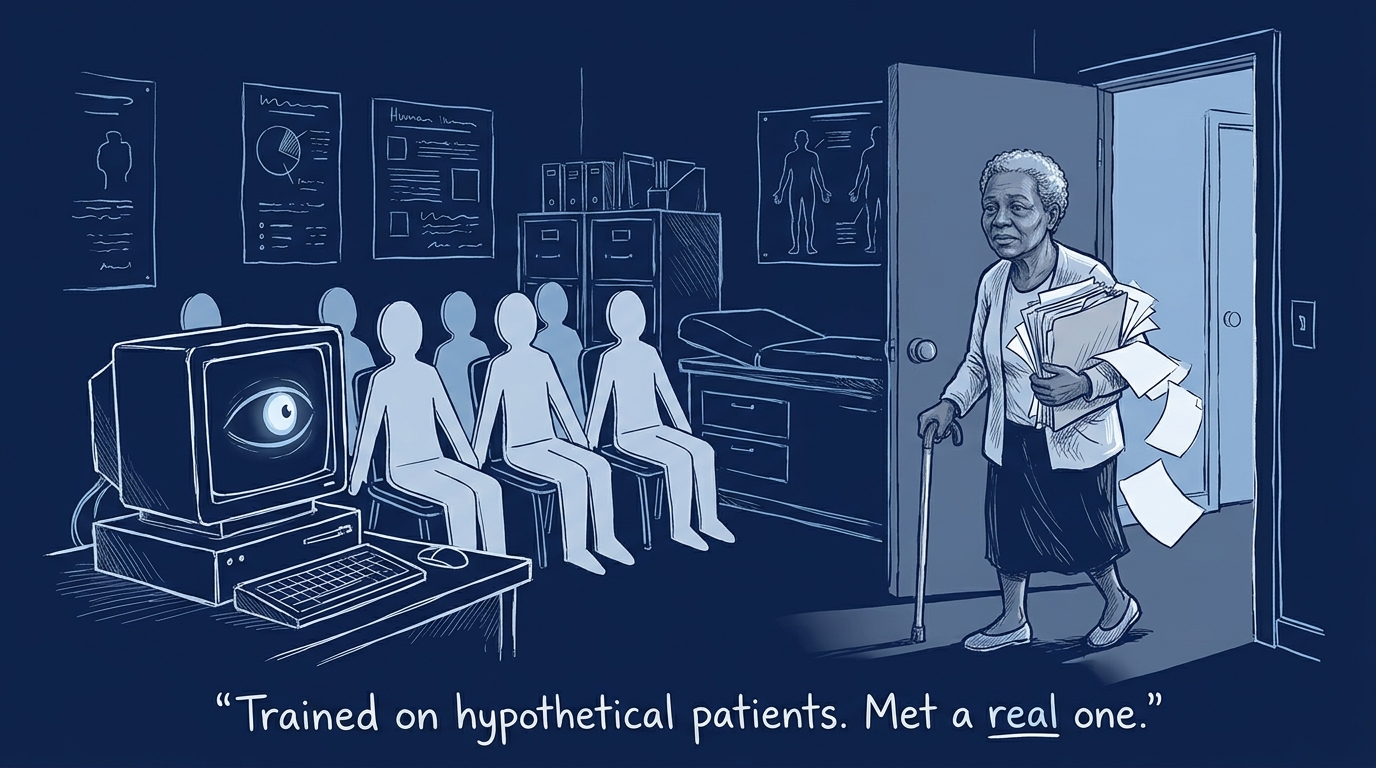
Watson's core capability -- the pattern-matching that won Jeopardy! -- was built for language, not medicine, and its flagship oncology product, Watson for Oncology, was trained largely on a small number of synthetic, hypothetical cancer cases developed with doctors at Memorial Sloan Kettering, not on data from actual patients.[3] Internal IBM documents obtained by STAT News in 2018 -- slide decks presented by the unit's own deputy chief health officer -- acknowledged that the product "often" returned "multiple examples of unsafe and incorrect treatment recommendations."[3] In one documented case, Watson recommended a treatment regimen containing the chemotherapy drug bevacizumab (Avastin) -- which carries an FDA black-box warning for causing severe or fatal hemorrhages -- for a 65-year-old lung cancer patient who was already presenting with severe active hemorrhage.[3] Real patients came with the comorbidities, incomplete records, and prior treatment history the training cases never had, and the system's guidance didn't reliably account for any of it.
Florida's Jupiter Hospital and Memorial Sloan Kettering itself were among the customers whose internal assessments criticized Watson for Oncology's safety and accuracy, according to the same internal documents STAT reviewed.[3] STAT reported no patients died as a result of the flawed recommendations, but the pattern was consistent enough across institutions that trust in the product eroded steadily rather than catastrophically.[3]
IBM spent over a year searching for a buyer before Francisco Partners acquired the core Watson Health data and analytics assets -- Health Insights, MarketScan, Clinical Development, Social Program Management, Micromedex, and its imaging software -- in a deal that closed in 2022; neither company disclosed the purchase price.[2] Francisco Partners relaunched the business as an independent company, Merative.[2]
IBM's own internal documents on Watson for Oncology admitted the number of synthetic training cases behind each cancer type's recommendations was small, and that the number "was determined without statistical input" -- a handful of hypothetical cases, hand-built with a few specialists per cancer type, standing in for the actual diversity of real patients.[3] Compare that to what makes today's large language models actually capable: GPT-3, the model that proved the modern approach worked, trained on roughly 400 billion tokens drawn from Common Crawl's web archive plus Wikipedia and two book corpora -- 45 terabytes of raw text filtered down to 570 gigabytes, spanning years of the open internet rather than a curated handful of cases.[4] The breadth is the whole story, and it wasn't a new lesson even when Watson was built. Narrow, hand-crafted expert systems had already hit this exact wall once before: MYCIN, a rule-based system built in the 1970s for the identical task -- medical diagnosis -- worked well on the cases its designers anticipated and broke on anything slightly different, part of the brittleness that helped trigger the AI winters of the late 20th century.[5] A system trained on a small, hand-picked set of examples learns the biases and blind spots of whoever picked them; a system trained on hundreds of billions of tokens of real, messy, contradictory human text has actually seen enough of the world's variation to generalize past any one curator's assumptions. Watson for Oncology wasn't an innocent bet made before anyone knew better. It was the same narrow, hand-crafted approach that had already failed once, in the same field, rebuilt decades later with a bigger marketing budget.
Why does this matter? Watson Health is the clearest recent case study of a failure mode AI research had already diagnosed once, decades before IBM built it: a system trained on clean, idealized data marketed as ready to guide decisions in a domain defined by messy, individual exceptions -- and specifically in medicine, where a confident wrong answer isn't a bad customer-service experience, it's a bevacizumab order for a hemorrhaging patient. The lesson isn't that AI has no place in clinical care. It's that the honest, hard part of the job is exactly the part Watson's marketing skipped past, and the part MYCIN's builders learned the hard way a generation earlier: knowing precisely what the system was actually trained on, and building a real check into the workflow before its answer reaches a patient. HoloMD's Dr. Holo is one real answer to what that check can look like -- human-supervised, and never the regulated party itself.
A chip-company CEO recently made the same raw-compute promise about AI and cancer that Watson Health was built to fulfill -- and named scale, not data quality, as the remaining obstacle. See "Arm's CEO Says AI Will Cure Cancer Within Our Lifetime. IBM Already Spent $4 Billion Proving That the Compute Isn't the Part That's Missing."