 Oluwadi
Investigating the Overlooked
Region
What
Who For
Analysis
Oluwadi
Investigating the Overlooked
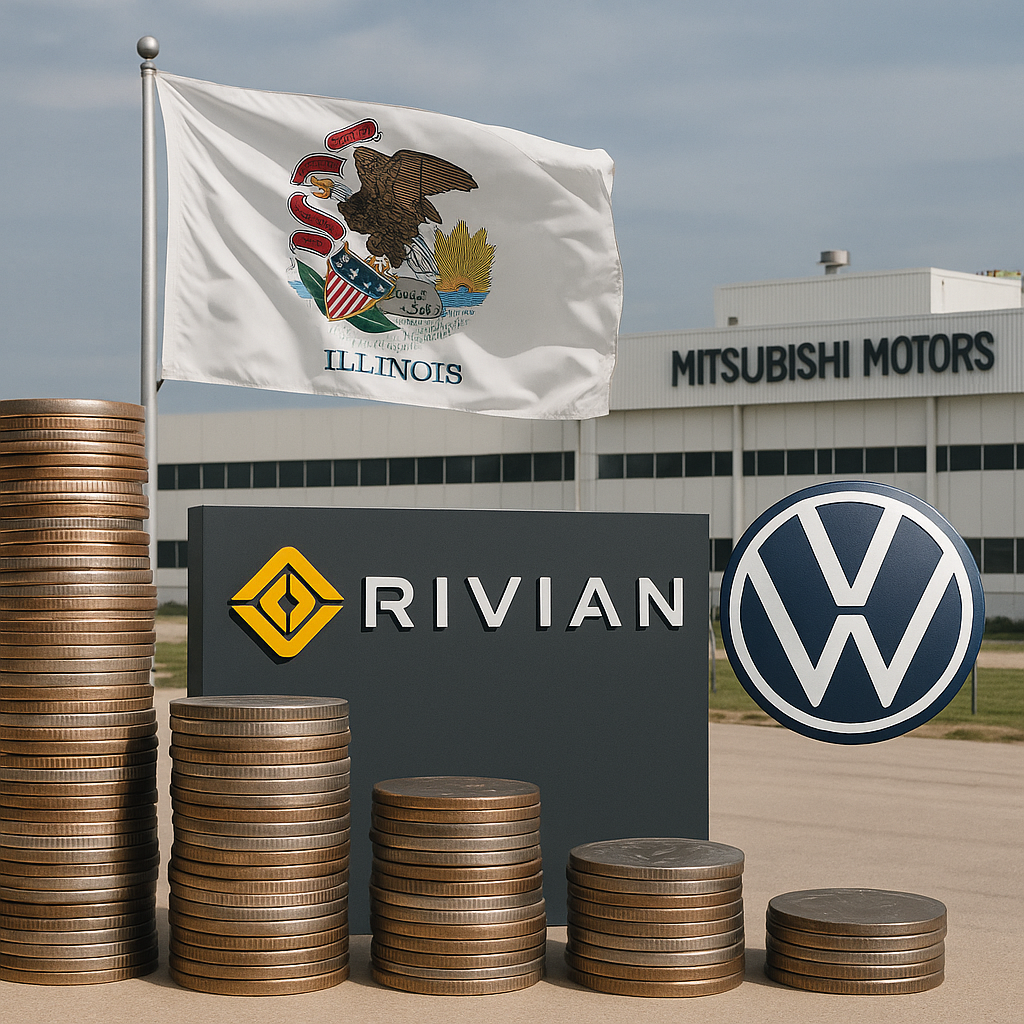
The plant Rivian builds electric trucks in today was built for a car company that doesn't exist anymore. Diamond-Star Motors, a 1985 joint venture between Chrysler and Mitsubishi, opened a 1.9-million-square-foot assembly plant in Normal, Illinois in 1988, rated for 240,000 vehicles a year.[1] Mitsubishi bought out Chrysler's half in the early 1990s, ran it alone for two more decades as sales slid, and closed it for good in December 2015 — production down from over 200,000 vehicles a year to roughly 64,000, about 1,200 jobs gone.[2] In January 2017, an EV startup nobody outside Silicon Valley had heard of bought the whole facility from a liquidation firm for $16 million.[3]
In May 2024, Illinois committed $827 million in state incentives to Rivian — mostly tax credits under the REV Illinois Act, plus a smaller capital grant and a manufacturing training program — in exchange for a $1.5 billion Rivian investment commitment, 559 new full-time jobs by the end of 2029, and retention of at least 6,000 existing jobs at wages above the county average.[4] The timing wasn't random. Two months earlier, in March 2024, Rivian had paused construction on a separate, roughly $5 billion plant it was building from scratch in Georgia, citing cash conservation, and said it would build its next model, the R2, at the existing Normal plant instead — a move it said would save around $2.25 billion versus standing up two plants at once.[5] Illinois's incentive package is what actually financed that redirection: the $1.5 billion Normal expansion it's tied to raised the plant's total capacity toward roughly 215,000 vehicles a year.[6]
Georgia's paused plant had its own, far larger financing story running in parallel — and it's easy to conflate the two if you're not precise about which dollars went where. The Department of Energy's Loan Programs Office finalized a $6.57 billion loan to Rivian on January 16, 2025, four days before the Biden administration left office — the first Advanced Technology Vehicles Manufacturing loan ever issued for a full assembled-vehicle plant rather than components.[7] The loan is for Georgia. None of it touches Normal.
It was already politically contested before it closed. In December 2024, incoming DOGE co-chair Vivek Ramaswamy publicly called for clawing the loan back; House Speaker Mike Johnson said the same.[9] By February 2025, Georgia's own governor said disbursement had been "put on hold" while the new administration reviewed it.[10] The loan was never formally cancelled. On April 30, 2026, Rivian announced it had been renegotiated down to $4.5 billion — a $2.1 billion cut — restructured around a single, larger first production phase rather than the original two-phase build. Rivian and DOE both frame the change as a capacity and timing decision, not a political one; the public record doesn't establish a direct causal link either way. What is confirmed: as of that restructuring, not one dollar of the loan had actually been disbursed. Drawdown is slated to begin in early 2027 — two full years after the loan was originally finalized.[11] Georgia's plant broke ground for real in September 2025, eighteen months after the pause.[12]
Rivian's early capital came from two auto-adjacent giants who no longer hold much of it. Amazon led a $700 million round in February 2019;[13] Ford put in $500 million two months later, growing its stake to roughly $1.2 billion across 2019's funding rounds before selling the large majority of it in 2022 for about $3 billion.[14][15] Amazon's own stake, once close to 20 percent, has been diluted down through Rivian's subsequent capital raises ever since.
Into that gap stepped Volkswagen. In November 2024, VW and Rivian formed a 50/50 joint venture — Rivian contributes its electrical architecture and software stack, VW gets to build future Audi, VW, and Scout-brand vehicles on it — with VW's total committed investment rising to as much as $5.8 billion, paid in staged tranches tied to development milestones.[16] By May 2026, those staged payments had pushed VW's equity stake to 15.9 percent, officially passing Amazon's 12.28 percent to make a German legacy automaker Rivian's single largest shareholder.[17] The same joint venture is also the reason Rivian posted its first-ever annual gross profit in 2025 — $144 million, entirely because VW licensing income outweighed a $432 million loss in the core vehicle business.[18]
While all of that was moving, the one piece of EV policy that reached every American car buyer directly went away. Trump signed the One Big Beautiful Bill Act on July 4, 2025, ending the federal $7,500 new-EV tax credit years ahead of its original 2032 sunset; purchases after September 30, 2025 no longer qualified at all.[19] Rivian's own numbers show the effect directly: fourth-quarter 2025 deliveries fell to 9,745 vehicles from 13,201 the quarter before, and full-year 2025 deliveries dropped 18 percent to 42,247, down from 2024's record 51,579 — a straightforward demand cliff timed almost exactly to the credit's expiration.[18]
The credit's disappearance didn't happen in a vacuum. Five months later, on February 28, 2026, the United States and Israel launched joint military strikes on Iran; Iran responded by threatening and attacking commercial shipping through the Strait of Hormuz, the 21-mile chokepoint that roughly a fifth of the world's oil trade passes through.[23] U.S. gasoline had averaged $2.98 a gallon right before the war started. By early May it had reached $4.48, a 50 percent jump in barely two months.[24] As of today, the national average sits at $4.08 a gallon — and this August is on pace to be the most expensive August at the pump ever recorded, surpassing the previous record set in 2022.[25]
None of that changed the price of an EV. It changed the price of everything an EV owner doesn't have to keep paying at all. The federal credit that made a new EV cheaper to buy disappeared in September. The war that made a gas car more expensive to keep driving arrived five months later. Rivian didn't cause either event and controls neither one — but the same window that removed one real incentive to buy its vehicles added a different one back, from a source with nothing to do with EV policy at all.
By mid-2026 the company had stabilized without the credit's help: the R2, Rivian's lower-priced model, began customer deliveries June 9, 2026,[20] and second-quarter 2026 deliveries beat Rivian's own guidance, with revenue up 27 percent year over year.[21] Normal itself was never a single-factory town the way the closure narrative implies — Illinois State University alone contributes more than $550 million a year to the local economy, and two major insurers, State Farm and Country Financial, are headquartered in the same metro area.[22] The plant mattered enormously to the region. It was never the only thing holding it up.
Line up the three sources of support side by side and the pattern is plain. Illinois's $827 million bet, tied to a real production decision already in motion, delivered real jobs and real output on a roughly two-year timeline. The federal government's much larger $6.57 billion bet on Georgia was finalized in the same administration-transition window that shows up again and again in these stories — days before a handoff — then spent the next sixteen months contested, cut by a third, and still hadn't disbursed a dollar as of this writing. And the capital that actually closed the gap when both the credit and the cash got tight came from neither government: it came from a German automaker buying its way into Rivian's software, one milestone payment at a time, until it owned more of the company than Amazon did. Three different institutions bet on the same company. Only one of them was still fully committed by the time the money actually needed to show up.