 Oluwadi
Investigating the Overlooked
Region
What
Who For
Analysis
Oluwadi
Investigating the Overlooked
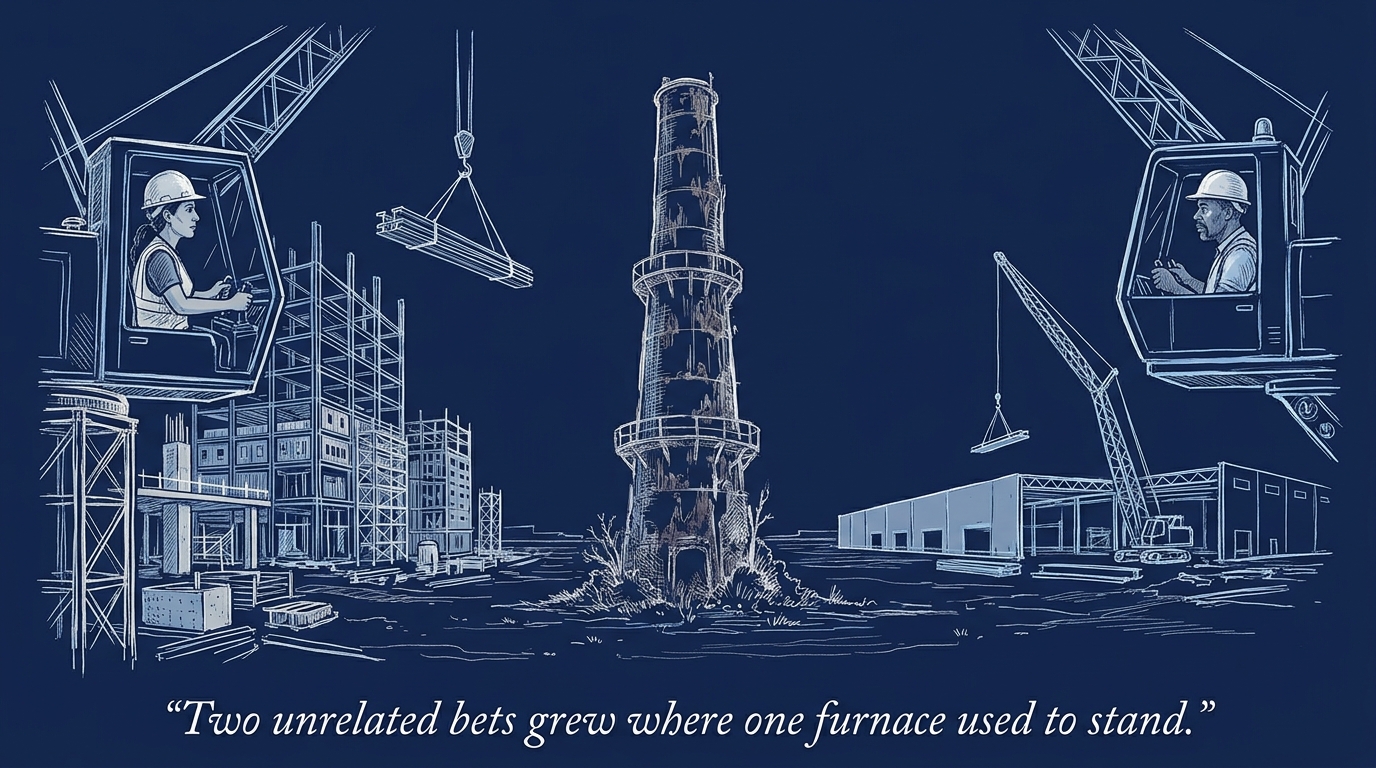
Bethlehem Steel ran its flagship plant in the Lehigh Valley for more than a century, and at its peak during World War II it employed 31,000 people there -- making it, for a stretch, the 14th-largest corporation in America.[1] The company began suspending steelmaking in Bethlehem in 1982 after a $1.5 billion loss, shut down its last blast furnace in 1995, and filed for bankruptcy in 2001 -- unable to compete with mini-mills running modern electric furnaces, and carrying a pension obligation it could no longer fund.[1] For a hundred years, if you asked what the Lehigh Valley made, the answer was steel. After 1995, that answer simply stopped being true, and nothing stepped in right away to replace it.
Most single-anchor industrial towns get one shot at a second act -- a new plant on the old ground, a single company or investor who decides to bet big. The Lehigh Valley got two entirely separate ones, running at the same time, neither one built to replace the other.
The first is healthcare. St. Luke's University Health Network, headquartered in Bethlehem, now runs 16 hospital campuses and more than 350 outpatient sites, employs over 23,000 people, and reports annual net revenue above $4.5 billion -- making it, on its own, the Lehigh Valley's single biggest employer.[2] A few miles away in Allentown, Lehigh Valley Health Network built a rival system of comparable scale: 20,000 employees and $4.1 billion in revenue as an independent network through 2023.[3] Two competing, homegrown hospital systems, each built up almost entirely after the steel era ended, together employed more people than Bethlehem Steel did at its absolute wartime peak -- without ever operating as one company, or coordinating the buildout between them.
The second is logistics, and it has nothing to do with healthcare at all. The Lehigh Valley sits at the intersection of I-78 and the Pennsylvania Turnpike, within about 90 minutes of both New York City and Philadelphia -- and warehouse developers noticed. The region has added three to five million square feet of warehouse space a year since 2014.[4] Amazon alone now holds 2.2 million square feet of fulfillment space in the Valley, including a 1.1-million-square-foot building in Palmer Township; Walmart holds a comparable 2.2 million square feet of its own.[4] None of that required steel, or healthcare, or a single anchor decision-maker -- it required an interstate interchange and open land, and it built an entire second economy on top of the first two.
In August 2024, Lehigh Valley Health Network stopped being an independent, Lehigh-Valley-run system at all: it completed a $14 billion merger with Philadelphia-based Jefferson Health, folding into a combined 32-hospital system with 62,000 employees, now Pennsylvania's second-largest nonprofit health system behind UPMC.[3] LVHN's own name survives locally, but the decisions now run through Jefferson's Philadelphia leadership -- the same basic pattern the region lived through once already with steel: a homegrown institution built by and for the Valley, eventually absorbed into a larger outside structure. St. Luke's, so far, has stayed independent.
It's worth naming what the Lehigh Valley's version of this story is not. It isn't Youngstown's, where a single foreign-owned pipe mill eventually reoccupied a fraction of the old steel footprint, making the same product on the same ground with a fraction of the jobs. It isn't Detroit's, where one private investor concentrated a $7.5 billion bet into a single downtown portfolio. And it isn't Newark's, where five public institutions coordinated a slow, deliberate rebuild over five decades. The Lehigh Valley's recovery wasn't planned as a recovery at all -- it's two unrelated private bets (hospital competition, warehouse geography) that happened to land in the same place, at the same time, for reasons that had nothing to do with each other or with steel.
Why does this matter? The instinct, watching a company town lose its anchor, is to ask what replaces it -- as if there's one answer coming. The Lehigh Valley's real answer is that recovery doesn't have to be a single bet, public or private, concentrated or distributed. It can also just be an accumulation: two hospital systems competing for the same patients, and a logistics industry that showed up because of a highway interchange, neither one aware it was "replacing" anything. The region ended up with more total employment across healthcare and logistics than steel ever provided at its peak -- but no one planned that outcome, and no single actor can claim credit for it the way Dan Gilbert can in Detroit or five university presidents can in Newark.