 Oluwadi
Investigating the Overlooked
Region
What
Who For
Analysis
Oluwadi
Investigating the Overlooked
Between 1949 and 1967, Newark's government agencies and universities spent hundreds of millions of dollars demolishing what city planners called "slums." At least 10,000 buildings across 2,500 acres came down, displacing an estimated 50,000 people -- 65 percent of them Black or Hispanic. Two projects inside that broader era did the most direct damage to the Central Ward, Newark's most densely populated Black neighborhood, and both were still in motion when the city rioted.[1]
Around 1960, Route 280 was carved through Newark's Central and North Wards, with Route 78 cutting south through the Weequahic neighborhood a few years later. Clearing the path for both highways displaced at least 5,000 residents and closed hundreds of small businesses, on top of hundreds more homes demolished outright. The 1956 federal Interstate Highway Act covered up to 90 percent of the land-clearance and construction costs -- Washington paid for most of it, Newark's own residents absorbed the loss.[2]
In early 1967, Mayor Hugh Addonizio's administration announced a plan to raze a 150-acre site in the Central Ward for a new medical and dental complex, what would become the University of Medicine and Dentistry of New Jersey. Estimates of the displacement ran as high as 20,000 residents, nearly all Black or Puerto Rican, in a neighborhood already thinned by the highway. Community complaints about the plan, led by resident Louise Epperson, went nowhere with the city for months.[3]
On July 12, 1967, police officers John DeSimone and Vito Pontrelli beat and arrested a Black cab driver, John Weerd Smith, over a minor traffic stop. A rumor spread that he had died in custody. What followed was five days of uprising -- the proximate trigger was that single beating, but it landed on a neighborhood already carrying two separate, unresolved government projects that had spent years taking its ground out from under it.[4]
Louise Epperson's objections to the medical school plan had gone unanswered for months before the riot. Once the uprising made national news, city officials who had ignored her now needed her cooperation to help calm the neighborhood -- and in the negotiations that followed, the medical school's footprint was cut from the original 150 acres down to roughly 60. It is the one piece of this entire era where a named resident's sustained objection actually changed the outcome, and it took five days of citywide rebellion before anyone with power was willing to listen to her.[5]
It traces back to the fact that the medical school fight left behind a genuine cluster, not one isolated winner. The neighborhood the fight was fought over is now formally named University Heights, home to five institutions inside a compact, walkable footprint: Rutgers University-Newark, NJIT, the medical school itself (New Jersey Medical School, now part of Rutgers Biomedical and Health Sciences), Rutgers Law School, and Essex County College, roughly half a mile from the others -- about 30,000 students total, close enough that the same relationship MIT and Harvard have across Cambridge, Massachusetts runs here across twenty blocks instead of a river. Four of the five public institutions formalized that cooperation directly: the Council for Higher Education in Newark was founded in 1971, just four years after the riot, specifically to coordinate them.[10]
The cross-pollination shows up concretely in what each institution built next to the others. NJIT had been offering a master's degree in biomedical engineering, an interdisciplinary program, since the early 1990s -- engineering research built specifically alongside the medical school next door, each institution's presence making the other more useful than either would have been alone. That program became a full standalone department in the fall of 2000, adding bachelor's and doctoral degrees, and has since grown into one of the largest producers of biomedical engineering master's degrees in the country -- an engineering pipeline that exists at that scale specifically because a teaching hospital sits within walking distance to draw on it. In 1988, NJIT had also opened its Enterprise Development Center on the same campus -- now rebranded VentureLink, it became the oldest and largest business incubator in New Jersey, today home to more than 90 high-tech and life-science companies, the same life-sciences focus that makes sense specifically because a teaching hospital and a biomedical engineering department already anchor the same few blocks.[8][9]
The rest of the cluster's institutions took longer to formalize their own role. Starting around 2015, Newark's largest anchor institutions, including Rutgers University-Newark, Rutgers Biomedical and Health Sciences (UMDNJ's successor after a 2013 merger), and NJIT, launched Newark 2020, a coordinated push to hire 2,020 city residents by 2020 and grow local-business procurement that stood at just 3 percent of anchor institution spending in 2013. Rutgers-Newark and RBHS together committed to 220 of those local hires; a companion five-week training program, Hire Newark, run with RWJBarnabas Health, kept 34 of its first 36 graduates in steady jobs. Rutgers Business School's Ascend Newark initiative has since built on the same premise, helping Black- and Latino-owned Newark businesses win more contracts with the anchor institutions around them.[6]
The clearest single marker of the shift: on October 23, 2025, Rutgers Health and University Hospital broke ground on a multiyear redevelopment of the same Newark medical campus -- a new administrative building, expanded outpatient clinical space, and eventually a new medical office building and patient tower, planned this time as what Governor Phil Murphy called "years of community-centered planning" rather than a plan announced to the neighborhood after the fact.[7]
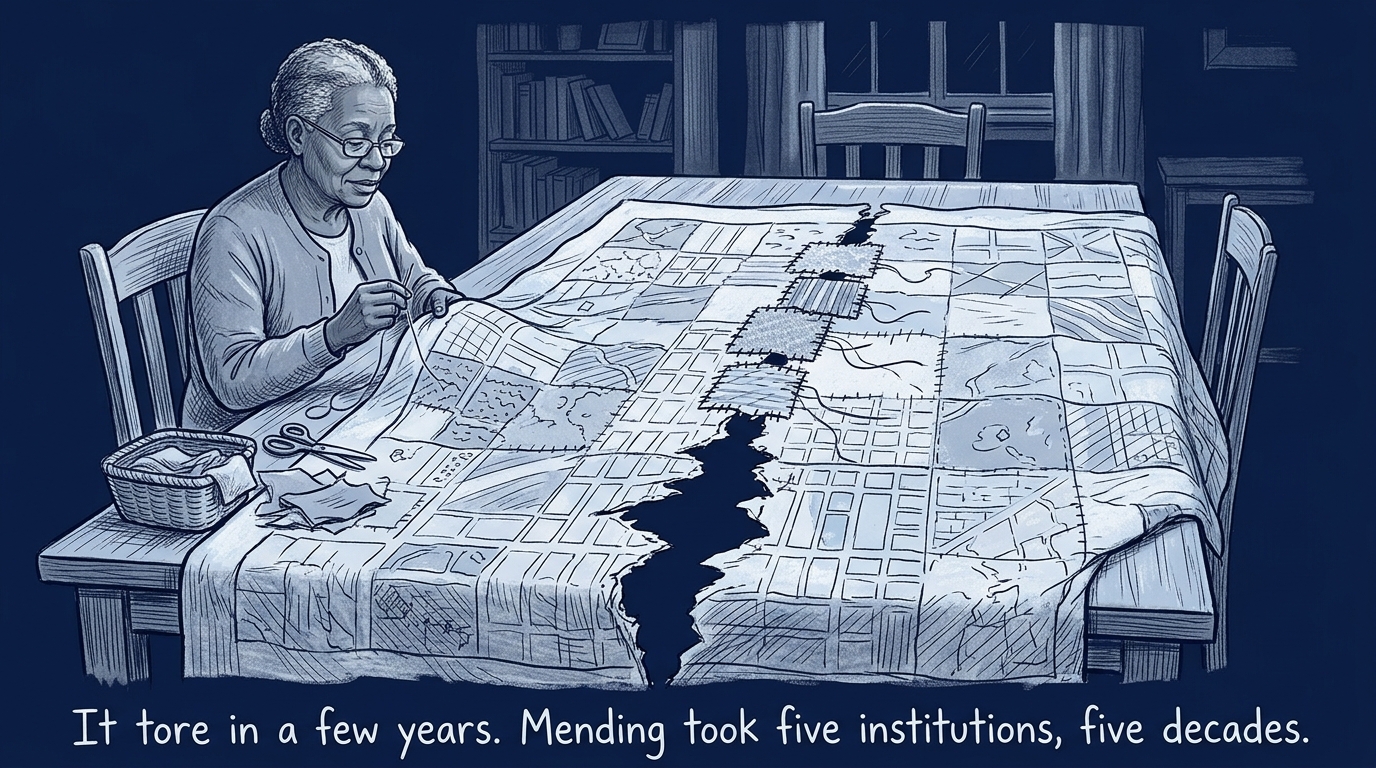
Newark's recovery took coordination -- five institutions, formally organized since 1971, compounding in pieces across five decades. The Lehigh Valley's own recovery from Bethlehem Steel's 1995 collapse ran the opposite way: two entirely separate private bets, hospital-system rivalry and warehouse logistics, that landed in the same place without either one coordinating with the other, or with anyone.
Both original projects ran on the same institutional logic: a highway authority and a mayor's administration each decided the Central Ward's existing ground was worth less than what could replace it, without the neighborhood's own consent. The institutions that grew out of those decisions have since become real anchors for the neighborhood they were carved from, and they did it together, not separately -- the University Heights cluster compounding across five decades rather than any one campus turning itself around alone. Neither the damage nor the repair arrived all at once. The highway, the medical school plan, and the riot itself all landed inside a few compressed years, which is exactly why they read as a single, sharp story -- decay concentrated enough to see happening. The repair ran on the opposite rhythm: real, but spread across four decades and three separate institutional decisions, none loud enough on its own to register as a turning point. Both are the same kind of process, arriving in spurts rather than continuously. One kind of spurt is just far easier to notice than the other while it's happening.