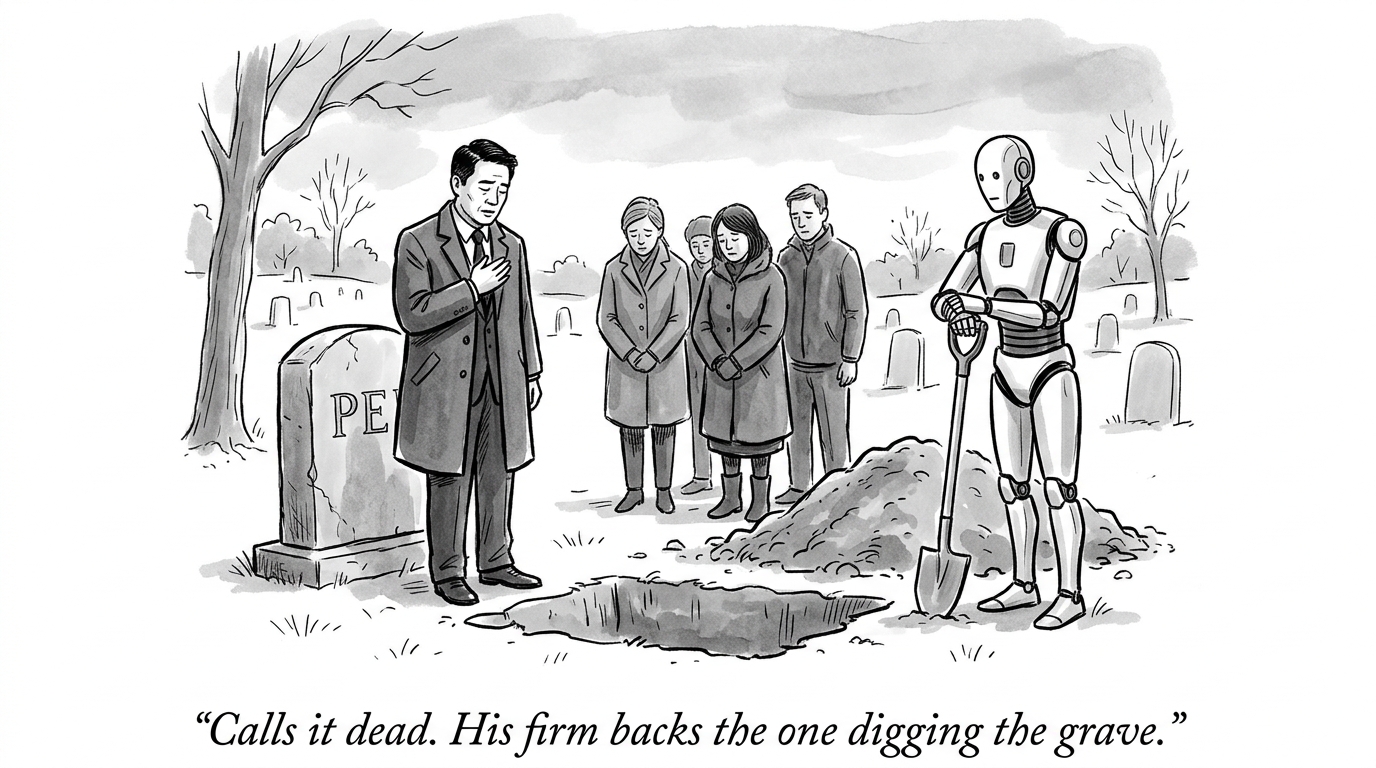
Isaac Kim spent twenty years buying and restructuring software companies, most recently as a senior managing director at Elliott Investment Management, before Lightspeed Venture Partners brought him on in 2024 specifically to build a technology buyout practice the firm had never run before. In February 2026, on Lightspeed's own account, he said the business he'd spent two decades running no longer works: "Technology private equity, in its current form, is dead."[1]
The argument, in his own words
"I started in software private equity when we would lever the businesses, take a bunch of costs out, and hope and pray that the multiples would go up when you sell. That paradigm has shifted completely because of AI and the disruption risk." The old model depended on one assumption holding steady long enough for the financial engineering to pay off: that the underlying product would stay relevant. AI broke that assumption directly -- AI-native companies are now reaching $100 million in revenue in 12 to 24 months, a climb that traditionally took a software company about a decade.[1]
He hasn't backed off the claim. In a piece published September 10, 2026, Kim went further: software investors are underestimating the coming damage, and many are quietly rewriting their own investment narratives to justify staying in companies that are visibly being disrupted by AI tools right now, not someday.[2] The distress is already showing up in real prices, not just commentary -- outsourcing firms KronosNet and Foundever have seen their debt trade at distressed levels amid AI-driven scrutiny, and bond prices on software names including McAfee and ION Platform Investment Group have fallen with them.[2]
The same firm making this argument has one of the largest financial positions anywhere in the company doing the actual killing. Lightspeed wired over a billion dollars into Anthropic's Series E, the majority of that round's first close, making it Anthropic's largest venture backer -- Bloomberg reported the firm's combined stake, across that round and additional purchases since, at roughly two billion dollars, and Lightspeed has continued adding to the position.[3] Anthropic's own Claude Code is one of the specific "vibe-coding" tools reportedly driving the disruption Kim is describing -- letting people with no programming background build working software directly, undermining the rigid, license-seat economics traditional SaaS and the buyout funds built on top of it depend on.[2]
Why does this matter? This isn't a hedge fund manager shorting a sector he has no stake in. It's a senior dealmaker, twenty years into exactly this business, telling the market plainly that his own asset class is finished -- while the fund employing him holds one of the largest positions on earth in the specific company doing the finishing. That's not a contradiction to explain away. It's the actual, coherent position: Lightspeed isn't betting against AI's disruption of software. It bet on the disruption directly, at the source, and Kim's public diagnosis of the wreckage downstream is the same bet, read from the other end.
The paradox in this piece just got bigger, not resolved
On August 12, 2026, Bloomberg reported that Lightspeed is seeking roughly $600 million in a secondary process the firm is calling Project Mercury: moving stakes in OpenAI and four other holdings -- Verkada, Rippling, Reflection AI, and Glean -- out of its Select V and Opportunity II funds and into a continuation vehicle, with UBS advising and Coller Capital as lead buyer. The same transaction adds a new commitment to Anthropic, not simply an extension of an old one.[4][5]
Lightspeed isn't trimming its Anthropic exposure to fund a hedge elsewhere in software. It's using a continuation fund -- a structure that exists specifically to let a VC firm hold a winning position longer while giving its original backers an exit -- to put fresh money into the same company, on top of the roughly two billion dollars Bloomberg had already reported the firm held.[3] The dealmaker who called tech PE dead works for a firm that, four months after that quote, chose to extend its bet on the company doing the killing rather than reduce it.
The scale of what Lightspeed is riding on has a real number now, and it's larger than any single VC bet in the industry's history. The Information calculated Anthropic's total compute commitments -- across cloud deals, chip capacity, data-center leases, and long-duration infrastructure agreements signed since October 2025 -- at up to $517 billion over 14.8 gigawatts of capacity, an estimate compiled over the same eleven months Lightspeed has been adding to its position. Google and AWS combine for 11 of those gigawatts; Microsoft Azure separately picked up a $30 billion, 1-gigawatt contract. None of it is a disclosed Anthropic budget or a same-day liability -- it's an upper-bound estimate built from contracts that phase in over years, some running past 2030.[6]
Read against Kim's own thesis, the number cuts in an uncomfortable direction: the AI-native economics he says are killing traditional software PE require exactly this kind of compute buildout to keep working. Lightspeed isn't just holding equity in the company disrupting the old model -- it's a backer of a company whose own committed infrastructure spend, alone, now rivals the market value of most of the buyout targets that model used to price.
 Oluwadi