 Oluwadi
Investigating the Overlooked
Region
What
Who For
Analysis
Oluwadi
Investigating the Overlooked
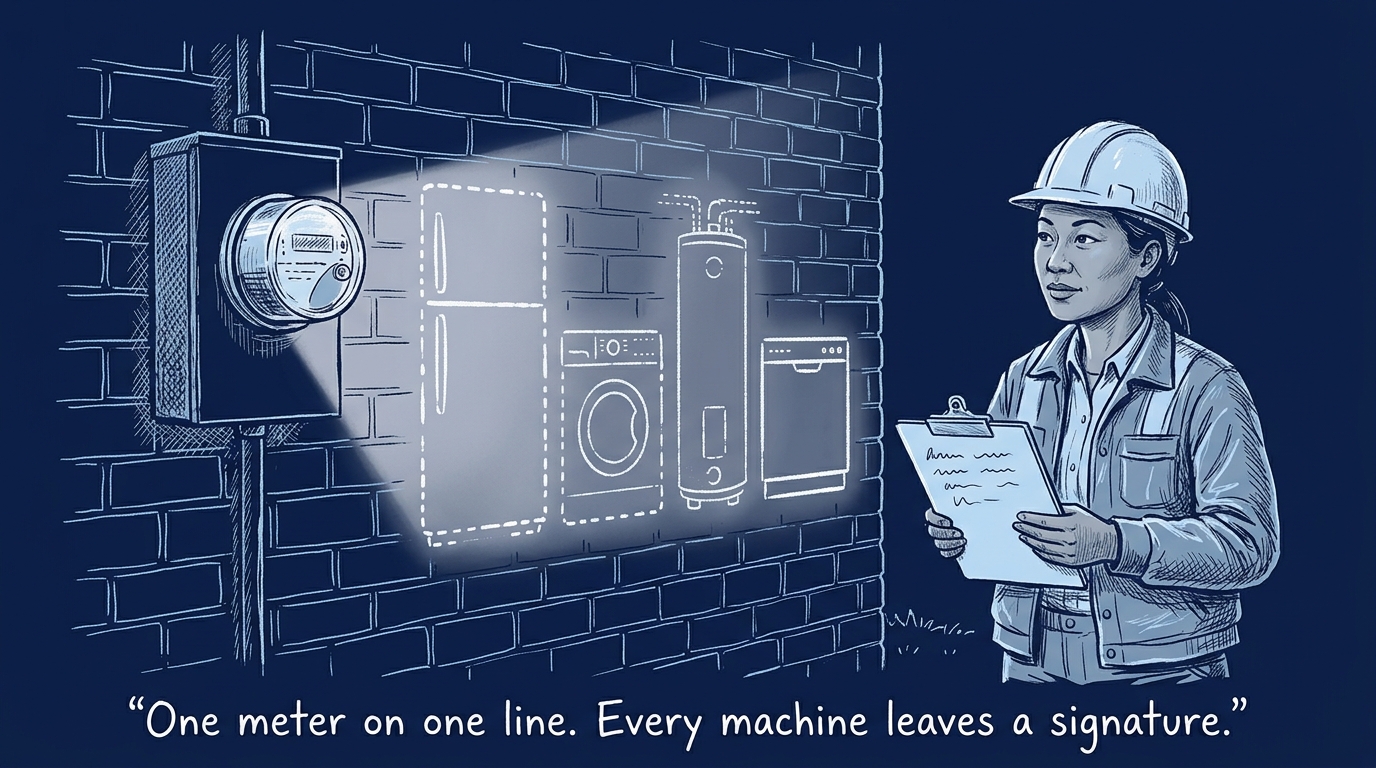
A single meter on a single power line, watching nothing but voltage and current, can reveal what's happening deep inside a building without anyone ever seeing the equipment itself. The technique is called Non-Intrusive Load Monitoring, and it didn't come out of intelligence work at all -- it was developed at MIT in the early 1980s by George Hart, Ed Kern, and Fred Schweppe, funded by the Electric Power Research Institute, for a mundane utility-research purpose: understanding residential energy use without installing a meter on every individual appliance in a house.[1] Hart's own early technical reports, in 1984 and then 1985, formalized what he called the Nonintrusive Appliance Load Data Acquisition Method; his 1992 paper systematically established the field.[1]
The method works by watching a home's or building's total electrical draw at a single point -- one digital monitor on the incoming line -- and looking for the specific voltage and current changes each appliance makes when it turns on, turns off, or shifts state. A refrigerator compressor, a water heater, a washing machine motor each leave a distinct, repeatable signature in the aggregate load, identifiable through cluster analysis without ever opening a wall or attaching a sensor to the device itself.[1] The insight scales far beyond a house: any facility running enough distinct, power-hungry equipment leaves a composite signature in its own electrical draw, whether the people running it want that visible or not.
Nuclear nonproliferation monitoring uses a version of the identical logic, formally, as one tool among several. Gas centrifuge enrichment plants draw a large, distinctive, and remarkably steady electrical load that scales directly with how many centrifuges are actually spinning. International Atomic Energy Agency safeguards inspectors track a declared enrichment facility's average power consumption over the period between material shipments, and use that figure -- alongside physical inspection, material accountancy, and other measurements -- as a basis for estimating the facility's actual separative work output, expressed in metric-ton-separative-work-units per day.[2] It's a genuinely different kind of signal from either of the two disciplines already covered on this site: Trusted Foundry asks who built a specific chip, and TEMPEST asks whether a specific finished device leaks its own signal through the air. Load-signature analysis doesn't care about any single chip or device at all -- it reads an entire facility's aggregate electrical behavior, over the power line itself, from a single point outside the building.
Why does this matter? The same technique that tells a utility a house's dishwasher just started a cycle, developed for reasons that had nothing to do with security, turns out to be a real, standing tool for inferring what a facility is doing at scale -- without needing access to a single piece of the equipment inside it. Trust, in the cluster of ideas this site has been building, isn't one property checked once at one point. It's fabrication trust before a device exists, emissions trust once it's built and running, and now a third kind entirely: aggregate trust, read off the electrical signature of an entire operation from outside its walls. None of the three requires the other two to hold, and none of them is sufficient by itself.