 Oluwadi
Investigating the Overlooked
Region
What
Who For
Analysis
Oluwadi
Investigating the Overlooked
A machine shop owner in Sterling Heights, Michigan, whom the authors call Dan, has four- and five-axis mills registered for defense work. For a long time he did not win any. A request for a quote reached him the way it reaches most shops: a zip file of forty drawings, with military specifications dated 2009. He read all forty to find the three his machines could make, and he wrote the quote at night, because in the daytime he is also the salesperson, the compliance officer and the person running the five-axis. By the authors' account, shops land about a third of what they quote, so most of those nights bought nothing.[1]
Nothing about his machines changed. What changed, the authors say, is that a layer of software and people began finding the work, quoting it and qualifying him, so the work reached him. Today his machines cut parts for satellite startups and fast-growing defense companies.[1]
That is the claim worth examining. The capacity was not missing. The route to it was. These places exist, and some of them are hard to find.
The scale is large and the sources do not agree on it. The essay says the United States has 16,876 machine shops, 83% of them with fewer than 20 employees, and that the average machine runs about a quarter of the time.[1] I could not trace those three numbers to a published original. Other sources give other counts. A 2024 report by Contrary Research says the defense industrial base depends on thousands of small shops representing more than $60 billion of spend, with an average operator age of 63.[2] In a 2022 interview, the CEO of Hadrian, a company that builds automated factories, put domestic outsourcing of high-precision components at about $50 billion a year across roughly 4,000 small shops, with an average owner age of 62.[3] An industry profile counts about 18,000 machine shop establishments with combined revenue of about $37 billion; no major company dominates, and the 50 largest generate about 10% of revenue.[4] These figures appear to count different things, and none of them is a measure of idle time. What they share is the shape: many small owners, an aging workforce, and no one in charge of the whole.
The authors also sell the fix. Stephen Rodriguez is an operating partner at the venture firm DCVC and an investor in defense and supply chain companies. Adar Hay is the chief executive of Jiga, which coordinates manufacturing across a network of U.S. suppliers.[1] "The problem is the layer in between" is also what a company that sells the layer would say. That does not make it wrong. It means the evidence has to be the part that survives without them: the forty drawings, the night spent writing the quote, the one-in-three win rate, and the paperwork that starts over with each new customer, each a different format.[1] Anyone who has run a small shop can check those against their own week.
Put software in front of a network and a factory floor. Protolabs sells machined parts, molded parts, printed parts and sheet metal. Its site promises design-for-manufacturing feedback and real-time pricing within a few hours, and some machined parts in as little as one day.[5] It does this with two businesses at once. In 2025 its own factories produced $416.9 million of revenue, and its partner network of outside manufacturers produced $116.2 million.[6] The company that has sold quote-by-software the longest still earns most of its money from machines it owns.
Own the metal. Protocase, in Sydney, Nova Scotia, describes itself as a custom manufacturer of sheet-metal enclosure parts and CNC components, in business since 2001, specializing in one-off custom work for scientists, engineers and innovators.[7] Its history runs through an open design. Backblaze, the backup company, built a wooden prototype of a storage chassis in its kitchen and asked Protocase to make it real. Protocase built it in cold-rolled steel, and Backblaze published the design as open source and pointed buyers to Protocase.[7] By Backblaze's own account, Protocase built the first three generations of what it called Storage Pods.[8] Protocase then forked the design for a general-purpose product, with redundant power supplies and direct-wired drives, and its subsidiary 45Drives sells it as the Storinator.[7] A small sheet-metal shop took a design it did not own and turned it into a product, and the quote was not the barrier because the shop was making the part itself.
In 2024, Protocase selected Wilmington, North Carolina for its first U.S. expansion. Company officials said the move would let it serve American customers better and make it easier to work in aerospace and defense, which can require certain clearances.[9] It started production in a 12,000-square-foot facility there in February 2025, beginning with sub-assembly for 45Drives.[10] By mid-July 2026 it had about 85 people in the Wilmington area and had added a laser cutter, so it could cut full sheets of metal there instead of shipping cut pieces from Canada, and it was preparing to lease 30,000 more square feet for machining. Co-founder Doug Milburn told the local business paper, "All of our growth in the near future will be focused here."[11] My own opinion is that they opened it to avoid the tariffs, since the storage server I bought from them came from Canada. That is my view, not something the company has said.
Replace the mold with the file. Slant3D, which I wrote about in the Boise and Micron piece, runs a farm it calls the MegaFarm: 2,000 printers in a former locomotive building, with no tooling and, by its own published math, a break-even against injection molding around 100,000 units.[12] Slant3D thinks of itself as a manufacturer: its founder told TCT Magazine in 2020, "We are an industrial production facility."[13] It still takes orders through an online quote system, where engineers review each model with the customer before it joins a production run.[13] Even the company that removed the mold has not removed the quote.
The federal government has its own answer to small size: the set-aside, a contract open only to small businesses or to a named group of them. In fiscal 2025, about 214,000 federal contract awards carried a set-aside code, worth $58.7 billion obligated, roughly 7.5% of all federal contract dollars in the same data.[14] That is a subset of what the Small Business Administration counts as small-business wins: its scorecard puts small businesses at nearly 28% of prime federal contract dollars, about $179 billion, most of it won in open competition.[15]
Narrow it to machine shops and the number is small. Awards classified under the machine shop industry code came to 1,479 in fiscal 2025, worth $75.7 million. Of those, 459 carried a set-aside code, worth $22.7 million.[14] That counts only awards where the buyer classified the work as machine shop work. Machining is also bought under other codes, such as aircraft and ordnance parts, and through subcontracts that prime-contract data does not show, so it is a floor, not a count of shop work. It fits the essay's point that set-aside targets measure prime contracts and miss the independent shops two tiers down.[1]
Set-asides matter more than their share suggests, because some places live on them. There is an assembly plant near me that hires people on the disability spectrum to assemble parts. I went there once, because I needed something made. As I understand it, the plant depends on government set-asides. If that is right, then for that plant a contract is the difference between those jobs existing and not.
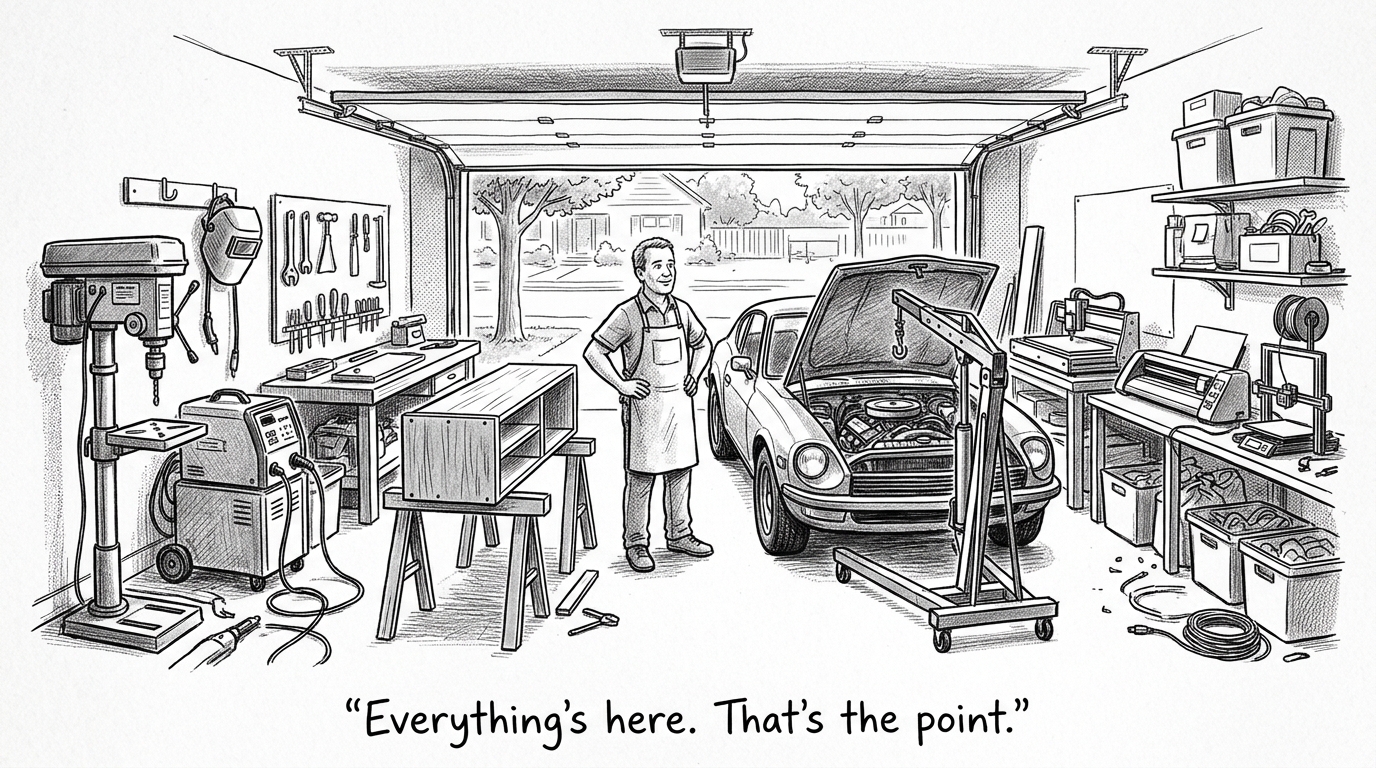
Some of these places are not shops at all. They are garages and spare rooms with the equivalent of a small-scale manufacturing plant inside: a drill press and an arc welder, CNC machines, 3D printers, a vinyl printer, a cousin who can run small batches of shirts at home, a neighbor who can drop an engine out of a Porsche 911 in his home garage. It did not take a search to find any of them. Most of the people who own them are not looking for customers. They are looking for self-sufficiency: to make what they need and fix what breaks without waiting on anyone. Some of that equipment exists to support what the manufacturer no longer does. A maker moves on, and the dishwasher or the soap tray is still in the house, and the part that broke can no longer be bought. A 3D printer can make it. One bought woodworking tools to build a daughter's changing table. That capacity is real, and it sits outside every count of shops, because it never goes through a quote. Small-scale manufacturing is already fully distributed, even in your own backyard.
If the shortage is partly a shortage of quotes, then buying more machines does not fix it, and counting machines does not measure it. The three answers above split the cost differently. Protolabs spreads it across a network and its own floor. Protocase and 45Drives absorb it by owning the shop. Slant3D moves it from tooling to a file. In every case, someone other than the small owner pays for the hour. The authors of the essay propose that the buyer at the top share demand forecasts down the chain, that one qualification count across programs, and that Congress attach forecasting duties to multiyear contracts.[1] Those are proposals, not results.
For a shop owner: write down what you can make, in tolerances and materials, in a form a buyer can match against a drawing before anyone calls. For a buyer: send the three facts a shop needs to say no quickly: the part, the quantity and the date. For anyone funding the layer: ask who pays for it, and what happens to the owner's night. For anyone who needs something made: ask. The person who can make it may be a shop whose name you have never heard, a plant that hires the people the market overlooks, or a neighbor with a garage.