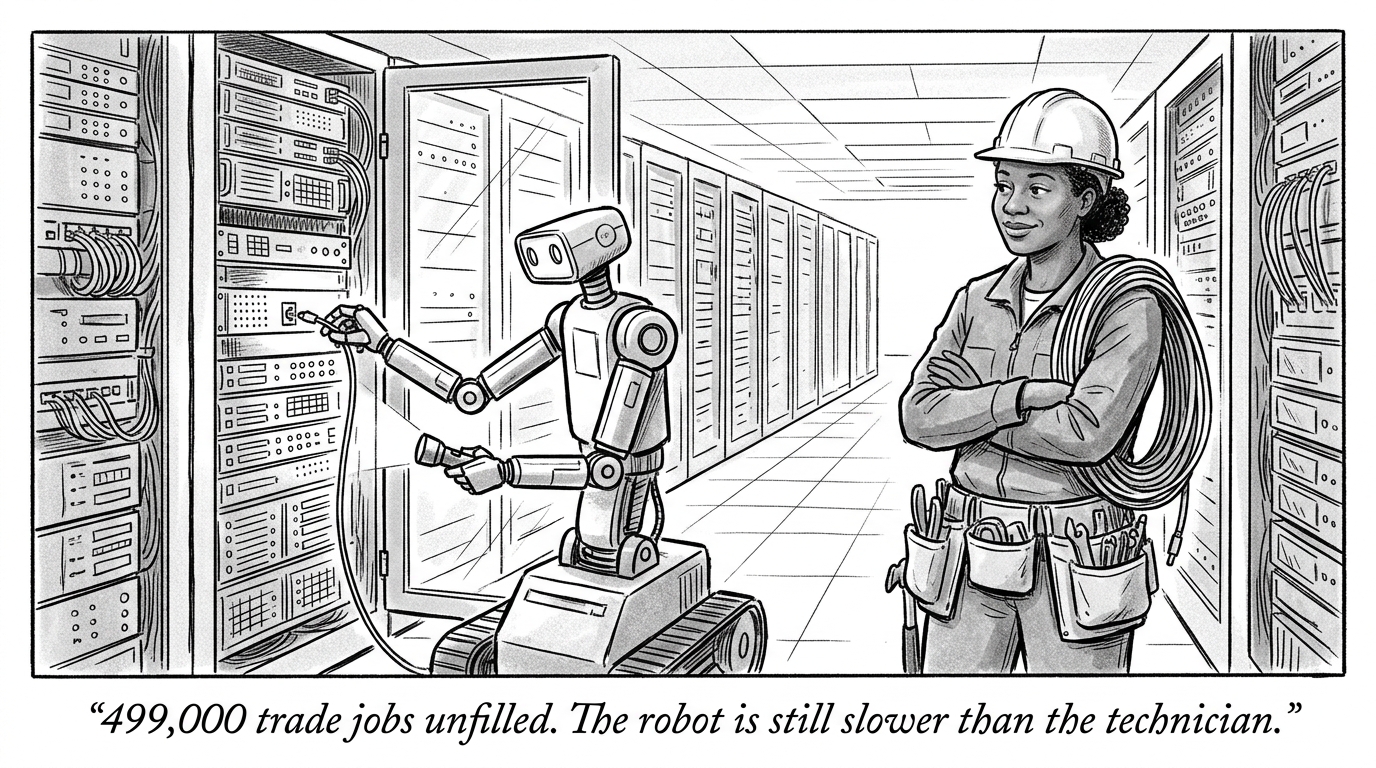
The US data-center construction industry is short an estimated 499,000 skilled-trade workers, with mechanical, electrical, and plumbing trades short in 87 to 90 percent of markets, and 87 percent of operators saying the gap is already affecting operations. Construction labor costs at primary North American data-center sites are rising 8 to 12 percent a year, driven almost entirely by that scarcity.[1] Journeyman electricians and high-voltage commissioning engineers are the hardest single roles to fill; data-center electrician pay has climbed into the $72,000-$150,000 range nationally as a direct result.[1] This is the actual backdrop Meta's robot testing sits inside -- not a company looking for an excuse to cut headcount, but an industry that genuinely cannot hire its way out of the problem.
Meta's actual robots, and how far they actually are from replacing anyone
At its Altoona, Iowa campus, Meta has been testing dual-armed robots from Watney Robotics on cabling work since June 2025 -- the machines remain slower than human technicians and operate under direct supervision.[2] At its newer Prometheus campus in New Albany, Ohio, four-wheeled ABB units with a scissor-lift riser and a six-axis arm handle component-reseating jobs, and Meta has separately evaluated whether a Kinova Gen3 arm can power-cycle a server rack -- cutting and restoring electricity to it -- without a technician touching the breaker.[2] One Meta employee told WIRED that a fully working cable-swap robot could eventually eliminate up to 80 percent of the workload in some roles -- an employee's estimate, not a company-measured result. Meta's own spokesperson has instead framed the effort as addressing the skilled-trades shortage directly, not reducing headcount -- a real, unresolved tension rather than a settled answer either way.[2]
499,000Estimated skilled-trade worker shortfall in US data-center construction
87%Data-center operators reporting workforce gaps already affecting operations
$13.7B → $44.2BGlobal data-center robotics market, 2024 actual to 2030 projected
This isn't a Meta story. It's an industry one.
Google demonstrated mobile data-center robots handling materials and monitoring at its 2024 Open Compute Summit. Microsoft Research has been detailing prototype maintenance robots aimed at what it calls "self-maintaining systems." Industry trade coverage expects Meta, Microsoft, Google, and Amazon to each name at least one additional robotics vendor partnership before the end of 2026, with pilots moving from single campuses to two or three sites apiece.[3] The global data-center robotics market was valued at $13.7 billion in 2024 and is projected to reach $44.2 billion by 2030 -- a 21.6% compound annual growth rate.[4] Four of the largest data-center operators in the world testing physical-labor robots in the same eighteen-month window, against the identical labor shortage, isn't a coincidence. It's the same structural pressure landing on every company that runs data centers at scale, at once.
The actual bottleneck isn't the robot arm. It's who can operate it.
On September 8, 2026, the speaker company Sonos opened its entire product line to external AI control through a feature called 27mcp -- hosting its own server built on the Model Context Protocol (MCP), so that any MCP-compatible AI client (ChatGPT, Gemini, Grok, or anything else a user authorizes) can identify devices, start music, move playback between rooms, and control the system directly, without Sonos having to build a custom integration for each AI assistant one at a time.[5] That is a consumer-hardware preview of the exact problem slowing down every data-center robotics pilot described above: each vendor's robot -- Watney's, ABB's, Kinova's -- currently needs its own bespoke software integration to do anything at all, which is slow, expensive, and has to be rebuilt for every new robot a data center adds.
Anthropic's Model Hardware Standard, announced August 27, 2026 -- twelve days before Sonos's own announcement -- is the direct industrial answer to that exact problem. MHS extends MCP from software tools to physical machines: a shared specification letting an AI agent read sensors, write to actuators, and safely operate equipment like robotic arms, with built-in safety limits (blocking a collision before it happens, halting on an anomaly) and automatic network discovery of what hardware is even present. It is a research preview today, built with HHMI Janelia Research Campus, with Anthropic planning to open-source the full specification.[6][7] Data-center robotics today runs on fragmented, vendor-specific control layers -- the same shape of problem ROS 2 and OPC-UA have only partially solved for industrial robotics generally. A standard that lets one AI agent operate any vendor's robot, the way 27mcp now lets any AI assistant operate any Sonos speaker, is what would actually let Meta's slow, supervised pilots become something that scales past a single campus.
Why does this matter? The robot arm is not actually the hard part of this story, and framing it as "will robots take data-center jobs" misses what's really being built. The hard part, structurally, is the same one Sonos just solved for a living room: getting an AI system to operate physical equipment it wasn't custom-built to control. A 499,000-worker shortfall is real and already raising costs today; a robot that's still slower than the technician it might replace is not yet a solution to it. What would actually close that gap is the boring infrastructure layer -- a standard control protocol -- not a better arm. Consumer electronics got there first. Data centers, running the same underlying shortage at a much larger scale, are the more consequential place to watch it land next.
 Oluwadi