 Oluwadi
Investigating the Overlooked
Region
What
Who For
Analysis
Oluwadi
Investigating the Overlooked
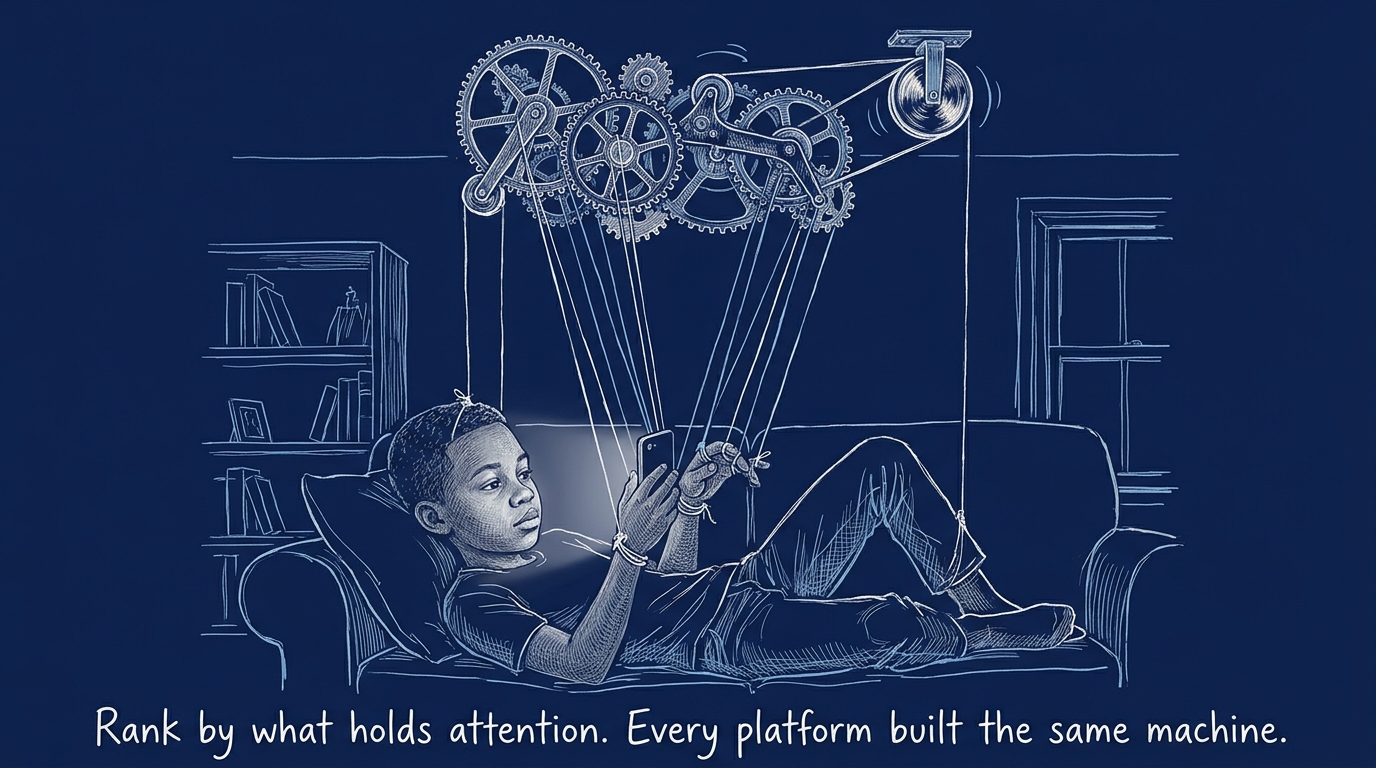
Meta's $16.68 billion settlement, disclosed in a court filing on August 26, 2026, resolves allegations from 29 states that the company engineered Facebook and Instagram to be addictive to children, misled the public about platform safety, and unlawfully harvested minors' data.[1] It is the largest child-safety settlement in social-media history. It is also, on its own, a story about one company. The mechanism the states put on trial -- rank content by whatever keeps a person watching, let engagement decide what gets seen -- is not something Meta invented alone, and it did not stay inside Meta.
Meta's own internal research is where the mechanism first surfaces on the record. In 2018, the company rewrote its News Feed ranking around what it called Meaningful Social Interactions -- weighting posts that drew comments and reshares far more heavily than ones people simply read. Internal researchers found the change did what it was built to do: it increased engagement. It also, they found, systematically rewarded outrage, misinformation, and divisive content, because those were the posts most likely to get a reaction. Mark Zuckerberg was presented with proposed fixes and resisted them over concern they would cost the company engagement.[2] None of this reached the public because a whistleblower chose to make it public. Frances Haugen, a former Facebook product manager, testified before the Senate on October 5, 2021, and provided the internal documents that put the company's own findings into the congressional record.[3]
Section 230 of the Communications Decency Act is the reason this mechanism went almost entirely unlitigated for nearly three decades. Passed in 1996 to shield platforms from liability for hosting third-party content, courts have since read it broadly enough to cover a platform's own algorithmic choices about what to rank and amplify -- meaning a lawsuit arguing that a ranking algorithm itself caused harm has historically run straight into that immunity.[4] The 29 states never made that argument against Meta. They won on a narrower, older statute instead: the Children's Online Privacy Protection Act, which since 1998 has required platforms to get verifiable parental consent before collecting personal data from a child under 13. That's a data-collection violation, not a publishing or curation decision -- and it sits outside Section 230's reach entirely.[5] The settlement isn't a ruling that engagement-ranking is illegal. It's a maneuver around the one law that has kept the ranking decision itself from ever being tested directly in court.
What Meta's engineers found in their own data matches what independent researchers found studying a different platform entirely. A 2018 study in Science, analyzing roughly 126,000 fact-checked news cascades on Twitter over eleven years, found false stories reached 1,500 people six times faster than true ones and were about 70 percent more likely to be retweeted -- across every category of content the researchers tested. The mechanism wasn't bots; the researchers explicitly tested for and ruled that out. It was novelty: false stories were simply more surprising, and people reward surprising content with attention.[6] Two platforms, two unrelated research efforts, the same underlying finding: when a feed is ranked by what earns a reaction, outrage and novelty are structurally favored over accuracy and calm -- not because any one engineer wanted that outcome, but because that is what the ranking function optimizes for.
X shows what happens when that same mechanism is run deliberately rather than discovered by accident. In February 2023, after Elon Musk's own Super Bowl tweet drew a fraction of the engagement of a competing post, he directed engineers to alter the platform's algorithm to artificially boost his tweets by a factor of roughly 1,000 -- a change made within hours, by dozens of engineers, at his direct instruction.[7] That is the Meaningful-Social-Interactions mechanism turned into an explicit lever rather than an emergent side effect. A subsequent peer-reviewed study found hate speech on the platform increased substantially after Musk's acquisition, with no corresponding drop in inauthentic account activity -- an academic finding independent of the advocacy-group reports that first drew Musk's legal challenge.[8] The mechanism didn't change when the ownership and the politics did. That's the part worth sitting with: this isn't a story about one executive's choices. It's a story about what a platform's ranking function does by default, regardless of who's running it.
The harm to the country, not just to individual users, is also already a matter of official record -- twice over. The Senate Select Committee on Intelligence's bipartisan 2019 report found that Russia's Internet Research Agency used Facebook, Instagram, Twitter, and YouTube -- the same engagement-ranked feeds -- to run a coordinated influence operation against the 2016 U.S. election, using fake American personas and targeted content to reach tens of millions of U.S. users.[9] And in January 2025, the Supreme Court unanimously upheld the federal law forcing TikTok's divestiture from ByteDance, on national-security grounds tied directly to the platform's capacity for covert content manipulation through its recommendation algorithm.[10] A bipartisan congressional committee and a unanimous Supreme Court have now separately treated a recommendation algorithm itself as a national-security-relevant instrument -- not a metaphor, an official finding.
Not every claim about algorithmic harm holds up under scrutiny, and a site that only cites the dramatic version isn't being honest about the mechanism. The early, influential argument that YouTube's recommendation engine was a radicalization pipeline -- most associated with a widely-read 2018 op-ed -- has been substantially complicated by more rigorous, later research: a 2021 study analyzing over 300,000 real users' browsing histories found most people who consumed extremist content on YouTube reached it through direct navigation or outside links, not the platform's own recommendations.[11] Similarly, Jonathan Haidt's widely-cited case that smartphones and social media caused the rise in teen depression and anxiety has drawn serious pushback from researchers in the field, including a Nature review arguing the underlying evidence is more mixed and correlational than the causal story suggests.[12] The honest version of this piece isn't that every platform harm traces cleanly to an algorithm. It's that the mechanism -- rank by engagement, let outrage and novelty win -- is real, documented at the design level by the companies' own researchers and by independent scientists, and distinct from the harder-to-prove downstream claims layered on top of it.
The infrastructure that made this mechanism possible at national political scale had already been demonstrated once before, in public, with consequences that reached an election. In March 2018, reporting revealed that Cambridge Analytica had harvested the Facebook data of more than 50 million users through a personality-quiz app, without meaningful consent, and used the resulting psychological profiles to target voters for the 2016 Trump campaign.[13] That wasn't a hack. It used the platform's ordinary data-access design as built. The pattern that produced Cambridge Analytica -- an engagement-and-data engine built for advertisers, available to whoever could pay for it -- is the same pattern underneath the settlement Meta just signed.
The mechanism that just cost Meta $16.68 billion isn't a Meta invention -- it's the default output of ranking content by what keeps a person watching, and every major platform built some version of it independently. A foreign intelligence service used it as a weapon against a U.S. election. A platform owner used it to inflate his own reach. A national-security law forced an entire company's algorithm out of foreign hands, and the Supreme Court agreed unanimously that the algorithm itself was the risk. Meta didn't lose in court because a judge ruled the ranking mechanism illegal -- Section 230 has never let that argument get that far. It paid because a 1998 data-privacy statute happened to reach where the newer harm couldn't. The other three platforms are still being sued, in the same consolidated docket, in front of the same judge -- and the mechanism that put Meta there, and the immunity that's kept it from being tested directly everywhere else, haven't gone anywhere.