 Oluwadi
Investigating the Overlooked
Region
What
Who For
Analysis
Oluwadi
Investigating the Overlooked
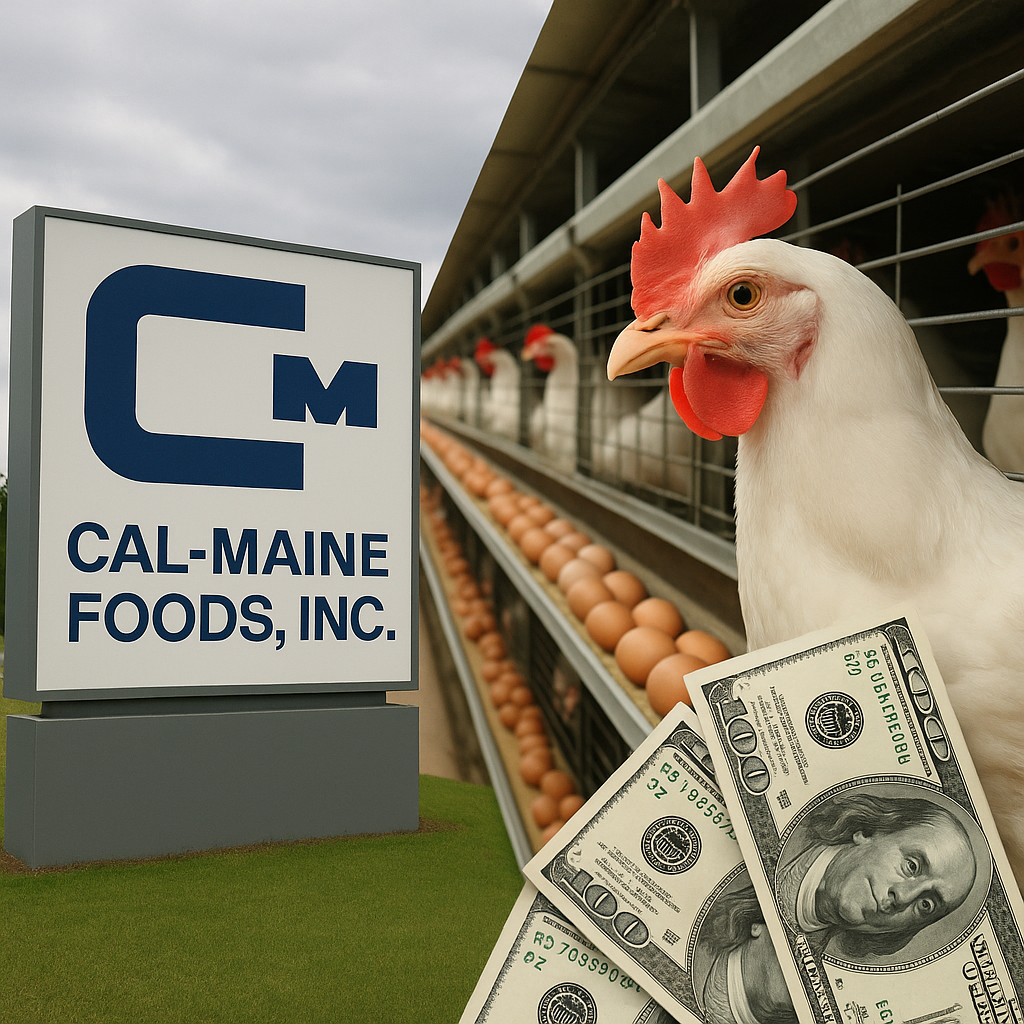
Cal-Maine Foods, headquartered in Ridgeland, Mississippi, made $1.22 billion in net income in its 2025 fiscal year. The year before, it made $277.9 million. Almost none of that 4.4-times jump came from selling more eggs. It came from Americans paying far more for the ones they already bought every week -- and the same industry structure that made the shortage catastrophic instead of contained is the same structure that made a federal price-manipulation case possible in the first place.[1]
Cal-Maine is the largest producer and marketer of shell eggs in the United States, with roughly 50.6 million laying hens as of 2025 -- up from 44.5 million the year before, after acquiring ISE America's flock in mid-2024. That's roughly twice the size of the next-largest producer, Rose Acre Farms. By the company's own account in its FY2025 annual report, the ten largest U.S. egg producers control 57 percent of the country's production capacity in a roughly $16 billion industry.[2] A March 2025 analysis found that 75 percent of all U.S. laying hens now live on just 347 industrial-scale facilities -- Cal-Maine alone operates 43 of them, averaging roughly a million birds apiece.[3]
When highly pathogenic avian influenza reaches a commercial flock, there is no partial response. USDA's own policy is formally called "stamping out": every bird on the affected premises -- not just the infected ones -- gets killed, typically within 24 to 48 hours of a confirmed positive. There is no isolating a wing of a facility. The whole site goes.[4]
Cal-Maine's own experience is the concrete example. In April 2024, a single positive test at its Parmer County, Texas facility triggered the slaughter of roughly 1.6 million laying hens and 337,000 pullets in one event -- about 3.6 percent of the company's entire flock, gone in days, because that one site alone held that many birds.[5][6] Industry-wide, by Cal-Maine's own count in its most recent quarterly filing, the 2025 calendar year alone saw 42.4 million commercial layers and pullets killed because of HPAI nationwide.[5]
That scale is not an accident of the virus. It is a direct function of how the industry is built. USDA's own economists found a clean natural experiment proving it: of the 43.8 million birds killed industry-wide by October 2022, only 2.3 million were broiler chickens -- less than a tenth of one percent of a typical year's broiler slaughter -- specifically because broiler production is spread across many more, smaller, geographically separated operations that largely missed the outbreak's footprint. Layers, concentrated into a small number of million-bird mega-facilities, had nowhere to hide. Same virus, same country, radically different losses -- because of how each industry is structured, not how contagious the disease happened to be in each case.[7]
It isn't only where the birds live that's concentrated. It's what they are. Nearly all commercial egg-laying hens in the U.S. -- and globally -- trace back to breeding programs controlled by essentially two companies, Germany's Erich Wesjohann Group and the Netherlands' Hendrix Genetics, which between them supply an estimated 90 percent of the world's commercial layer genetics.[8] Evolutionary biologists have a name for what that does to disease risk: the "monoculture effect" -- a genetically narrow host population gives a pathogen far fewer walls to run into, the same reason a single crop variety planted across a million acres is more vulnerable to blight than a diverse one.[9] Applying that specific mechanism to the 2022-2025 U.S. egg flock is still an argument being made by journalists and food-system researchers, not yet a settled finding in peer-reviewed poultry epidemiology -- real and worth stating plainly, but a case still being built rather than closed.[10]
Concentration doesn't just explain why the shortage was this severe. It's also what made the next part possible. On June 29, 2026, the Department of Justice and seventeen state attorneys general announced a civil settlement with Cal-Maine, Hickman's Egg Ranch, and Versova (Centrum Valley) -- resolving allegations that the three coordinated bidding activity to manipulate Urner Barry's daily egg price benchmark, the reference price much of the industry uses to set contracts. The window covered: June 2022 through March 2025, the same years, almost to the month, as the HPAI supply shock.[11] A market concentrated enough that a handful of companies can lose tens of millions of birds and still control the majority of national supply is also, mechanically, a market small enough for a handful of companies to coordinate on a shared price benchmark -- fewer players to align, fewer players to watch.
The combined settlement totaled $3.3 million to the participating states plus roughly 53 million eggs donated to food banks. Cal-Maine's individual share was the largest of the three companies: $1.5 million and 30 million eggs. Associate Attorney General Stanley Woodward's statement on the settlement: "No product more quintessentially represents affordability than the price Americans pay for eggs."[12][13]
Cal-Maine's own position is specific and worth stating precisely, not summarized past what it actually says: the company maintains it was "not assessed any fines or penalties" in the settlement, disputes that its conduct "impacted egg prices in any market," and attributes the communications at issue to the actions of a single former employee, not company policy. The settlement itself is a civil resolution, not a criminal conviction or an admission of an antitrust violation -- Cal-Maine did not plead guilty to anything.[13]
This is not the first time a federal case has gone against the industry's largest players over how egg prices actually get set. In December 2023, a federal jury in the Northern District of Illinois found Cal-Maine and Rose Acre Farms liable in a long-running case brought by Kraft, Kellogg, General Mills, and Nestlé, alleging a supply-control conspiracy dating back over a decade. The jury awarded $17,777,579 in damages, automatically tripled under the Clayton Act to roughly $53.1 million.[14][15]
None of this is three separate stories that happened to land in the same years. It's one structure -- a small number of companies holding a large majority of both the facilities and the genetics behind the national egg supply -- producing three different, entirely predictable consequences: a disease event that would have been contained on a distributed landscape instead wiped out tens of millions of birds at a stroke; a company positioned to capture the resulting price spike at a scale smaller competitors couldn't match; and, per the Justice Department, an alleged temptation to coordinate on the benchmark price that concentration itself made logistically possible. Cal-Maine's $1.22 billion did not arrive despite the chaos. The same structure that produced the chaos is the structure that produced the number.