In 1990, the National Security Agency opened a $200-million-plus computer-chip factory inside its own headquarters at Fort Meade, Maryland -- not to save money, but because it didn't trust anyone else to build the chips it needed without risking that someone, somewhere in the supply chain, could compromise them. The plant ran a 20,000-square-foot class-10 cleanroom plus a 4,800-square-foot packaging center, managed at the time by National Semiconductor Corp. By around 2000 it was running roughly 1,000 wafer starts a month across some 150 product designs at once, output grown from about 3,000 die a year at the start to 350,000-450,000 a year -- large enough that NSA was marketing its spare capacity to other federal agencies (JPL, Sandia, the Naval Ocean Systems Center) as "one-stop shopping," 12-week standard turnaround, three-week expedited.[1][2]
The choice wasn't cost. It was trust.
Older or specialized chip designs the intelligence community actually needed were exactly the kind commercial fabs either wouldn't produce at all, or couldn't be trusted to produce without a real risk of compromise somewhere in the process. Building the fab in-house was the direct answer to that problem: if you can't verify what a vendor does behind their own walls, put the walls around your own building instead. That's not a hypothetical concern retrofitted onto old history -- it's the reasoning the government gave at the time, when the plant was still new.[1]
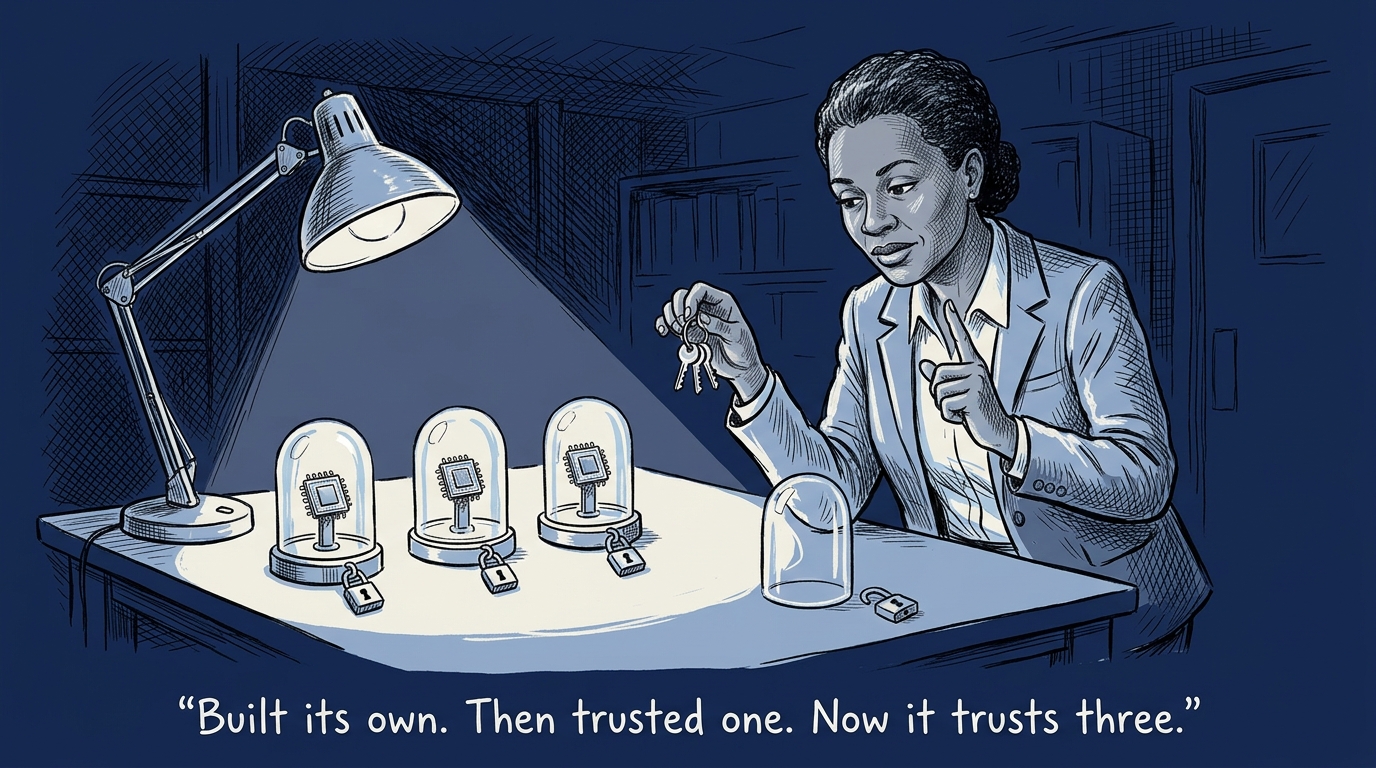
This is the same build-vs-buy-vs-certify choice every AI chip company is being asked to make right now, decades before any of them existed. Build it yourself and control every step, at real capital cost. Certify one outside vendor you trust and depend on them entirely. Or diversify across several vendors and accept that trust becomes a portfolio question instead of a single relationship. The US government already ran this experiment on real chips, for real national-security stakes, starting in 1990 -- and it didn't land on "build it yourself" as the permanent answer.
The fab is gone. The stated reason wasn't the chips -- it was the economics of keeping up.
NSA's in-house fab was eventually shut down, and trade-press reporting on the program's later history attributes the closure specifically to the cost of continually upgrading to keep pace with new process nodes on its own -- not to any failure of trust in what the fab produced.[3] That reasoning tracks with what's independently documented about the economics of leading-edge chip fabrication generally: a Government Accountability Office assessment of the trusted-microelectronics supply chain found that fabrication facilities now require initial capital costs of several billion dollars, plus several billion more a year in operating costs -- a cost curve that keeps climbing as each new process node arrives.[4] Nobody had to stop trusting the in-house model for it to stop being viable. It just got too expensive to run alone.
1990NSA opens its own in-house chip fab at Fort Meade
1outside vendor DoD certified as the sole Trusted Foundry, 2003/2004 (IBM)
3vendors the government relies on today (Intel, GlobalFoundries, Micron)
One vendor, then three -- the same lesson landing twice, in the government's own record
When the in-house model ended, DoD didn't diversify right away -- it certified a single outside vendor, IBM Microelectronics, as the sole Trusted Foundry beginning 2003/2004, running fabs in East Fishkill, New York, and Burlington, Vermont, on a 10-year contract initially valued at more than $600 million.[5] IBM sold that business to GlobalFoundries in 2015 -- the deal that opens the story of the government's current chip supply chain, and the same event this site has already covered in detail.[6] NSA's own office for managing trusted-chip access, the Trusted Access Program Office, moved out of NSA entirely and into the Defense Microelectronics Activity in fiscal year 2016 -- the same year DMEA awarded TAPO's GlobalFoundries contract, with options now running through 2033.[7] DMEA also runs its own separate in-house fab, the ARMS foundry in McClellan, California, active since about 1999 -- proof the "build it yourself" option was never abandoned government-wide, just moved out of NSA specifically and consolidated somewhere else.[7] From there the model kept diversifying into what's now a multi-vendor system -- Intel, GlobalFoundries, and Micron all holding pieces of the government's trusted chip supply chain today, not one company alone.
Why does this matter? Three eras, one underlying problem, three different answers: build it yourself, certify exactly one outside vendor, then diversify across several. Each answer superseded the last, and none of the transitions were forced by a trust failure -- they were forced by the economics of keeping pace with the chip industry's own relentless node-shrink cycle. That's worth holding onto specifically because it's not a story about secrecy or espionage. It's a story about a government that already tried owning its own most sensitive supply chain outright, decades before "sovereign AI compute" or "domestic chip fabs" became a live policy argument again -- and it's already on record why that specific answer didn't last.
 Oluwadi