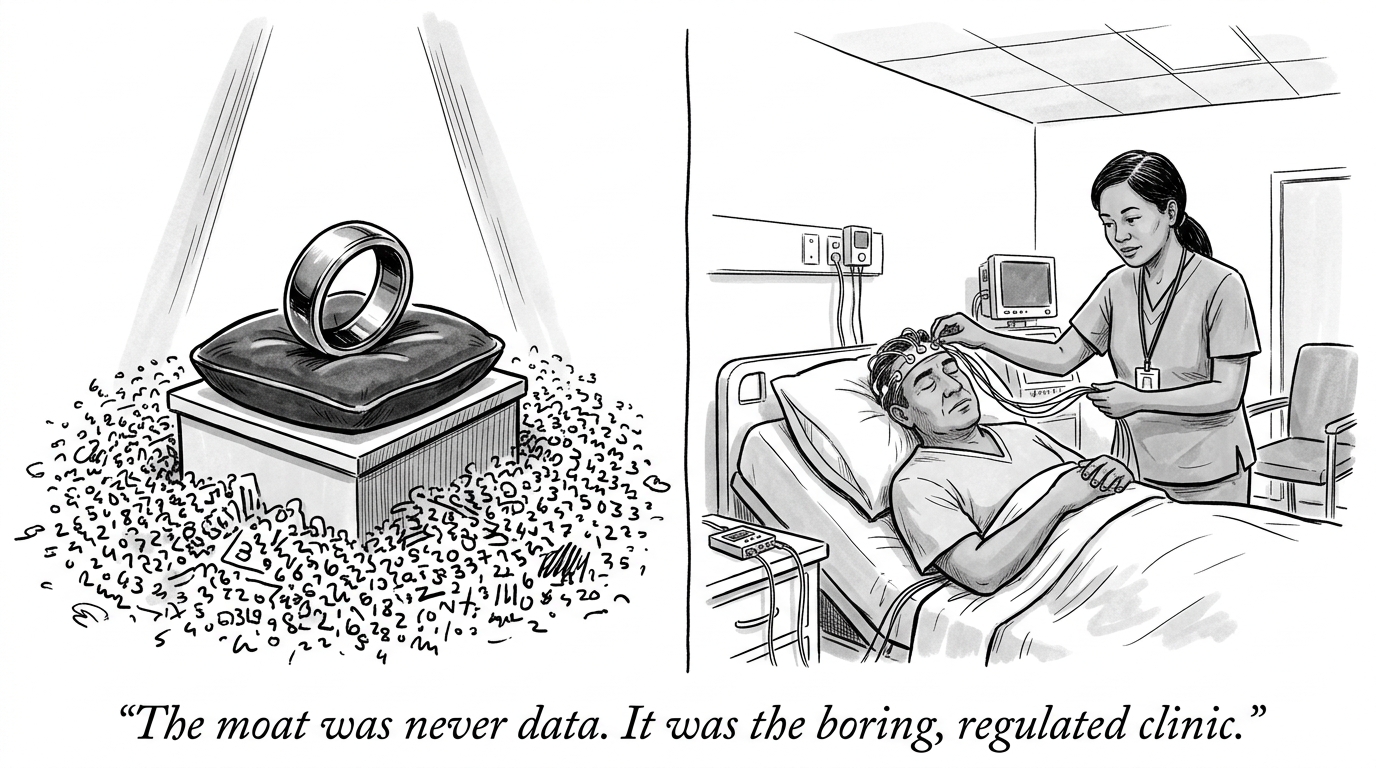
I've used a CPAP machine for about twenty years. I was diagnosed by a neurologist friend, in his own office, with a real sleep study -- electrodes, sensors, an overnight read of what my body actually does while I sleep. That was two decades before Fitbit existed, let alone an Oura Ring. Today I also wear an Apple Watch with a blood-oxygen sensor and a heart monitor. Three separate devices, three separate companies, three separate dashboards that have never once talked to each other. That fragmentation is exactly the thing Scott Galloway's newsletter argues a company like Oura is about to get very rich fixing.
The bet: data is the moat
Galloway's framework, laid out under the heading "Shares of Health Interface," is that the world's most valuable companies each captured a slice of a basic human instinct, then used first-party data and AI to make their product more valuable the more you use it, then locked you in with a recurring bundle. Apple sells status. Google sells omniscience. Amazon sells the hunter-gatherer's fantasy of infinite supply. His reading of Oura: the ring runs a version of the same play on a different instinct -- a status signal to a potential mate, and a promise of longevity set against the fear of mortality underneath it.[1]
Oura filed to go public on September 3, 2026, targeting a Nasdaq listing above a $16 billion valuation and looking to raise as much as $3 billion -- up from an $11 billion valuation just a year earlier. Revenue hit $1.21 billion for the nine months ended June 30, 2026, up 74% year over year, with 5 million paid members and $61 million in net income.[2] The company's own S-1 names its real asset directly: not the ring, but nearly 42 billion hours of longitudinal biometric data, pitched to investors as the actual moat.[3]
Three weeks before that filing, a proposed class action landed in a California federal court arguing the data underneath the moat doesn't hold up. Clarkson Law Firm's complaint, filed on behalf of a California resident who paid $513.68 for a ring in 2025, alleges Oura advertised 95% accuracy identifying sleep stages against clinical sleep-lab readings, when the real figure is closer to 50%. The suit cites a March 2025 Nature study finding 53% overall stage-classification accuracy across 45 nights, with REM sleep overestimated by roughly 31 minutes a night. Real clinical sleep staging requires electrodes on the scalp and sensors on the eyes -- equipment that exists in a sleep lab, not in a ring. Oura's own answer: "We stand behind our science, research, and accuracy claims."[4] That's the exact test a neurologist ran on me twenty years ago, in an actual lab, with actual electrodes -- the thing Oura is now being sued for implying a $300 ring can quietly replace.
The company that actually won this market never tried to be a wearable
ResMed holds roughly 62% of the global sleep-apnea device market right now. That dominance isn't a data story. In 2021, its main rival, Philips Respironics, recalled its own CPAP and BiPAP machines over a health risk and never fully returned -- ResMed and Philips still control more than 80% of the global market between them, but almost all of the growth of the last five years landed on one side of that split because the other side pulled its own product off the shelf. Philips is now trying to re-enter, and analysts expect ResMed's share to settle back toward 49-52% as that happens.[5] ResMed's real moat was never a data feed. It's FDA clearance, insurance reimbursement codes, durable-medical-equipment supply chains, and the sleep-lab referral relationships that put a machine in someone's home in the first place -- the same kind of relationship that put mine there. A competitor's own recall handed ResMed more market share than any algorithm ever did.[6]
Why does this matter? Galloway's framework is a real, useful lens for the companies it was built on -- Apple, Google, Amazon, Meta genuinely do get more valuable the more data they collect, because the product they're selling is the data loop itself. Applied to health, the same lens assumes the thing that's been missing is more measurement, and that whoever measures the most wins the category. Sleep apnea is the market that's already run the experiment, for decades, and the company that actually holds it never played that game -- it built the boring, regulated, unsexy infrastructure nobody's tried to disrupt, and a competitor's own failure did more for its market share than any dataset. Oura is now selling investors on the idea that 42 billion hours of consumer data closes the gap a real sleep lab exists to close. A lawsuit filed three weeks before the IPO is the live answer to whether that's actually true, or just what the moat looks like from the outside before anyone checks.
 Oluwadi