 Oluwadi
Investigating the Overlooked
Region
What
Who For
Analysis
Oluwadi
Investigating the Overlooked
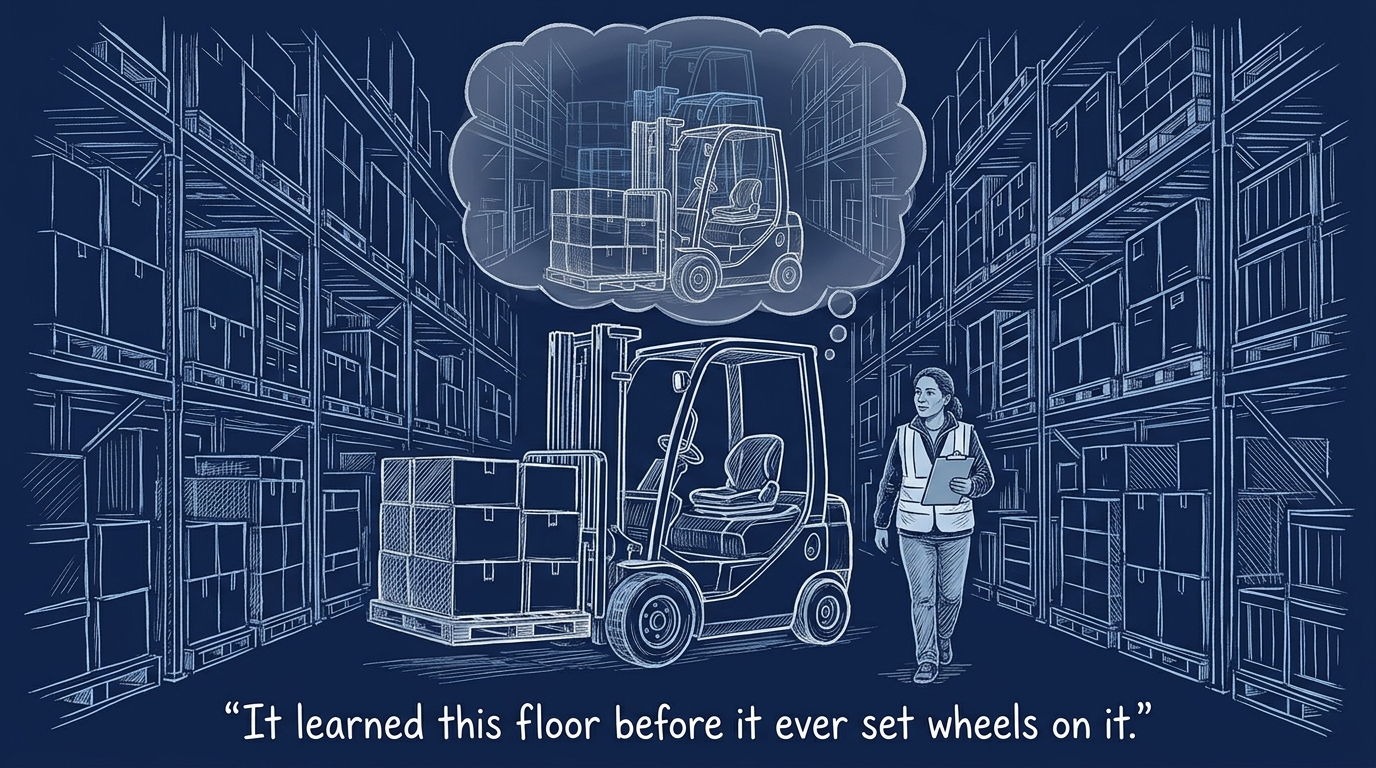
In 2026, GXO -- the world's largest pure-play contract logistics provider -- put an autonomous forklift onto a live warehouse floor, with real inventory, active human workers, and genuine throughput demands, not a demo stage. Three different companies each built one layer of what made that possible: KION built the vehicle, Accenture engineered the digital twin, and NVIDIA supplied both the simulation platform the robot trained inside and the physical computer running inside it once deployed.[1] That last detail is easy to miss and is the actual point: NVIDIA sits at two different layers of the same stack, not one.
NVIDIA's Mega Omniverse Blueprint, first shown at CES in January 2025 and expanded through 2025 and 2026, lets a company build a physically accurate digital twin of an actual factory or warehouse and run robot fleets through an effectively unlimited number of simulated scenarios before any physical robot enters the building.[2] Amazon Robotics built digital twins of its own real warehouses this way, using NVIDIA Omniverse and Isaac Sim, to train warehouse robots before physical rollout; Siemens, FANUC, and Foxconn have connected their own systems to the same blueprint.[3] KION used the identical approach -- its own Omniverse- and Mega-based digital twin, engineered with Accenture -- to train and test the autonomous forklift fleet before GXO ever let one onto a real floor.[1]
A few weeks before the GXO/KION deployment went public, Anthropic opened a research preview of its own Model Hardware Standard (MHS) -- a shared specification letting an AI agent operate real physical devices (microscopes, robotic arms, liquid handlers, lasers) through one standardized interface instead of custom, bespoke integration work for every device, cutting that integration time from weeks or months down to hours or minutes.[4] Launch partners with real case studies include Genentech, the University of Washington's Baker and Pinglay labs, Carnegie Mellon, HHMI Janelia, quantum-computing company QuEra, and Tetsuwan Scientific, with hardware vendors AWS, Danaher, Tecan, and Universal Robots building support and Hugging Face's open-source LeRobot project as an early adopter.[4] MHS is technically built on top of Anthropic's existing Model Context Protocol (MCP), the standard that already lets an AI model call any software tool without bespoke integration -- MHS is the identical move, one layer down, applied to physical hardware instead of software.[4] It's a different domain from warehouse robotics -- laboratory and scientific instruments, not forklifts -- but it's the same underlying pattern: bespoke integration work replaced by one shared interface, held by a single vendor.
Underneath both of those software layers sits the actual chip a deployed robot computes on, and NVIDIA just built an entirely new one for it. The Jetson Orin Nano 2, announced August 30, 2026 for release in the first half of 2027, is genuinely new silicon -- not a rebadge of an existing chip -- purpose-built for the entry-level edge-AI tier that covers "classic robotics... drones and computer vision systems."[5] NVIDIA had to build it specifically because its planned successor chip, Atlan, was canceled back in 2024, and its newer Thor silicon is too costly and too large for this lower tier; four years later, NVIDIA is still investing fresh engineering into filling that gap rather than letting the entry-level tier go unserved.[5] That's a real signal about how big NVIDIA now expects the edge/robotics silicon market to become, on its own, separate from the datacenter GPU business that dominates its headlines.
Why does this matter? Three real, dated, currently-active initiatives -- Mega/Omniverse for simulation, MHS for physical control, Jetson for edge compute -- now stack cleanly on top of each other into one working pipeline: simulate and train a robot in a digital twin, control it in the field through a standardized hardware interface, and run it on purpose-built silicon once it's real. NVIDIA already holds two of those three layers for the same customer, in the same deployment, at the same time. The interesting question for anyone diligencing a company in this space isn't whether physical AI is real -- GXO's live warehouse floor answers that. It's which of these three layers ends up as the actual chokepoint, and how many of them end up owned by the same handful of companies before anyone else gets a turn at building one.
The pattern this piece described kept extending in the days around its own publication. NVIDIA's agreement to acquire Hugging Face -- the open-source model hub already named above as an early adopter of Anthropic's Model Hardware Standard -- was confirmed September 3, 2026, for $12.9 billion, NVIDIA's second-largest acquisition on record after the $20 billion Groq asset purchase in December 2025.[6][7] More than 18 million developers and 200,000 companies use Hugging Face to discover and deploy AI models -- the same platform whose LeRobot project sits inside layer two of this piece's own three-layer stack, one step below the digital-twin training layer NVIDIA already owned through Omniverse.[7]
NVIDIA says Hugging Face will keep its brand and remain "an open platform for the entire AI ecosystem," continuing to support open-weight models from any lab, not only NVIDIA's own.[6] Ownership and neutrality aren't the same fact, though, and the question this piece closed on -- how many of these layers end up owned by the same handful of companies before anyone else gets a turn -- now has a sharper answer than it did when this piece went live. NVIDIA doesn't just supply the simulation platform a robot trains inside and the chip it runs on in the field. It now owns the hub where the models moving through both of those layers get discovered and distributed in the first place.