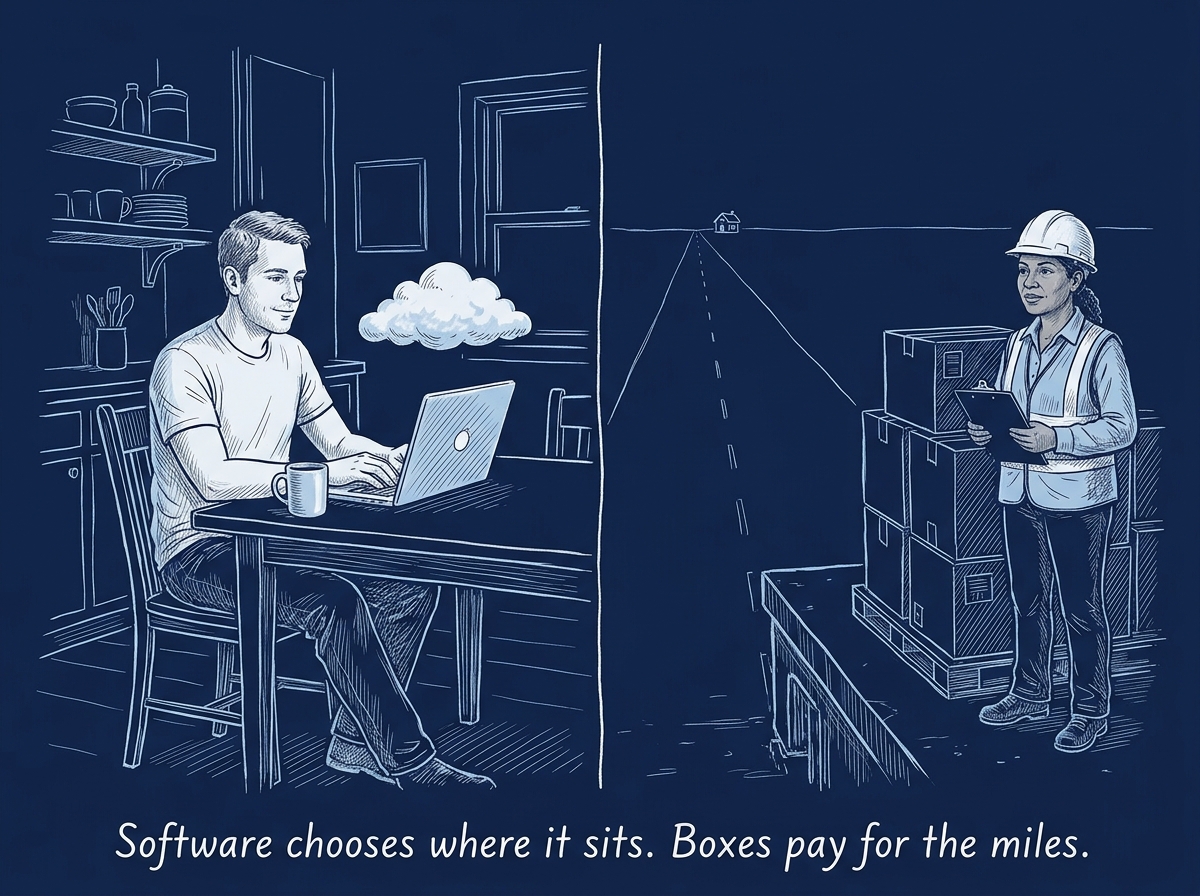
This site's own servers sit in Oregon. The people who built it work from Herndon, Virginia. That distance costs nothing extra -- not in shipping time, not in fees, not in any line item at all. For a software company, where the infrastructure physically sits relative to where the founders sit, or relative to the customers being served, is a pure identity choice. Nothing in the underlying economics forces it to be anywhere in particular.
A physical-goods company doesn't get that choice, no matter how committed the founder is
Slant3D, a high-volume 3D-printing company founded by Gabe Bentz in 2017, took over a former locomotive-manufacturing building in southeast Boise in 2022 and filled it with 2,000 printers -- a facility the company calls the MegaFarm, sitting two miles from Micron's own newly broken ground on a $15 billion memory-chip fab.[1] Boise is a real, deliberate anchor, not an accident of where the founder happened to live. It's also a genuine shipping-distance liability: most of the US population sits east of the Mississippi, and a print farm in Idaho has real cost and time exposure serving that market from one location. Bentz's own answer was direct -- he needs to build a second farm east of the Mississippi, for shipping reasons, full stop.[2]
This isn't a smaller version of the same problem software companies face. It's a second, independent force that only applies to physical goods. Every company, physical or digital, has to decide how rooted it stays to its original location as it grows -- call that the identity/will axis, the question of whether a founder actually wants to stay put. For a software company, that's the whole story: nothing else pulls on the decision. For a physical-goods company, a second force runs alongside it, completely independent of ownership, exposure, or will -- real shipping-distance economics that can force a second location regardless of how committed the founder is to the original one. A print farm needing an East Coast node isn't evidence the founder's commitment to Boise is softening. It's a cost gradient that exists whether or not the founder ever raises a dollar of outside capital.
Micron already runs the identical pattern, at a much larger scale
Micron itself -- the company whose new Boise fab sits two miles from Slant3D's MegaFarm -- doesn't manufacture only in Idaho. It runs major operations in Clay, New York, and elsewhere, the same multi-node shape Slant3D is now building toward, just at a different order of magnitude and for the same underlying reason: manufacturing capacity has to sit near enough to where it's needed, in a way that server infrastructure simply doesn't.[1] A software company adding a second data-center region is usually about latency or redundancy, a technical optimization. A physical-goods company adding a second node is very often a forced response to a cost structure no amount of founder rootedness removes.
Why this is a real diligence error, not just an abstraction
Reading a physical-goods company's multi-node expansion through a software company's economics is a specific, checkable mistake: treating "added a second location" as automatically meaning "diluting the original anchor," the same way rising outside-capital exposure might genuinely signal a founder's weakening commitment to a home base. They're not the same signal. A software company staying in one place its whole life is a pure will/identity choice -- nothing forces otherwise. A physical-goods company adding a location is very often not a choice about commitment at all. Before reading either kind of company's footprint as a signal about the founder's priorities, the actual question has to be asked first: is this an identity decision, or a cost gradient? Conflating the two produces exactly the wrong read on exactly the company that deserves credit for building the harder version of the same commitment.
Why does this matter? Distance is free for a business built on packets and pixels, and it's never free for a business built on physical mass moving through physical space. That's not a footnote to add to an investment memo -- it's a structural difference in how many independent forces are acting on a company's own footprint at once, and missing it means misreading exactly the founders who are working hardest to stay rooted while the economics keep pulling in a second direction.
 Oluwadi