 Oluwadi
Investigating the Overlooked
Region
What
Who For
Analysis
Oluwadi
Investigating the Overlooked
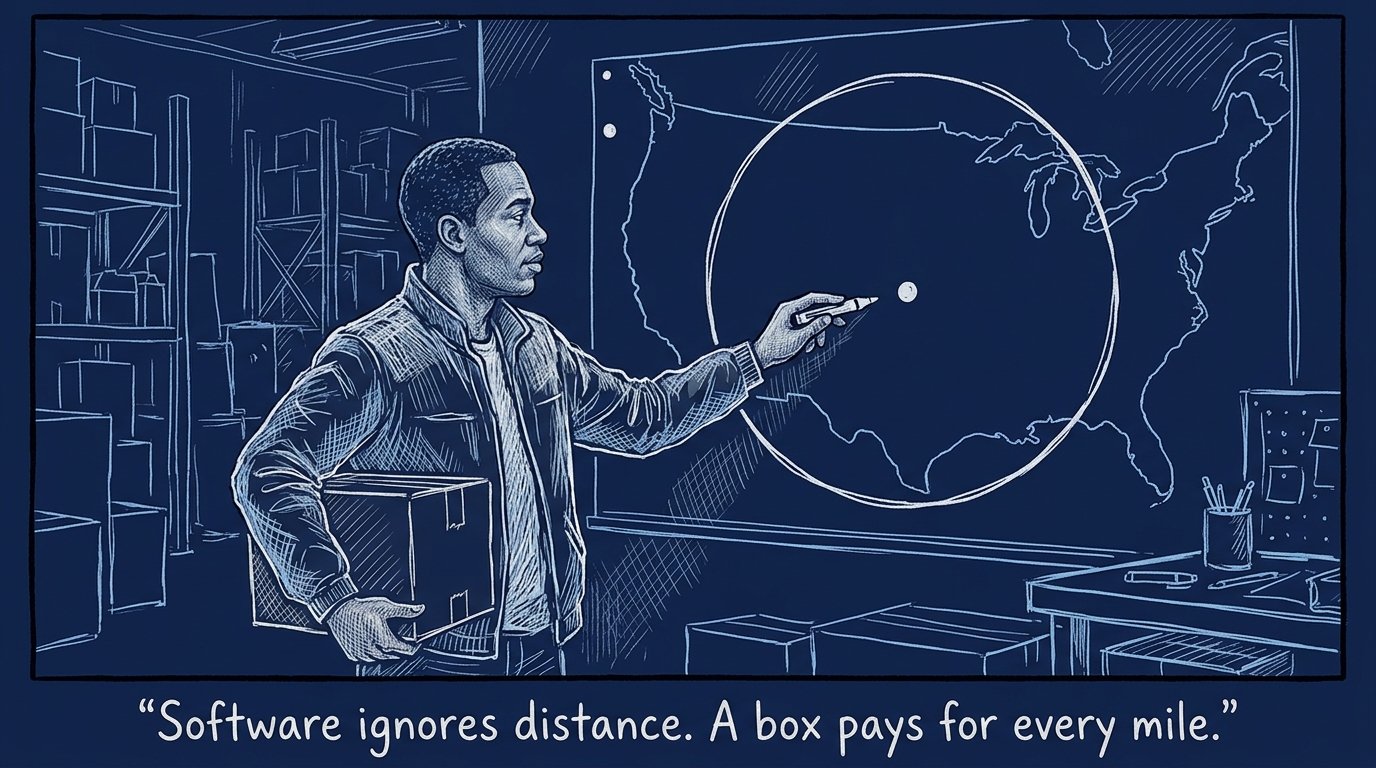
Slant3D's second factory isn't going to Louisville because Kentucky is a bigger market than Idaho. It's going there because Louisville sits inside UPS's largest air-cargo hub in the world, four hours of flight time from 95% of the U.S. population — and Boise, six hours from the nearest coast, structurally isn't.[1]
Slant3D, the high-volume 3D-printing company that filled a former locomotive factory in Boise with 2,000 printers, raised a $1.5 million Series A round in April 2025 to scale its automated Teleport print-on-demand product and build additional printing farms.[2] One of those new farms is slated for Louisville — chosen specifically to cut shipping times for Teleport's customers, because Louisville is one of the country's densest air-freight corridors and Boise is not.[3]
That single expansion decision is the whole shape of a real investment divide, one that has nothing to do with which company is better run: physical goods cost real money to move across distance. Software does not.
UPS built Worldport in Louisville starting in the 1980s specifically for this reason: a 5.2-million-square-foot sorting hub, 300 flights a day, and a location that puts nearly the entire country within a half-day's flight.[1] That is not an accident of Kentucky's geography being convenient — it's the single fact that determines where a company shipping physical parts nationally can afford to sit. Freight itself isn't cheap and isn't getting cheaper: dry-van spot rates climbed from $2.40 a mile in January 2026 to $3.00 a mile by June, according to DAT Freight & Analytics, the industry's own rate-tracking service — an 11.9% jump in the first quarter alone, the steepest quarterly climb since the pandemic.[4] A part printed in Boise and trucked to a customer in Ohio pays that rate for roughly 2,000 miles. The same part printed a few hundred miles from Ohio pays it for a few hundred.
That's the actual investment-diligence version of the divide, and it cuts both ways. Two companies can look identical on a pitch deck — same growth rate, same founder conviction, same story about staying rooted in a hometown — and still be answering to completely different physics. A software company that never opens a second office anywhere is making a pure statement about identity and will: nothing in its cost structure requires otherwise. A physical-goods company that opens a second factory is very often making no statement about identity at all. It's paying a toll that was always going to come due once it grew past a certain radius, the same way Slant3D's Boise factory was never going to be able to serve the whole country from one warehouse indefinitely, no matter how committed its founder was to Idaho.
Micron is running the identical divide two miles from Slant3D's own MegaFarm, at a much larger scale. Headquartered in Boise since its founders started the company in a dental-office basement in 1978, Micron broke ground on a new $15 billion memory fab there in 2022 — paired with a second, even larger project already under construction in Clay, New York, backed by up to $6.165 billion in combined CHIPS Act funding across both sites.[6] Silicon wafers, like 3D-printed parts, are physical. Micron didn't split its manufacturing across two states because Boise stopped mattering to the company that's been synonymous with the city for almost fifty years. It split because a chip fab, like a print farm, has to sit inside a real supply chain — proximity to specific customers, specific suppliers, specific labor markets — and a single site eventually can't carry all of it at once.
Slant3D's Boise factory isn't going anywhere because of the Louisville build-out — the two are additive, the same shape as Micron running Idaho and New York at once, neither site canceling the other out. What the $1.5 million round is actually buying isn't distance from Boise. It's proximity to everyone Boise's own geography makes expensive to reach, the identical trade every physical-goods company eventually has to make once its addressable market outgrows a single truck route.
The comparison sharpens further once the direction runs backward. A software company facing the exact opposite pressure — too much of its infrastructure concentrated in one place — would only ever consolidate for cost or reliability reasons, since geography itself imposes nothing. When Render added its Virginia region, the reason was latency and redundancy for customers already close to the East Coast, not a freight problem.[5] There is no version of a cloud-hosting company needing to open a second data center specifically because trucks are too expensive between Oregon and Ohio. That absence is the whole point: the same expansion logic that looks identical on the outside — "we're opening a second location" — is being generated by two entirely different forces depending on what the company actually ships.
For anyone reading a physical-goods company's growth the way they'd read a software company's, that difference is easy to miss, and expensive to miss badly. A multi-node physical-goods company isn't necessarily spreading itself thin or losing focus on its founding site. It may simply be doing the one thing its own product forces on it that a software company never has to do at all: paying, in trucks and jet fuel and warehouse leases, for the actual distance between where a thing is made and where somebody needs it.