 Oluwadi
Investigating the Overlooked
Region
What
Who For
Analysis
Oluwadi
Investigating the Overlooked
A blood-testing device that didn't work, an office-leasing company that called itself a technology platform, and a $400 juicer that a Bloomberg reporter out-squeezed by hand -- three separate companies, three separate industries, and the exact same shape of failure: a claim that collapsed the moment someone outside the company actually tested it. None of that alone explains why trust in Silicon Valley has thinned out generationally. What explains it is what happened after -- specifically, what happened to the person at the center of the second story.
Theranos raised its valuation to roughly $9 billion on the claim that its proprietary "Edison" devices could run hundreds of diagnostic tests from a single finger-prick of blood. They couldn't -- the company was secretly running samples through conventional lab equipment from other manufacturers while telling investors and patients otherwise. A 2015 Wall Street Journal investigation exposed the gap between the claim and the machine; Theranos dissolved in September 2018. Founder Elizabeth Holmes was convicted on four counts of wire fraud and conspiracy in January 2022, sentenced to eleven years and three months, and has been serving that sentence since May 2023 -- her final appeal was rejected by the Ninth Circuit in February 2025.[1]
WeWork built a $47 billion valuation on the claim that it was a technology company reshaping how people work, not a company that signed long leases and re-let the same space at a markup -- a business model that only worked as long as growth metrics stood in for a conventional balance sheet. When WeWork filed to go public in August 2019, the S-1 itself was the exposure: investors reading the actual numbers watched the marketed valuation collapse from $47 billion to under $10 billion in six weeks. Founder Adam Neumann was pushed out as CEO that September. SoftBank stepped in with a rescue package that October at under $8 billion -- an 83 percent discount to the number WeWork had been selling months earlier.[2]
Juicero raised roughly $134 million from investors including Google Ventures and Kleiner Perkins to sell a $400, wifi-connected juicer that required proprietary produce packs. In April 2017, Bloomberg reported that those packs could be squeezed by hand, yielding nearly as much juice, faster, than the machine did. The company cut a quarter of its staff that July and shut down entirely by September 2017, refunding customers on the way out.[3]
Here is the detail that separates WeWork from a simple story about a bad business model. Adam Neumann didn't just survive the collapse -- he left with an exit package worth roughly $1.7 billion, negotiated as part of SoftBank's rescue.[2] Three years later, in 2022, Andreessen Horowitz backed his next company, Flow -- a residential real estate startup -- with a $350 million investment at a valuation over $1 billion. It was a16z's largest single check at the time.[4] Then, in 2025, after WeWork itself had actually filed for Chapter 11 bankruptcy in November 2023, a16z didn't pull back from Neumann -- it put in more than $100 million further, lifting Flow to a $2.5 billion valuation and raising a16z's own stake from 20 percent to 25 percent.[5]
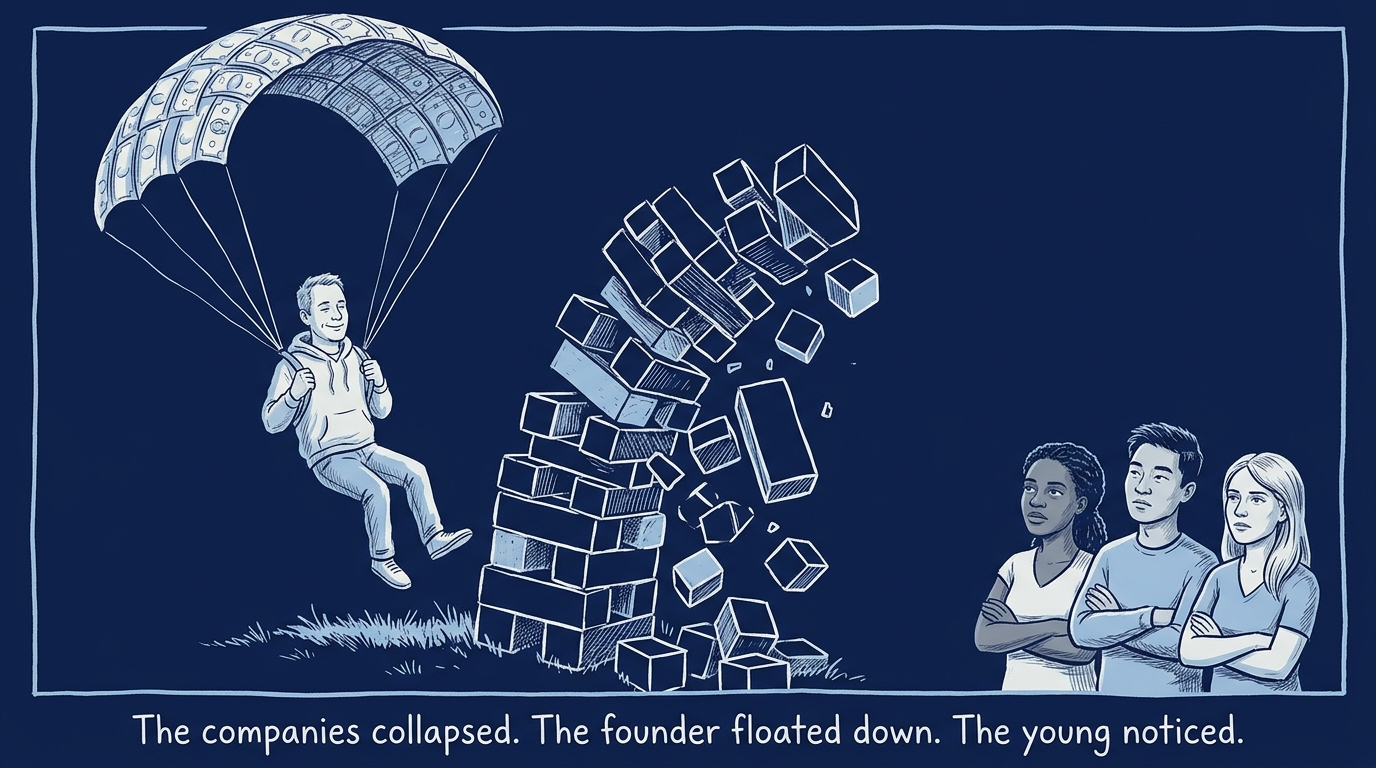
That is the mechanism a generational trust gap is actually built from. It isn't that one company failed -- companies fail constantly, in every industry, for reasons that don't indict an entire sector. It's that the person whose company failed in the most publicly humiliating way of the last decade was re-funded, at growing scale, by the same class of investor, without the failure functioning as a cost to him personally at any point in the sequence.
Someone who is 18 years old today has no living memory of a Silicon Valley promise that quietly, reliably paid off -- no personal-computer moment, no dial-up-to-broadband moment. What they've watched instead is a specific, nameable sequence: a health-diagnostics claim that turned out to be fabricated, an office-leasing company that called itself a tech platform until its own IPO paperwork proved otherwise, a $400 juicer beaten by a human hand, and the founder at the center of the second story getting funded again and again regardless. None of that requires cynicism to explain -- it's a track record, read plainly. The industry doesn't need better marketing to close that gap. It would need the failures to actually cost the people responsible for them something -- and the Flow story is the clearest evidence yet that they don't.
On August 31, 2026, Andreessen Horowitz announced it had closed additional capital for its fifth Growth fund, lifting the vehicle from $6.75 billion at its January launch to $8.5 billion total -- a $1.75 billion expansion the firm attributed to "unprecedented investment opportunities" in enterprise AI, defense tech, and manufacturing.[6] The announcement came days after a16z separately raised a fresh $1.1 billion "Machine Age Fund" targeting the same categories plus robotics and the AI compute stack.[7]
This is the same firm, expanding the same pool of capital, that backed Adam Neumann's Flow with $350 million in 2022 and then added more than $100 million further in 2025 -- after WeWork itself had filed for bankruptcy -- lifting Flow to a $2.5 billion valuation and a16z's own stake to 25 percent. Nothing about that sequence cost the firm access to more capital. If anything, the opposite: a16z's growth fund is $1.75 billion larger four years into the Flow bet, still run by the same general partners, still deploying at the same scale. The mechanism this piece named -- failure that never becomes a personal or institutional cost -- isn't just holding steady. The pool of capital behind it is growing.