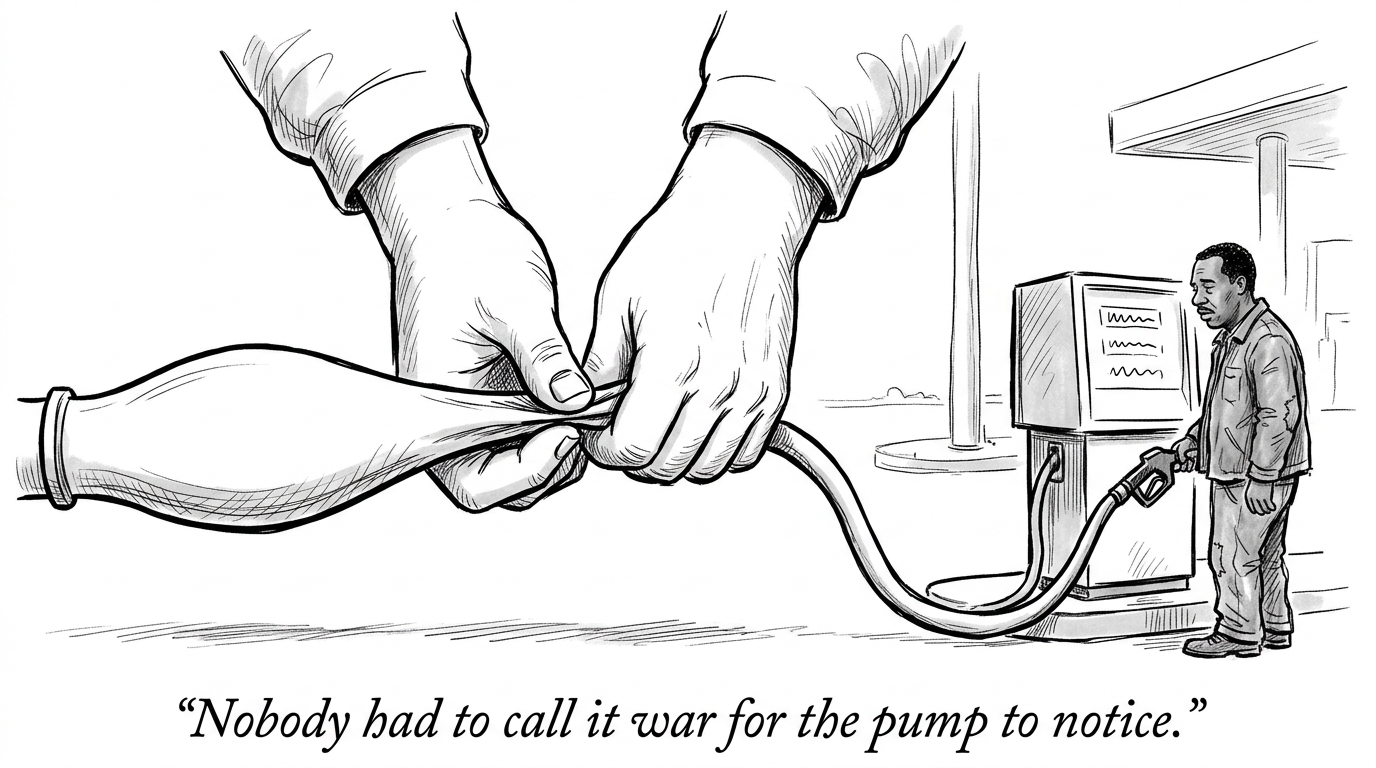
The Strait of Hormuz is the width of a wide river at its narrowest point and carries about a fifth of the world's oil. In the first half of 2025, an average of 20.9 million barrels a day moved through it — roughly 20% of global petroleum consumption and a quarter of all oil moved by sea, most of it bound for Japan, India, South Korea, and China.[1] On February 28, 2026, US and Israeli strikes killed Iran's Supreme Leader and other senior officials in an operation aimed at the country's nuclear program; Iran answered with ballistic missiles at Israel and Gulf states within hours.[2] Six months later, the fighting has never fully stopped, and Iran has held Hormuz transit under what current reporting calls an "exclusion zone" — not a full closure, but sustained enough disruption that transit volumes are described as "fractional" against normal flow.[3]
The word "war" turns out to be optional. The economics aren't
In early September, Vice President JD Vance stated there is no war with Iran — this despite six months of military exchanges and closed shipping lanes. The distinction isn't rhetorical color: calling it a war would trigger the constitutional requirement to seek Congressional approval the administration has not sought.[3] Whatever it's called, the numbers move like a war's. US gas prices rose from $3.19 to $4.14 a gallon over the same stretch; wages stopped outpacing inflation; tariffs on beef were pulled after prices jumped 15%.[3] Diesel reached an all-time US high of $5.85 a gallon last week -- up from $2.14 a year ago, and past the previous record of $5.82 set in June 2022 in the aftermath of Russia's invasion of Ukraine.[4] None of that required the word "war" to happen.
The transmission runs all the way to a Tokyo utility bill
The clearest proof the chokepoint mechanism is real, not rhetorical, showed up eight time zones away: Strait of Hormuz shipping disruption pushed Japan's second-quarter electricity prices up 30% year-on-year.[5] Japan imports the overwhelming majority of its oil through Hormuz. A missile exchange between Iran and Israel doesn't touch a Japanese power plant directly — it touches the price of what fuels it, within one fiscal quarter, measurably.
20%Share of global oil consumption that transits the Strait of Hormuz
Feb 28, 2026Date US/Israeli strikes killed Iran's Supreme Leader and opened the war
+30%Japan's Q2 2026 electricity price increase, year-on-year, tied directly to the disruption
India took the hardest single-country hit on record
India imports about 88% of the crude oil it uses, and roughly 70% of that ran through Hormuz before the war.[6] The IEA called what followed the strikes "the largest supply disruption in the history of the global oil market." India's crude imports fell 23% in March alone. The rupee, already sliding on unrelated tariff pressure, dropped a further 4.9% to 93 to the dollar.[7] Eleven weeks after the strait closed, four separate fuel-price hikes passed roughly Rs 7.5 a liter on to Indian consumers directly.[7] India has spent the months since diversifying toward the US, Russia, West Africa, and Fujairah, UAE, routes that bypass the strait entirely, and has cut its Hormuz-dependent share of imports roughly in half. That response is itself the data point: an entire country's energy-import strategy got rebuilt in six months because one channel became unreliable.
Africa's ledger looks balanced. It isn't
The Centre for Research on Energy and Clean Air tracked fossil-fuel costs across 41 African countries from March through August 2026: 32 of them, net importers, paid a combined $21.9 billion more; nine exporters earned $21.6 billion more.[8] Add it up continentally and the net is close to zero — $0.3 billion, a rounding error on $90 billion of annual Gulf fuel imports. That number is also close to meaningless, because it isn't the same countries on both sides of the ledger. Kenya, Tanzania, Ghana, Senegal, and Rwanda absorbed higher fuel and freight costs, wider current-account deficits, and real pressure on foreign-exchange reserves. Nigeria, Angola, Libya, and Algeria captured $18.1 billion of the gain between them. Egypt alone paid $5.2 billion — more than Nigeria, the continent's largest oil producer, earned.[8] Nigeria is the sharpest version of the whole mechanism in one country: Africa's biggest producer of crude, and still dependent on imported refined fuel, meaning the same shock that filled its export revenue also raised its own pump prices.
A global shock doesn't hit a global average. It sorts. The same six months that cost Kenya, Tanzania, Ghana, Senegal, and Rwanda real currency reserves handed Nigeria, Angola, Libya, and Algeria a combined $18 billion gain — the identical price movement, opposite outcome, depending entirely on which side of the import/export line a country sits. India's 23% import collapse and Japan's 30% electricity jump are the same mechanism at the demand side. None of this required anyone to target anyone. A chokepoint doesn't discriminate on the way in. What happens next depends entirely on what each economy already was before the shock arrived.
The spillover reached a war that has nothing to do with oil
The same week Iran's exclusion zone was tightening, the US brokered a preliminary peace deal between Armenia and Azerbaijan — using expanded approvals for Nvidia AI chips into an Armenian data-center project as part of the leverage.[9] Chip access and Middle East oil security are not the same crisis, and Yerevan is not Hormuz. But a government managing one active energy chokepoint has an obvious incentive to open every other lever it holds, and semiconductor access — a genuinely scarce, genuinely wanted resource — turned out to be one of them.
An "exclusion zone" is not a closure, and that distinction is doing real work. A full closure of Hormuz would be catastrophic and immediate — insurers would stop covering tankers, prices would spike overnight, and the pressure to resolve it would be total. A chronic, partial disruption is a different instrument entirely: it imposes a sustained tax on global energy prices, reaches a Tokyo utility bill within a fiscal quarter, and never produces the single dramatic event that would force a faster resolution. Six months in, that's exactly the shape of what's happened — not a blockade, a toll.
The transmission reaches the Federal Reserve, not just the pump
Diesel doesn't register as a line item for most households, because it doesn't fuel their car. It fuels the trucks, trains, and farm equipment that move nearly everything else, so a diesel-price record gets baked into the cost of harvesting lettuce or delivering a package before it ever reaches a receipt -- the exact channel through which an oil-supply shock becomes a broad inflation problem rather than a narrow one. Fed Governor Christopher Waller said last week that persistent inflation could warrant a rate hike at the Federal Reserve's next meeting, specifically naming military conflict as one source of that uncertainty, while a stronger-than-expected August jobs report has already pushed the odds of a near-term rate cut further out of view.[10] Bond yields, already elevated for unrelated reasons, tend to stay elevated when investors expect inflation and interest rates to persist. The Federal Reserve cannot reopen the Strait of Hormuz. Interest rates are its only real lever against the inflation a closed-enough strait produces -- meaning a record at the diesel pump can eventually raise borrowing costs for a consumer or a government with no fuel tank anywhere in the transaction.
Why does this matter? A chokepoint doesn't need to fully close to reorder a global economy. Iran didn't have to sink a tanker or stop all traffic through the Strait — a war six months old, an exclusion zone short of a blockade, and a government that won't call it a war were enough to move Japanese electricity prices, American gas prices, and US diplomatic leverage on the other side of the world, all at once, all measurably, none of it requiring anyone to agree on what to call what's happening.
Cross-linked to Oluwadi's "An $87 Billion Bill to Fund the Iran War Includes $1 Billion for a New York Train Station. Farmers Are Still Waiting on Theirs.", which covers the same war's domestic funding fight.
 Oluwadi