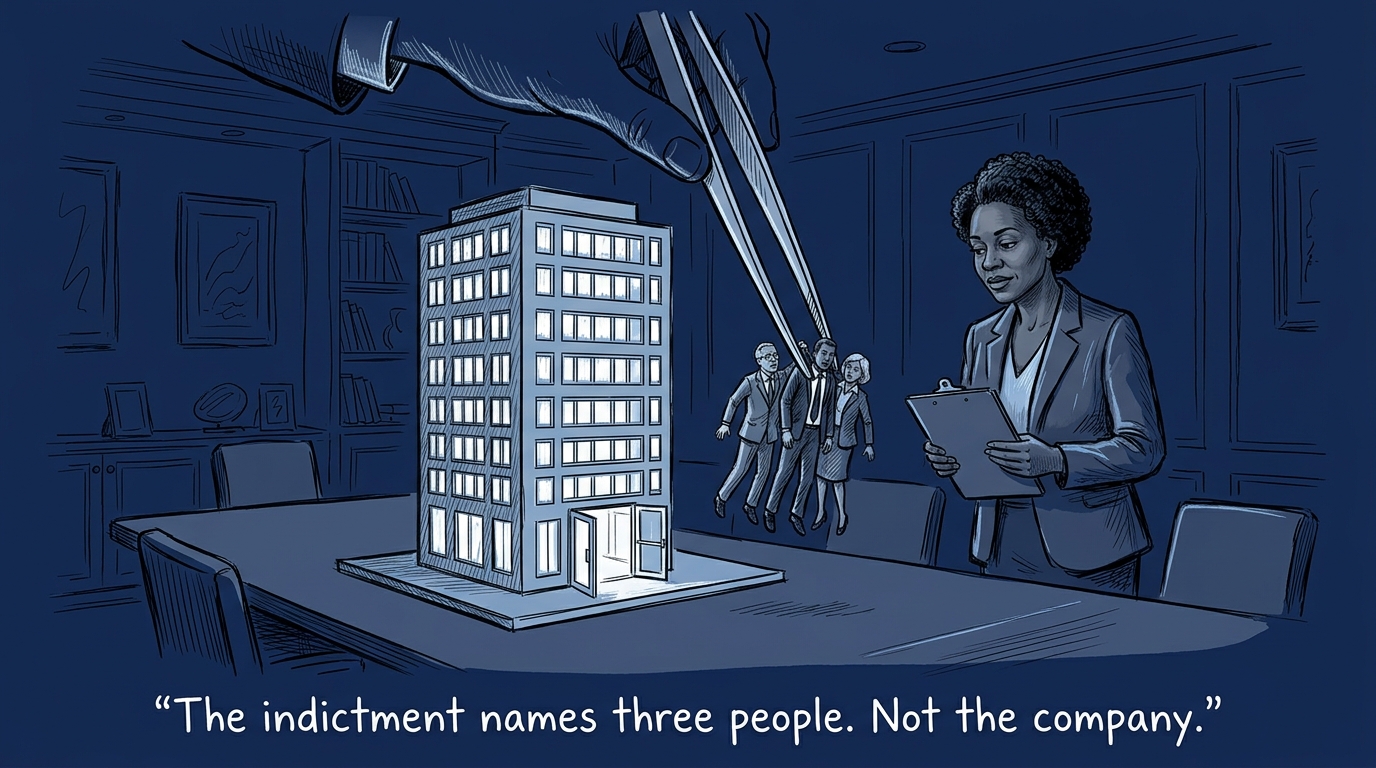
The Department of Justice unsealed an indictment on March 19, 2026, charging three people with conspiring to divert cutting-edge US AI technology to China. Named: Yih-Shyan "Wally" Liaw, a US citizen and one of Supermicro's three original co-founders; Ruei-Tsang "Steven" Chang, a Taiwan citizen still a fugitive; and Ting-Wei "Willy" Sun, a Taiwan citizen. Liaw and Sun were arrested and presented in the Northern District of California the same day. Each faces one count of conspiring to violate the Export Control Reform Act (up to 20 years), one count of conspiring to smuggle goods from the US (5 years), and one count of conspiring to defraud the United States (5 years).[1]
Two numbers, describing two different stages of the same scheme
DOJ's own filing puts $2.5 billion as the total value of servers sold into the alleged scheme, and $510 million as the value of banned-chip-carrying servers that DOJ alleges actually reached China. Those aren't competing figures -- $2.5B is what went into the pipeline; $510M is what came out the other end in China specifically. The alleged method: sell the servers to an intermediary company in Southeast Asia, which repackaged and transshipped the restricted units onward, using false documentation and staged dummy servers to mislead inspectors along the way.[1]
$2.5Btotal value of servers sold into the alleged scheme
$510Mvalue of banned-chip servers DOJ alleges reached China
1 of 3Supermicro co-founders charged; the company itself was not
The distinction the indictment draws is the actual story. Supermicro, the company, was not charged. Three individuals were -- one of whom happened to co-found the company decades earlier and sat on its board until the day his charges were unsealed. That's a meaningful, deliberate legal line: DOJ's theory is that people used a company's own supply chain and reputation as the vehicle for a scheme the company itself wasn't run to execute, not that the company was built to smuggle. Liaw's own dual role -- cofounder-and-board-member on one hand, indicted defendant on the other -- is exactly why that line needed drawing explicitly rather than left implied.
Cleared by its own board, not by the government
Supermicro launched an internal investigation after Liaw's indictment; its board announced the results August 20, 2026: no evidence CEO Charles Liang or other current senior management knew about the alleged scheme. Liaw co-founded Supermicro more than three decades ago alongside Liang and Liang's wife, Sara Liu. The company has since taken personnel actions -- including terminations -- within its sales, technical support, and business development functions, and Liaw's own trial, after he pleaded not guilty, has been pushed from November 2026 to March 2027.[2]
What's actually at risk is a 30-year relationship, not just one contract
Nvidia and Supermicro were both founded in Silicon Valley the same year, 1993 -- one making the AI chips, the other building the server racks and cooling systems around them, a partnership that grew alongside the entire AI-hardware buildout. Jensen Huang and Charles Liang, both born in Taiwan, have a personal friendship layered on top of that corporate one, visibly warm at industry events like GTC, joking about switching between Taiwanese, Mandarin, and English depending on how much they agree. That's the relationship an indictment naming one of Supermicro's own founders now sits directly on top of -- not just a supplier contract at risk, but three decades of a bond between two specific people.[3]
Why does this matter? This surfaced while checking whether Supermicro belonged in a piece about the AI chip market splitting into separate, non-competing races (Broadcom, AMD, Intel, and Micron each winning a different lane).[4] It doesn't -- this is a different kind of story entirely, enforcement and individual liability rather than market structure, and folding it into that piece would have blurred both. But it's worth holding next to it anyway: the same AI buildout that's producing record, non-competing wins across the chip-tier stack is also the exact buildout valuable enough that three people are now accused of routing $510 million of it to China through staged paperwork. The market-structure story and the enforcement story are about the identical boom, just read from two different rooms.
 Oluwadi