 Oluwadi
Investigating the Overlooked
Region
What
Who For
Analysis
Oluwadi
Investigating the Overlooked
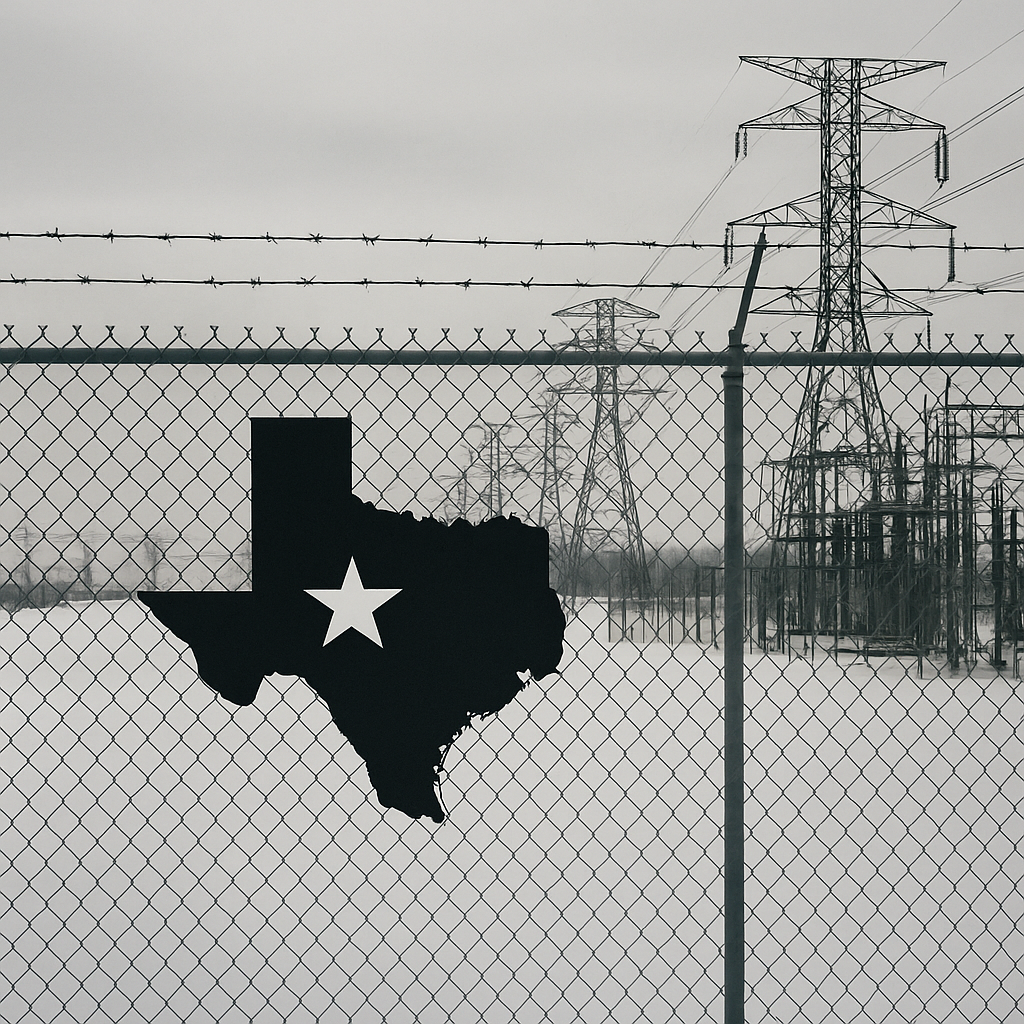
The continental United States runs on three electrical grids: the Eastern Interconnection, the Western Interconnection, and one that covers most of a single state. ERCOT — the Electric Reliability Council of Texas — manages about 75 percent of Texas's land area and delivers roughly 90 percent of the power used by its more than 27 million residents, entirely separate from the other two.[1][2] That separation isn't geography. It's a choice, made deliberately, for a specific legal reason that has nothing to do with keeping the lights on.
The Federal Power Act of 1935 gave federal regulators — what's now the Federal Energy Regulatory Commission — jurisdiction over electricity sales that cross state lines, "in interstate commerce." A utility that never sends power across a state border falls outside that authority.[4] Texas utilities understood this immediately. During World War II they tied their systems together into what became the Texas Interconnected System, deliberately keeping every connection inside Texas's own borders to support wartime manufacturing without inviting federal oversight. In 1970, after the 1965 Northeast blackout forced the creation of national reliability standards, that system reorganized into ERCOT.[3] The reasoning behind the original choice has been described plainly in the historical record: freedom from federal regulation was a cherished goal — more so because Texas itself had no state regulation of the industry until the 1970s either.[3]
ERCOT today is a membership-based 501(c)(4) nonprofit, governed by its own board and overseen by the Texas Public Utility Commission and the state legislature — not FERC.[2] The grid isn't 100 percent sealed off: four small direct-current ties connect it to the outside world — two to the Eastern Interconnection (820 megawatts combined) and two to Mexico's grid (400 megawatts combined).[1] The reason those ties are DC rather than AC is itself the point. A direct synchronous AC connection to another grid is exactly what would trigger full FERC jurisdiction over ERCOT; a DC tie, legally, does not.[4] The isolation was engineered around a legal definition, not around how much power Texas might someday need to borrow.
On February 15, 2021, at 1:20 a.m., ERCOT declared its highest level of grid emergency. It stayed there until 10:35 a.m. on February 19.[7] More than 4.5 million Texas homes lost power.[8]
The scale is easier to read against what the grid was working with going in. ERCOT's total installed capacity that winter was roughly 103,000 megawatts, built to comfortably cover a forecast winter peak under 58,000 megawatts.[23] The storm itself pushed demand past that forecast entirely: ERCOT served a winter-record 69,812 megawatts on the evening of February 14, with underlying demand — the amount people actually wanted, before rotating outages started cutting it — estimated at 76,819 megawatts.[24] At the same time, on the supply side, roughly 34,000 megawatts of generating capacity dropped into forced outage, continuously, for two straight days — about a third of the entire fleet by nameplate capacity, or 48.6 percent of the generation ERCOT actually expected to have available that day, the smaller and more relevant number, since utilities never counted on the whole nameplate fleet running at once anyway.[11] A record demand spike met a mass equipment failure at the same moment.
The federal-regulator postmortem, a joint FERC and NERC report released that December, found the dominant cause wasn't the wind turbines that got blamed in the immediate political aftermath. Natural gas-fired units accounted for 58 percent of all generating failures; wind accounted for 27 percent. Just over three-quarters of all unplanned outages traced to freezing equipment or interrupted fuel supply.[11]
This is where the isolation actually mattered. ERCOT's total combined tie capacity to the outside world is 1,220 megawatts. The shortfall during the storm, Winter Storm Uri, ran into the tens of thousands of megawatts. Technical analysis of the storm treats this as a straightforward physical constraint, not a contested claim: the ties that existed were never sized to matter against a shortfall that size.[12] A grid built to stay outside federal jurisdiction had, as a direct consequence, almost no capacity to import its way out of a crisis when its own generation failed at scale.
Four of ERCOT's own unaffiliated board members resigned within days, in a joint statement citing the need to "allow state leaders a free hand," after it became public that several didn't live in Texas at all — one in Michigan, one in Germany, one in Illinois.[5] A fifth resigned separately. Days later, a sixth — the one board member among them who actually lived in Texas — resigned too.[6]
The state's official death toll, finalized in January 2022, stands at 246 — the state's own health department has said it may be impossible to ever account for every storm-related death.[9] An independent BuzzFeed News investigation, using excess-mortality methodology reviewed by outside statisticians, put the number at more than 750; a separate academic analysis using a comparable method arrived at 814.[10] The two counts aren't measuring a disagreement so much as two different methods — official cause-of-death coding on individual certificates versus statistical excess-mortality modeling — and neither has displaced the other.
At least 17 of the confirmed deaths came from carbon monoxide poisoning, as people without power burned cars, generators, and grills indoors for heat.[13] On the financial side: the Public Utility Commission held the wholesale price of electricity at its $9,000-per-megawatt-hour cap for nearly four days. Griddy Energy, a retailer that passed wholesale prices straight through to customers, billed its roughly 29,000 customers a combined $29 million during the storm.[14] One customer, Ty Williams, was billed $17,000 across three meters over five days.[15] Griddy went bankrupt within a month; a 2023 Texas appellate court ultimately ruled that the PUC itself had set prices too high during the storm.[16]
Texas responded. Senate Bill 3, effective June 2021, mandated weatherization for power generators and required better coordination between the electric grid and the natural gas system that supplies it.[17] Voters approved a $5 billion Texas Energy Fund in 2023 to finance new dispatchable generation.[19] A separate proposed market redesign, the Performance Credit Mechanism, drew criticism as overly complex and was effectively superseded rather than implemented as originally written.
Something else changed in the background, not by mandate but by economics: Texas quietly became the largest wind-and-solar state in the country. ERCOT's own numbers as of mid-2025 put installed wind capacity at roughly 40 gigawatts, solar at another 32.7 gigawatts, and battery storage — which barely existed at meaningful scale in 2021 — at roughly 14 gigawatts.[18] None of that was built in response to the storm, Uri, specifically; it was built because Texas has cheap land, strong wind and sun, and an interconnection queue that let developers move fast. But it left the grid with a real buffer of dispatchable-adjacent capacity that simply didn't exist five years earlier — including from the exact technology, wind, that took the loudest public blame for causing the 2021 blackout in the first place.
Five years later, in January 2026, another hard freeze hit Texas. This time the grid held — no statewide blackout. Energy researcher Josh Rhodes noted a real, unglamorous reason: the storm "didn't make it all the way down to the Mexican border," which made a meaningful difference on its own.[22] The power-plant weatherization mandates that Texas could directly regulate and inspect appear to have worked as designed — generators stayed online.
But the same weak point from 2021 showed up again anyway. Natural gas production — the fuel supply for most of ERCOT's generation, and the single largest source of failures in 2021 — plummeted a second time, to lows not seen since the original storm, pushing gas prices to record highs.[22] Energy economist Ed Hirs put it bluntly: "The natural gas marketers know a thing or two about price gouging. It's OK to call it that!"[22] A 2025 state audit found that the winterization rules covering the gas supply chain "lacked teeth" — no baseline weatherization standard, and no independent verification that companies had actually complied.[22] NERC's own president, Jim Robb, summarized the gap directly: "Voluntary may not get us there."[22] The grid survived January 2026 because the storm was milder and the new wind, solar, and battery buffer had real capacity behind it — not because the specific vulnerability that caused 2021 had actually been closed.
The one change that would most directly address the import-capacity problem — a real synchronous connection to a neighboring grid — is also the one change ERCOT has never made, for the same reason the isolation existed in the first place. A federal bill introduced in February 2024 would require exactly that.[20] ERCOT's own CEO, Pablo Vegas, has publicly pushed back, arguing that interconnection proposals "often leave out economics" and questioning whether it's the most cost-effective path to reliability.[21] Private companies have proposed new transmission lines to neighboring grids on a multi-year timeline; the state legislature has ordered its own study of synchronous interconnection. As of this piece, no synchronous AC tie has been built. The DC ties remain exactly what they were in 2021: real, and far too small to matter in a large enough emergency.
None of this required anyone to act in bad faith. The 1930s choice to stay inside Texas's own borders was a rational response to a real regulatory incentive, made decades before anyone could have modeled what a 2021-scale freeze would do to it. But the mechanism is visible now in a way it wasn't then: the parts of the system Texas could directly mandate, inspect, and enforce got meaningfully more reliable. The part it left voluntary — the gas supply chain that caused most of the original failure — didn't, and showed the same weakness again five years later. And the one structural fix that would most directly solve the isolation problem is the one option that would also cost Texas the exact independence the whole system was built, ninety years ago, to protect.