 Oluwadi
Investigating the Overlooked
Region
What
Who For
Analysis
Oluwadi
Investigating the Overlooked
The secondhand server, drive and memory market is not a separate market. It is the bottom rung of a chain whose price is set at the top, by whoever buys new in volume. For years that buyer was the enterprise refresh cycle, and it passed down cheap, working gear. The buyer at the top is now AI, and the price is coming down the chain with it. This piece lays out the chain, shows what has moved, and says who is paying. It is not a claim that anyone is leaving the hobby. The people who already own the gear are mostly fine. The people about to buy are not.
My first computer was a Commodore VIC-20. It plugged into a television, so if a family could afford a television it could afford the computer. It launched in 1981 at $299.95 and later fell below $100.[9] The machine I run for my own work today is an Intel i9 with 128GB of memory and an RTX 4090. The card alone launched at $1,599, it is no longer made new, and used ones sold for about $2,300 to $2,800 this summer in one U.S. tracker's data, and for a median of about 2,100 euros in a German sample of sold listings.[10] That is priced out of most pocketbooks, and it is the same hobby. I should say which side of that line I stand on. The core of my home lab, the servers and drives, was built before any of this got expensive. I started in 2019 and finished during the pandemic lockdown. I could not justify building it today. At work I had a purchasing budget. At home I had my own.
So the line has always had a price. The question is who gets priced out of it, and that is what the rest of this piece is about.
Nobody builds a home lab because the numbers work. They build it because they love it. You can see that in the people who teach the hobby. Craft Computing's recent titles include "Homelabs don't have to be expensive, even in 2026."[5] Jeff Geerling designs his projects so a beginner can replicate them for under $100, and says he is shifting toward older boards and microcontrollers.[4] In my reading, neither is selling a bargain. Both are inviting someone in.
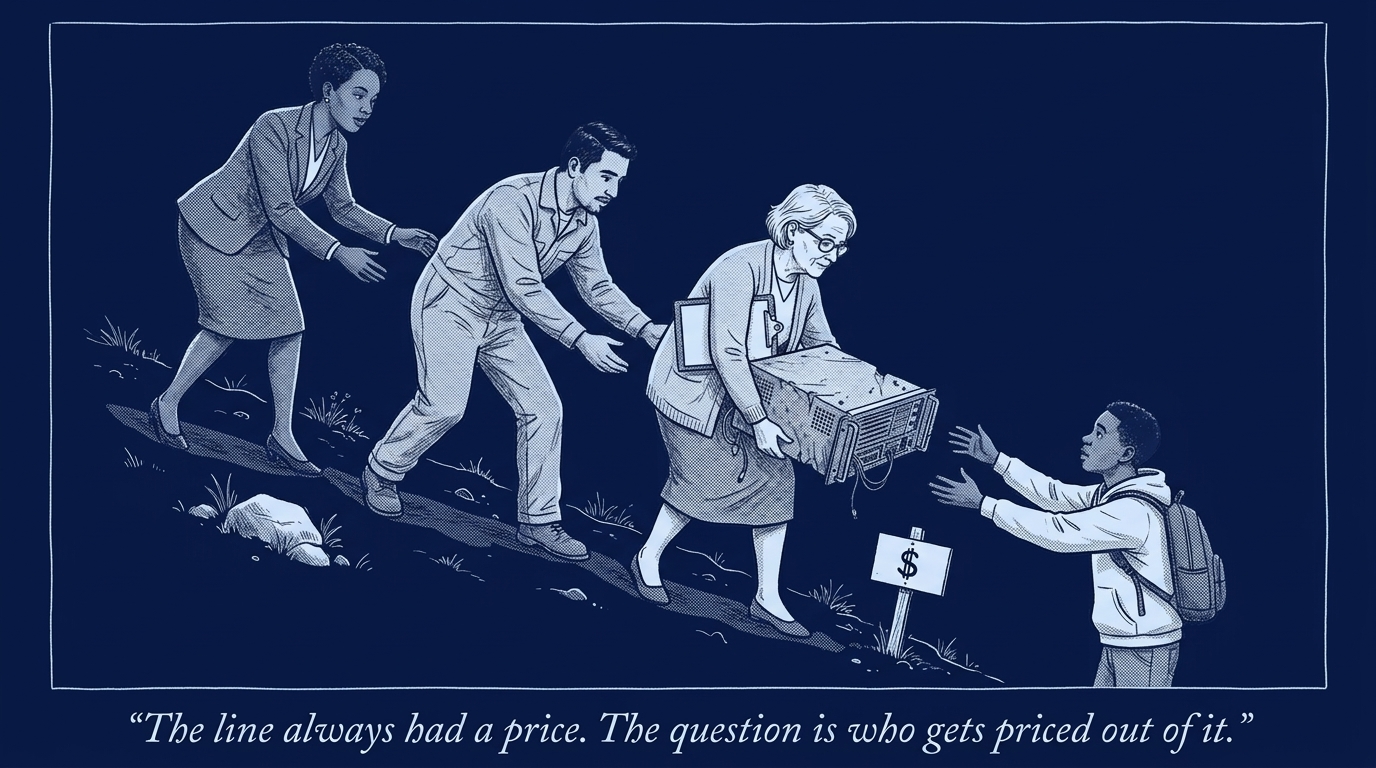
That is why the price matters more than the line on a receipt. A hobby that runs on love has an on-ramp, and the hand-me-down chain is that on-ramp: the cheap, used part that lets someone with a television and some curiosity find out whether they love it. Price the on-ramp out and the loss is not a sale. It is the people who would have fallen in love and never find out.
| Rung | Who | What sets their price |
|---|---|---|
| 1. New parts | The largest buyers: hyperscalers, now AI builders | Contract negotiations with a few makers |
| 2. Enterprise refresh | Banks, clouds, large IT shops | Their own accounting, warranty and power cycle |
| 3. Resale | Brokers and liquidators who buy retired lots | What they think rung 4 will pay |
| 4. The used buyer | Small business, schools, MSPs, hobbyists | Whatever it costs them to get the same thing new, less a discount |
Everything about rung 4 is downstream. The enterprise at rung 2 is not selling to the people at rung 4. It is disposing of an asset on its own schedule, and the buyer at the bottom benefits from a decision that was made for reasons that had nothing to do with them. A homelab is mostly a museum of other people's budgets: servers, drives and memory bought by a bank or a cloud provider, used for five years, retired, and sold on for a fraction of the price. The enterprise is disposing of an asset. Once the part reaches a person, it is different: when one hobbyist hands a drive or a card to the next, that is not disposal. Handing down is an act of love.
The part I think is underappreciated is the pricing rule at the bottom, and it is reasoning, not a finding. A used part is not priced by what the enterprise paid or by what it sold for. It is priced, roughly, by what it would cost the buyer to get the same thing new, discounted for age, risk, and how badly the seller wants it gone. When the new part gets dear, the old part is worth more, and the reseller knows it.
The buyer at rung 1 has changed. According to Counterpoint Research's second-quarter 2026 tracker, enterprise SSDs took 48 percent of all NAND bits shipped in the second quarter of 2026, against 26 percent a year earlier.[1] TrendForce's early-2026 forecasts called for conventional DRAM contract prices to rise by 90 to 95 percent in the first quarter alone, with PC memory up by more than 100 percent. TrendForce's second-quarter release called for conventional DRAM contract prices to rise another 58 to 63 percent.[2] The memory makers have been moving capacity toward the products AI buyers want.
At retail on October 16, a 32GB (2 x 16GB) DDR5-6000 desktop kit ran from about $460 to $700 at Newegg, and a 512GB NVMe drive about $70 to $95 when I looked the day before.[3] Those prices move daily, so read them as a dated snapshot. Together that is between half and two-thirds of the $1,100 I paid for the whole used Mac Studio I am typing on. I want to be exact about that, because I got it wrong once in drafting this piece. I expected the parts to cost more than the machine. They do not. They cost somewhere between half and two-thirds, depending on the kit. The squeeze is real and it is not an absurdity.
There is a second squeeze that rarely gets said. The minimum has grown. Microsoft's official minimum for Windows 11 is still 4GB, but reporting on its own testing has a machine using about 3.8GB while idle and roughly 7.2GB once a browser, streaming and a few applications were running, and the class of PC Microsoft calls AI-ready starts at 16GB.[11] Several buyer guides now call 8GB a frustrating floor, and Microsoft has said it is working to slim Windows 11 down on 8GB machines.[11] In my own experience an 8GB machine is no longer usable for real work. That matters because memory is the part that just got expensive. The cheapest usable computer now needs more of the part that costs the most. The cost is getting dear, and the culture requires paying it.
Single-board computers are the clearest case, because they have no used market to fall back on. In April 2026 Jeff Geerling, whose main channel is aimed at hobbyists and the Raspberry Pi, wrote that Raspberry Pi had raised prices again, that the 16GB Pi 5 had gone to $299.99, and that memory chips now make up the majority of board cost for the vendors he checked with.[4] His headline was "DRAM pricing is killing the hobbyist SBC market," and the video version drew about 859 thousand views.[5]
Two details matter more than the headline. First, mini PCs, which had been the hobbyist's escape from expensive boards, were now $250 and up for 8GB, and used PCs were also pricier, especially ones with more than 4GB of memory.[4] The fallback was repricing too. Second, his response: he designs projects to be replicated for under $100 and says he is shifting toward older boards and microcontrollers.[4] The cheap path now runs backward in time. His post does not mention AI at all. Where the demand comes from is the section above, and it is my argument, not his.
I am one household and one batch, so this is not a market statistic. It shows price direction on a shelf. I held a batch of spare drives and memory bought used in batches over several years, because I run servers and drives fail. This September and October I sold most of them for more than I paid, at roughly $75 for a 4TB hard drive and $250 for a 4TB SSD, because they had become worth more than the cost of a single failure. I price below what the buyer could pay for the same thing today, on purpose. The point is not the money. The point is that someone else can make better use of a drive than I can, and a drive on a shelf earns nothing. That makes my numbers a floor and not what the market would bear. For comparison, a new Samsung 870 EVO 4TB listed at $929.89 at Newegg on October 16, with refurbished listings from about $600 and used listings from about $730, and I sold a used one at $250.[3]
The platform takes a visible slice. From my own payout screen on a $250 drive I sold this week: the buyer paid $282.72 once a $7.60 shipping label and $25.12 of sales tax were added. Facebook's selling fee is 10 percent of the total the buyer pays, which came to $28.27, so I would receive $221.73, and not until October 27, about twelve days after the sale and only once the package is delivered. Then I bought drives from an individual: eight server-size 4TB hard drives and eight laptop SATA drives, sixteen in all, for $800. The seller was a medical student who had them from his father, and they came out of a defunct medical firm. He had listed the 4TB drives at $75 each. We met, two people and no platform between us. On a $75 drive the fee is roughly $9, and a handshake removes the fee, the label and the wait. It does not explain the whole discount, and I will not pretend it does. The rest, I suspect, is that I took sixteen drives in one afternoon. In one season my position went from insurance to asset and back to insurance.
The cost does not land evenly.
Will bends the arc only if it can afford the lever.
I should complicate my own villain. A growing part of the hobby is AI. Raspberry Pi sells an AI accelerator card for the Pi 5, the AI HAT+, at about $70 for a 13 TOPS version and $110 for a 26 TOPS version, and in January 2026 followed it with an AI HAT+ 2 built to run language and vision-language models, with 8GB of memory of its own.[6] Digital Spaceport's recent titles are almost entirely local-AI rigs, many framed as budget builds around a used RTX 3090 and 32GB of memory.[5]
This changes the shape of the argument, not the conclusion. One household buying a used GPU does not move NAND contract prices. It does move the used-GPU market, where the hobbyist is the marginal buyer and the price someone else's old card sells for rises with every person who wants to run a model locally. I sold my own RTX 3090 in April for a little over $700 on Facebook Marketplace, to someone just starting out in AI who drove two hours to pick it up. Money is not the objective; optimization is, and handing down is how I practice it. I sell usable things I no longer need, below what the buyer could pay today, because someone else can make better use of them than I can. That makes that price a floor too. I do not have a clean sold-price average for used cards. Trackers I found put asking prices for a used 24GB RTX 3090 at roughly $1,200 to $1,450, and one eBay sale in late August cleared at $899, so the spread is wide and I would not rely on any single figure.[8] So the picture has three layers: enterprise demand sets the price of new memory and storage, the chain passes that price down, and the small buyer's own appetite for AI hardware makes them a participant in the market that is tightening.
smartctl on them before you trust them, and before you sell them.The descriptions of the author's own computers, sales, purchases and fees, including the payout screen, are the author's account and cannot be independently sourced. Prices change daily; the retail figures are a snapshot from the dates shown. The reading of why used prices follow new prices is the author's reasoning, not a measured result.