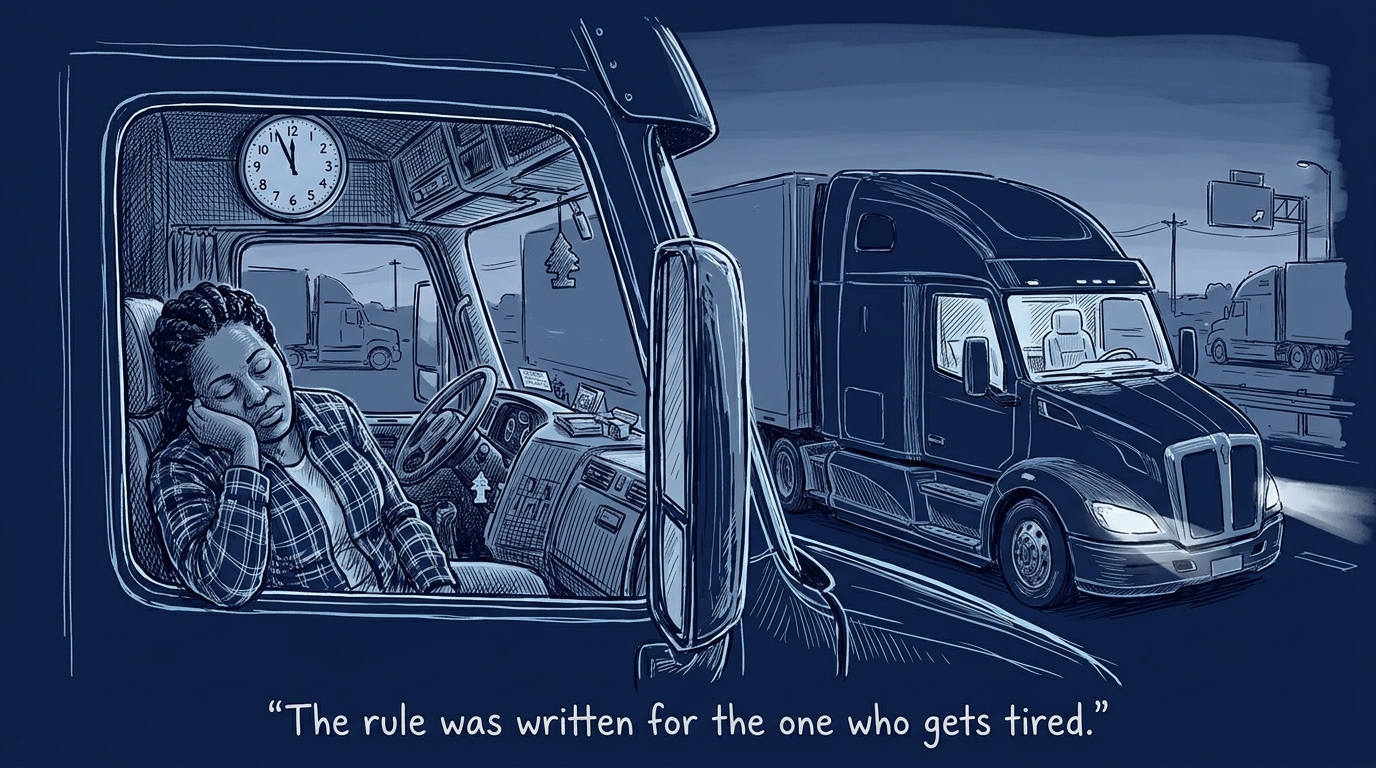
Federal law caps a commercial truck driver at 11 hours of driving in a day, inside a 14-hour on-duty window, before a mandatory rest break -- a real safety rule, not a formality, written to keep an exhausted person off the road at 70 miles an hour. Aurora Innovation's driverless trucks are already running a route that ignores that ceiling entirely: a roughly 1,000-mile lane between Fort Worth and Phoenix that takes more than 15 hours of continuous driving -- four hours past what the law allows a human to drive without stopping, on the same road, hauling the same freight.[1] The truck doesn't get tired, so the rule that exists specifically because a human does simply doesn't apply to it.
The rule was never written with a competitor in mind
Hours-of-Service regulation exists because drowsy driving in an 80,000-pound vehicle is genuinely dangerous, and the Federal Motor Carrier Safety Administration built the 11-hour/14-hour framework specifically to keep fatigue out of the cab. It was never written to handicap trucking against anything -- there was nothing else being regulated. That changes the moment one of the two things sharing a route is a system that doesn't fatigue at all. A regulation built to protect people ends up binding only one side of a competition once the other side stops being a person.
The mechanism, named plainly. This isn't a story about a machine being cheaper per mile, though it likely is. It's a case where a genuine, well-justified safety regulation on human labor becomes, without anyone intending it, a structural competitive disadvantage the moment an unregulated alternative exists to do the same job. Nobody has to argue the machine is "better" at driving. It just isn't bound by the rule that was written for the thing it's replacing -- and on a fixed, defined route, that alone is enough to move nearly twice as fast.
This is already running, not a pilot waiting for approval
Aurora has logged more than 250,000 driverless miles on public roads with zero Aurora Driver-attributed collisions, and tripled its driverless network to 10 commercial routes across the Sun Belt.[1] The company's own 2026 investor guidance targets exiting the year with more than 200 driverless trucks in commercial operation and roughly an $80 million revenue run rate on its Transportation-as-a-Service business.[2]
Kodiak AI is running the same transition in a different lane: its driverless fleet for Atlas Energy Solutions, hauling sand for oilfield operations, grew to 28 trucks by the end of March 2026, with a delivery schedule already agreed to reach 100 by mid-2027. In July 2026 the two companies completed the first-ever autonomous triple-trailer haul -- a single driverless truck pulling three connected trailers, more than 135 tons combined -- which Kodiak and Atlas describe as the world's largest fleet of driverless big rigs.[3] And the software layer may not stay locked to one manufacturer's hardware: Waabi transferred its AI "virtual driver," originally trained on a Peterbilt 579, onto Volvo's VNL Autonomous platform with no new data collection, simulation, or retraining -- what the company calls zero-shot generalization -- and reports the Volvo truck drove safely on public roads from its first mile.[4]
What's actually at stake in headcount, not just miles
Trucking supports 8.4 million industry-related jobs in the US, including 3.58 million professional drivers, per the American Trucking Associations' own 2025 industry survey.[5] The federal government counts a narrower slice directly: 2.06 million heavy and tractor-trailer drivers specifically, with a median annual wage of $58,640.[6] It's also one of the fastest, cheapest, most accessible licensed trades in the country -- a commercial driver's license takes a national average of 79 days to earn, licensed in all 51 states, alongside cosmetology, barbering, and manicuring in the same low-barrier tier of the Institute for Justice's occupational-licensing survey.[7]
11 hrslegal daily driving cap for a human trucker under federal Hours-of-Service rules
15+ hrscontinuous driving time on Aurora's driverless Fort Worth-Phoenix route -- no stop required
8.4MUS jobs supported by the trucking industry, including 3.58M professional drivers
Why does this matter? The honest version of this story isn't "robots are coming for truck drivers" -- that framing has been said about every wave of automation and it flattens a genuinely specific mechanism into a generic fear. The specific mechanism here is narrower and sharper: a safety law written to protect a human body from fatigue has, as a pure side effect, become a real timing and throughput advantage for whichever competitor doesn't have one. That's not a flaw in the Hours-of-Service rule -- fatigue is real and the rule should stay. It's a genuinely new question the rule was never built to answer: what happens when the thing the regulation protects and the thing competing against it are no longer the same category of driver at all. Trucking is a fast, cheap, widely licensed path into real paid work for 3.58 million people right now. The regulation that keeps them safe on the road is, for the first time, also the exact measure of how much faster the alternative to them can move.
But the cost isn't only what happens to the 3.58 million people driving today. Trucking is also one of the largest first-job on-ramps into the American labor force -- a real income floor reachable in 79 days, with no degree, no credential, and no network required, in any of 51 states. A safety regulation can protect the people already inside a trade. Nothing in this story protects the on-ramp itself once the trade stops needing entry-level drivers at all -- and the people who would have used it next have no way to show up in this piece yet, because they haven't gotten there.
 Oluwadi