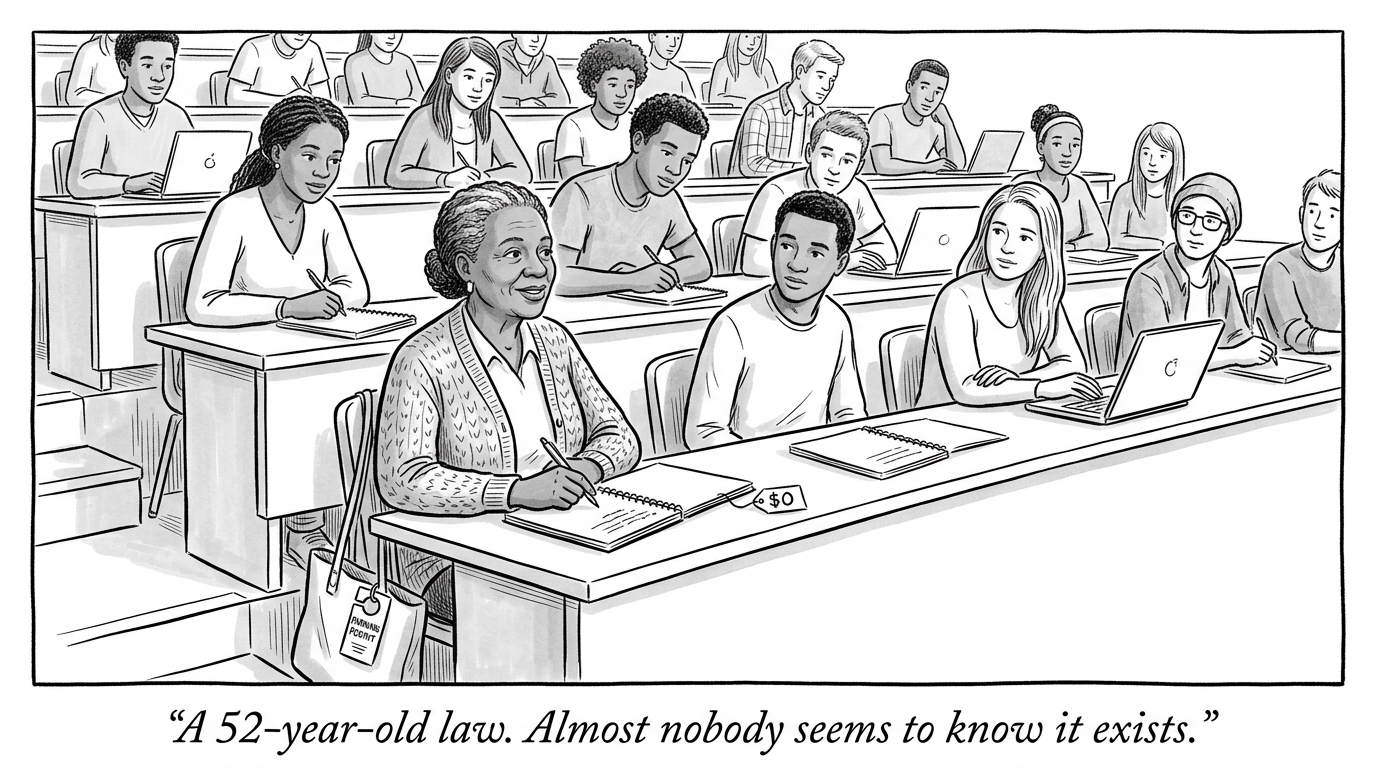
Start with the actual bill someone just paid, because it proves the law is not theoretical. A Virginia professional who recently turned 60 texted a simple report from a George Mason University construction engineering class: "I even get free parking because the state law doesn't let them charge fees. So far absolutely $0 for this class." Tuition, parking, everything -- zero dollars, for a real class at a real public university, this semester.
The law itself, and why "or fees" is doing more work than most people assume
Virginia's Senior Citizens Higher Education Act of 1974 is now 52 years old and still fully active. Virginia Code § 23.1-640 states the exemption plainly: "No senior citizen who enrolls in or audits courses... shall pay tuition or fees except fees established for the purpose of paying for course materials such as laboratory fees."[1] Most people who have heard of this law at all assume it covers tuition. The actual statutory language covers tuition and fees, with the single, narrow exception of charges tied directly to course materials -- lab fees, and similar. A parking fee is not a course-material fee. Under the statute's own wording, it is simply one more fee a senior citizen does not pay.
Two real tracks, with different rules attached to each
The law splits into two distinct paths, and confusing them is the most common way someone assumes they don't qualify when they actually do.[2]
Auditing a course -- taking it for no credit, no grade -- is open to any Virginia resident 60 or older, at any Virginia public institution of higher education, regardless of income, with no exceptions. This is the track behind the $0 George Mason class above.
Taking a course for actual academic credit toward a degree carries one real restriction: the applicant's Virginia taxable income in the preceding year must be $23,850 or less, a figure confirmed as current across multiple Virginia public university financial-aid offices.[3] Seniors using either track are seated only after tuition-paying students have registered -- a space-available basis -- with one further carve-out: a senior who has already completed 75 percent or more of the requirements for a degree registers alongside paying students instead of waiting.[2]
1974Year the Senior Citizens Higher Education Act was enacted
$23,850Income cap for the credit-toward-a-degree track only
$0Total cost of one real class, this semester, audit track
A 52-year-old, statewide, genuinely valuable law with essentially no income requirement on its most accessible track, and a great many eligible Virginians have never heard of it. This is not a hidden loophole or a recent policy change nobody had time to learn about. It has been sitting in the Virginia Code since 1974, available at every public community college and university in the state, to every resident who turns 60. What kept it from being common knowledge was never secrecy -- it was simply that no institution has a strong, ongoing incentive to advertise a program that fills otherwise-empty seats for free. A senior citizen finding out is left almost entirely to chance: a friend who happens to have used it, a text message, rather than any structural channel actually built to reach the people it was written for.
Why does this matter? The gap here is not between people who could benefit and people who couldn't. It is between people who happen to have encountered the fact that this exists and people who haven't -- a distinction with nothing to do with need, income, or education, and everything to do with which conversations someone happened to be part of. A benefit with no marketing budget and no natural audience it reaches on its own stays invisible precisely because nothing about not knowing it exists looks any different, from the outside, than not qualifying for it.
 Oluwadi