 Oluwadi
Investigating the Overlooked
Region
What
Who For
Analysis
Oluwadi
Investigating the Overlooked
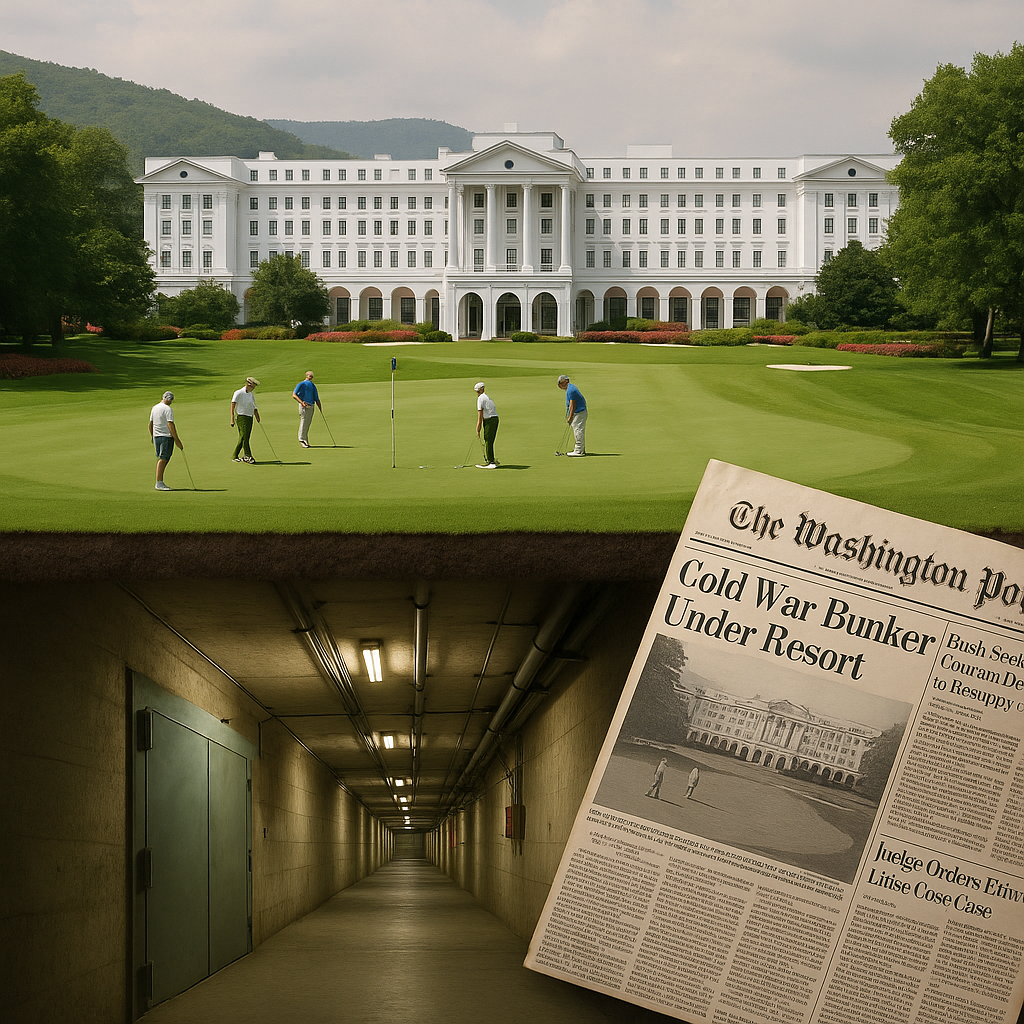
Guests at The Greenbrier, a luxury resort in White Sulphur Springs, West Virginia, spent thirty-four years golfing, dining, and sleeping directly above a classified government bunker built to shelter the entire United States Congress through a nuclear war. Almost none of them knew it was there. Neither did most of the resort's own staff.
The bunker was built between 1959 and 1961, disguised as something real and ordinary: a genuine new hotel wing, the "West Virginia Wing," constructed on the surface at the same time as the classified structure beneath it. The finished facility ran to roughly 112,500 square feet, built into the side of a hill under twenty to thirty feet of earth and rock — not buried straight down, but tucked sideways into the terrain, which is part of why guests walking the grounds never noticed anything unusual.[1][2] Its official purpose, part of the Cold War's continuity-of-government program: shelter all 535 members of Congress, plus enough staff to keep the government functioning, for up to 50 to 60 days after a nuclear strike on Washington.[1]
Keeping that secret for over three decades took a genuine cover operation, not just a locked door. A dummy company called Forsythe Associates, ostensibly a television repair outfit responsible for the hotel's 1,100 television sets, staffed the site permanently — twelve to fifteen government employees who spent roughly 80 percent of their time maintaining the bunker and the rest doing enough real TV repair to make the cover hold. Its first manager, John Londis, was a former Army Signal Corps cryptographer. Every worker passed an FBI background check and signed a non-disclosure agreement; bunker phone calls were routed through the hotel's own switchboard so they'd appear to originate from the resort itself.[1][3]
Inside: eighteen dormitories with sixty bunks each, enough beds for over a thousand people. A hall sized to seat the full 435-member House, a smaller chamber for the 100-member Senate. A twelve-bed medical clinic with an operating room. A power plant, water tanks, an air-filtration system, a decontamination room. A television studio built with changeable backdrops of the actual Capitol building, wired to a hundred-foot radio tower more than four miles away, capable of broadcasting to the entire country if Washington itself went dark. The largest blast door weighed 28 tons and was rated to survive a detonation fifteen to thirty miles away.[1][2]
Washington Post reporter Ted Gup published "The Ultimate Congressional Hideaway" on May 31, 1992, after the Washington Times had run a shorter version two days earlier. How Gup actually got onto the story has never been definitively established; the government itself may have had a hand in it, since by 1992 the bunker was an expensive, aging relic of a threat model — bombers taking hours to cross the pole — that ballistic missiles had made obsolete in minutes. Gup's own later description of what he was actually reporting on: "The bunker mentality that preserved that place was itself a threat to national security."[4][1]
House Speaker Thomas Foley personally asked the Post's executive editor to kill the story, reportedly warning that publishing it would force the government to shut the facility down immediately.[3] He was right about the consequence, even if it didn't change the outcome. Decommissioning began essentially the next day; the full process — stripping equipment, ending the government's contract with the site — took about three years. Greenbrier employees and hotel guests could tour the declassified bunker starting in 1995.[1]
The government's own figures on what it spent are more modest than the scale of the secret. Construction ran about $14 million — roughly $140 to $150 million today. By the late 1980s, annual upkeep alone ran well over $1 million, including a documented $227,000-a-year line item just for rotating the food supply so it stayed edible.[1][2]
The bunker tour is a real, ongoing business today: $52 for adults, $24 for youth, ninety minutes, no cameras or phones allowed — a restriction that outlived the Cold War, because a meaningful portion of the underground space is now leased to CSX for secure commercial data storage.[5] Roughly 30,000 to 35,000 people take the tour every year, walking through a facility built to be the last functioning seat of American government and never once used for that purpose.[6]
The Greenbrier itself has been owned by the Justice family since 2009, when Jim Justice bought it out of bankruptcy; Justice, who served two terms as West Virginia's governor, was sworn in as a U.S. senator in January 2025.[7][8] In April 2026, a subsidiary of TRT Holdings — the parent company of Omni Hotels & Resorts — bought roughly $289 million of Justice family business debt from Carter Bank. The Justice family sued, alleging the bank and TRT Holdings had conspired to force them out of the resort entirely; a separate action sought a judgment against Greenbrier Hotel Corp. of more than $52 million.[9][10][11] By August 2026, the family had resolved it — a new financing partnership with Kennedy Lewis Investment Management, the prior lender's case dismissed.[12]
It's a strange, almost literal echo of the building's own history sitting directly above the bunker: a piece of West Virginia ground that mattered enough for someone to fight hard, quietly, over who actually controlled it — the government once, hidden from the public it was meant to protect; a hedge fund and a hotel chain more recently, largely invisible until a lawsuit forced it into the open. The bunker was built on the premise that whoever controls a hardened, hidden piece of ground controls what happens when everything else fails. Sixty years later, that's still the fight — just fought with credit agreements instead of blast doors.