Aging takes hearing, sight, the body's control. A rail has solved the logistics for decades; what a robot shaped like a person might give back is something else. A piece about frailty, recognition, and who decides.
My great-grandmother was born in 1919 on a farm. I will never know what that felt like.
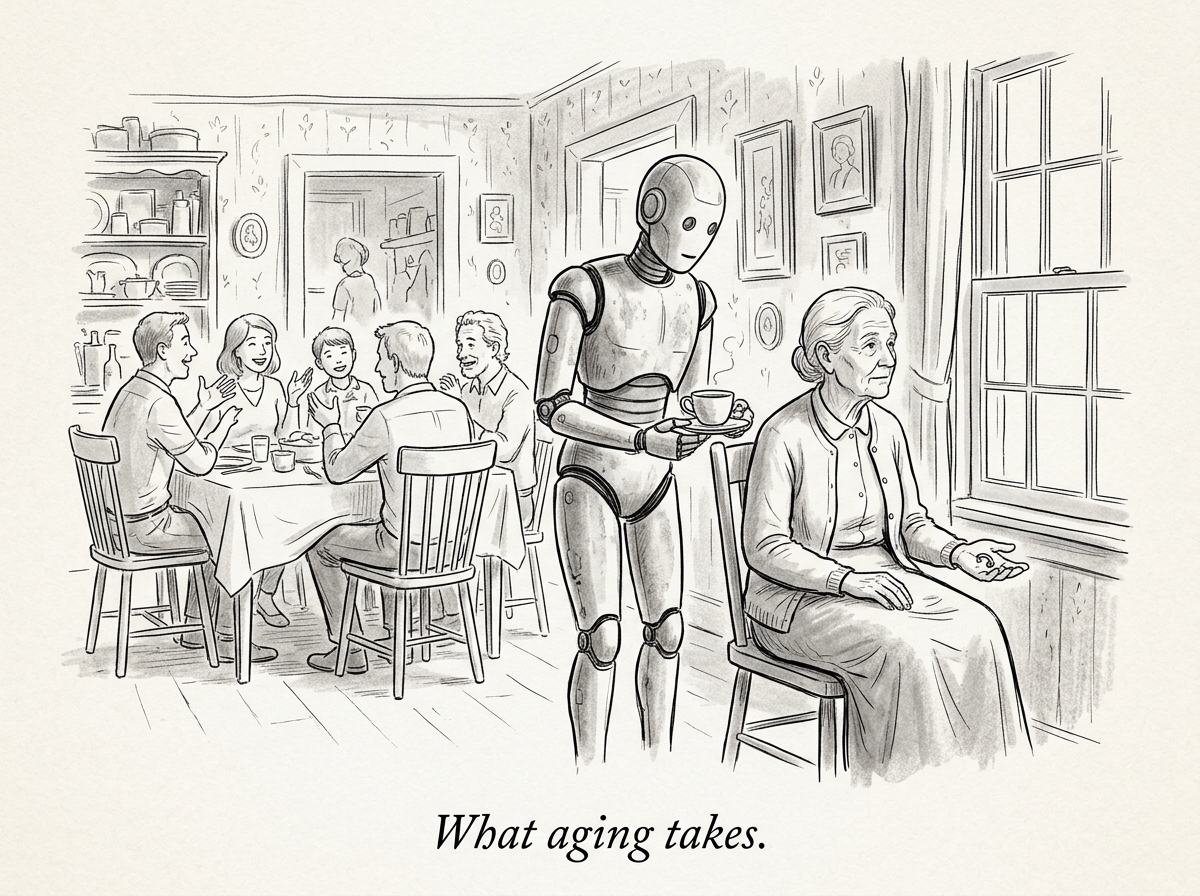
Near the end of her life she lost her hearing. She did not have dementia. Her mind was all there. What she lost was the way in and out of it. The people around her talked, and she could not follow. She had things to say, and the conversation moved on without her. She was, in effect, trapped inside her own mind.
I think about that more than I expected to.
Aging takes, and it does not take the same thing from everyone. For some people it is hearing. For others it is vision. For others it is the body's control, as it is with Parkinson's, or the memory itself, as it is with Alzheimer's. The losses are different, but they share a habit: they tend to arrive late, and sometimes they arrive when the person has the most to offer. Someone who has spent eighty or ninety years learning how things work and how people behave has more to give the world than at any earlier age, and the way to give it is closing.
That is my reading, not a finding. But it is the question I keep coming back to: what happens to what a person knows when the channel closes?
Not every loss is a lost channel. Alzheimer's takes the memory itself, and no new body would give that back. My great-grandmother's case was the other kind. The mind was there. The way out was gone.
I am writing about her because of what some of the largest companies in the world are now building. They are putting real money into robots shaped like people, and I keep asking why they chose a human shape. I do not know their reasons. I know what a body that could hear, speak and move would have done for her, and I know which problem I would have wanted it to solve.
A rail and a robot
I buy from B&H, and I have been in the store. It is large and divided into sections: film, paper, camera bodies, studio lights. You do not carry anything. The salesperson prints a ticket, puts what you bought into a crate, and sends it along a rail to the cash wrap, where it waits for you. If you buy from more than one section you end up with more than one ticket, and the crates meet at the register. No AI, no robot, nothing shaped like a person.
It solves a problem every factory has. Parts start in different places, and they have to arrive at one place in the right order. In September 2026 Boston Dynamics opened a training center inside Hyundai's Georgia car plant, and what it says its humanoid Atlas is learning there is "preparing the logistics and sequencing of automotive parts before placing them in the correct order for assembly."[1] Assembly is a target for 2030. Hyundai plans 25,000 of the robots at its plants over the next few years, and a new U.S. factory able to build 30,000 a year.[1] Hyundai has also been simulating Atlas on its assembly lines in a digital copy of the plant, using NVIDIA's software.[2]
Those are plans. Boston Dynamics itself still calls Atlas "our electric humanoid platform currently in development."[1] And car makers have had robots for decades, none of them humanoid: factories were rebuilt around the machine, not the other way around. The B&H rail is the old, plain answer to the same problem. In my reading, logistics alone is a weak reason to build a robot that looks like a person.
What a rail cannot do
So why a person's shape? The human reason is frailty. A body is the first thing to fail. In my great-grandmother's case it was her ears, and a mind that was entirely there could no longer get out. A rail moves a crate. It does not move a person back into the room.
Robots are frail in their own way. One analysis puts the average humanoid in 2026 at under 2.5 kilowatt-hours of battery, with runtimes clustering between two and four hours, and argues that the battery, not the AI, now caps the industry.[3] My body needs sleep, but it does not power down. A machine does, and it stays down until someone plugs it in.
One capability, three companies
Elon Musk's companies are a useful place to look, because they are building most of the pieces at once. In February 2026 SpaceX acquired his AI company xAI in an all-stock deal that valued SpaceX at $1 trillion and xAI at $250 billion; the combined company's stated goal was space-based data centers.[4] Tesla's own first-quarter 2026 report says its first large Optimus factory is a line designed for a million robots a year at Fremont, replacing the Model S and Model X lines, with a second line planned for Texas designed for ten million a year.[5] The same report says Tesla's partnership with SpaceX aims to build "the largest chip fab ever."[5] On Tesla's third-quarter call, on October 21, the stated target was 20,000 Optimus units a week within about a year, and Musk said the early ramp would have a "shallow slope" and be "somewhat bumpy."[6]
That is three companies and one pattern: AI, a body for it, the chips that run it, and a way to launch what it needs. My reading is that it is one capability built through separate companies. That is a reading of the record, not something any of them has said.
NVIDIA is in the same picture from another side. Its software is how Hyundai rehearses Atlas, how Mercedes-Benz rehearses Apptronik's Apollo humanoids, and how two other firms test fleets of Agility Robotics' Digit, all before the robots touch a real part.[2]
The books we read as kids
We build the future we read about as kids. I have said this about space and about data, and it fits here too. Three stories are the ones I think of.
In Isaac Asimov's Foundation, an Encyclopedia Foundation is set up to preserve the Empire's knowledge so that the collapse everyone expects will be shorter.[7] It is the answer that passes capacity on to others. Its founder, Hari Seldon, also appears as a prerecorded message, a mind that persists only for moments someone planned.[9] And Asimov's R. Daneel Olivaw is the first humaniform robot, built to work among people; by the later books he has survived for thousands of years, replacing much of his body with new hardware.[10] The television series adds something the novel's summary does not have: an empire ruled by a dynasty of clones of Cleon I, secretly administered for centuries by Demerzel, an ageless humanoid robot.[8]
Clones are not the same thing as continuing. A clone copies a genome. It does not carry a mind. People clone their pets and the result is a new animal. What I am describing is different: the same person continuing, in a body that lasts. For my great-grandmother, that would have fixed the problem.
The other story is William Gibson's "Johnny Mnemonic," published in 1981, and the 1995 film for which Gibson wrote the screenplay. It was a bad movie, and it had the right theme. In the film, Johnny carries data in a storage device implanted in his brain "at the cost of his childhood memories."[11][12] The mind was a container, and the container had a price.
The same boat
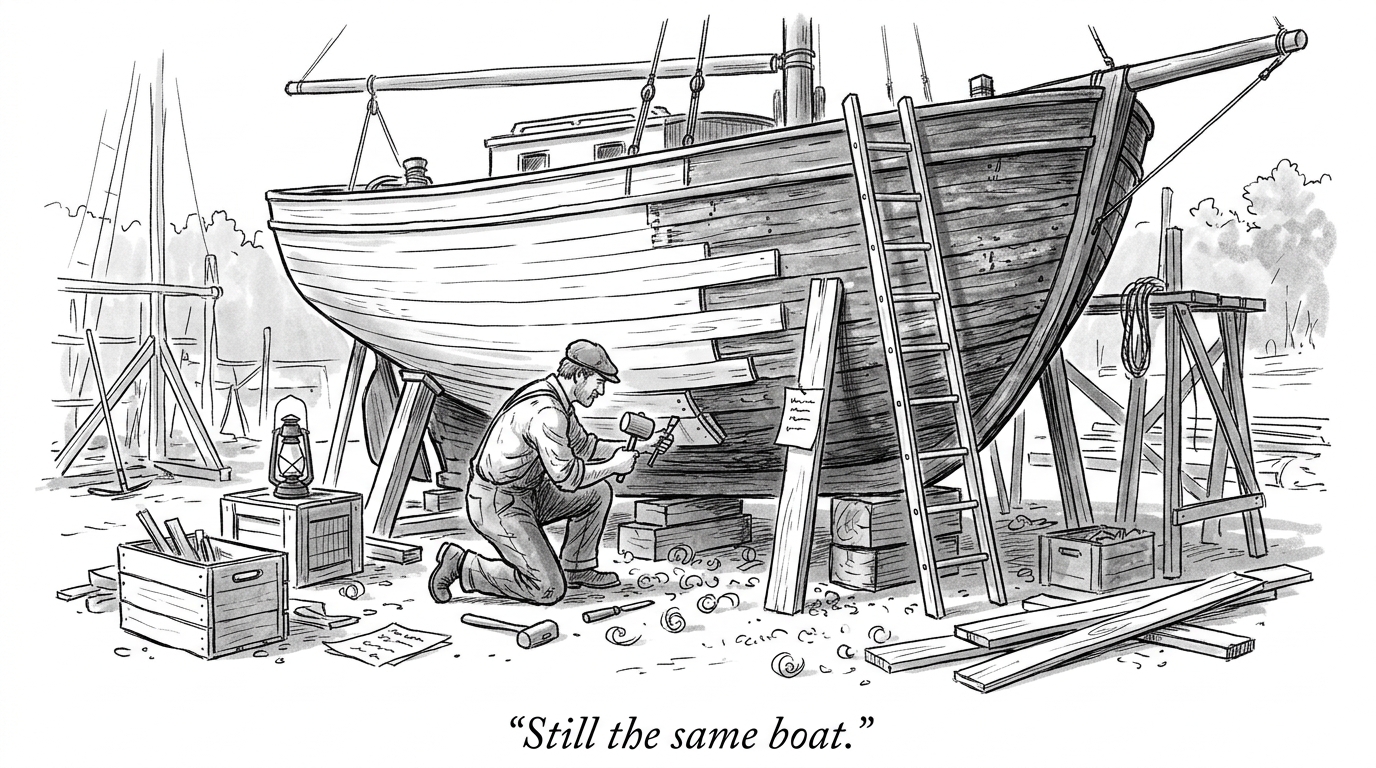
When you rebuild a boat, it is still the same boat as long as you do not do it all at once. I think that is especially true of wooden vessels. That is what I have learned from boats, not a finding. The old puzzle has a name. Plutarch told it about the ship of the Greek hero Theseus, which the Athenians kept for generations by replacing its rotted timbers one at a time, and people argued about whether it was still the same ship.[14] The English philosopher Thomas Hobbes added a twist: what if someone built a second ship out of the planks that were taken off?[14] The U.S. Navy's USS Constitution, launched in the 1790s, is the real version. About 85 percent of her was renewed in a restoration finished in 1930, and the Navy now estimates that only 10 to 15 percent of her timber is original. She is still the Constitution.[15]
The stories sort the same way. Nebula, in the Marvel films, was raised alongside her adoptive sister Gamora. After every fight she lost, Thanos had a piece of her replaced with a cybernetic part, until she was largely a machine.[13] To me she is still Nebula, and still Gamora's sister. Daneel, over thousands of years, replaced much of his body and is still Daneel.[10] Those are gradual. An upload is all at once. And Hobbes's second ship, the one built from the discarded planks, is the copy standing next to the original.
But I should be honest about what this is. It is not logic. If every plank is gone, no argument says it is the same boat, and no argument says it is not. Humans sort oddly, and the sorting is emotional. A change that happens a little at a time feels like the same thing continuing. A change that happens all at once feels like a loss, even when the result is identical. I cannot prove that. It is what I notice in myself and in how people talk about boats, and about each other.
It also runs the other way. What you believe makes a thing itself changes how a replacement feels, and the feeling changes what you believe. I have done this with a car. I have replaced the engine in my 911, and the clutch, and the transmission: basically the entire car except the body. Is it the same car? My answer is that it is an enhanced version of the same car. The engine I put in makes about 100 horsepower more than stock. It is the car's equivalent of an exoskeleton. I notice that the answer depends on which part I decide the car is: if it is the engine, it is a different car, and if it is the body, it is the same one, improved.
Restoring is not the same as enhancing. My engine adds to the car. An exoskeleton adds to the person inside it. My great-grandmother did not need more than she had. She needed back what she had lost, and a hearing aid does that. Which of the two the companies are building is something I would want to know. A person is harder than a car. Is she her memory, her voice, her body, or what the people who loved her recognize?
The stories split the same way. Nebula's parts were not restoration. Thanos had a piece of her replaced after every fight she lost, until she was largely a machine.[13] In my reading that is enhancement, and enhancement done to her, not chosen by her. Daneel's replacements over thousands of years, as I read them, kept him going; the sources say he replaced much of his body, not why.[10] My great-grandmother would have wanted restoration, and she would have wanted to choose it. Replacing a body can mean getting back what you lost, being made into something stronger, or being kept going, and the person who decides makes the difference between a gift and a loss.
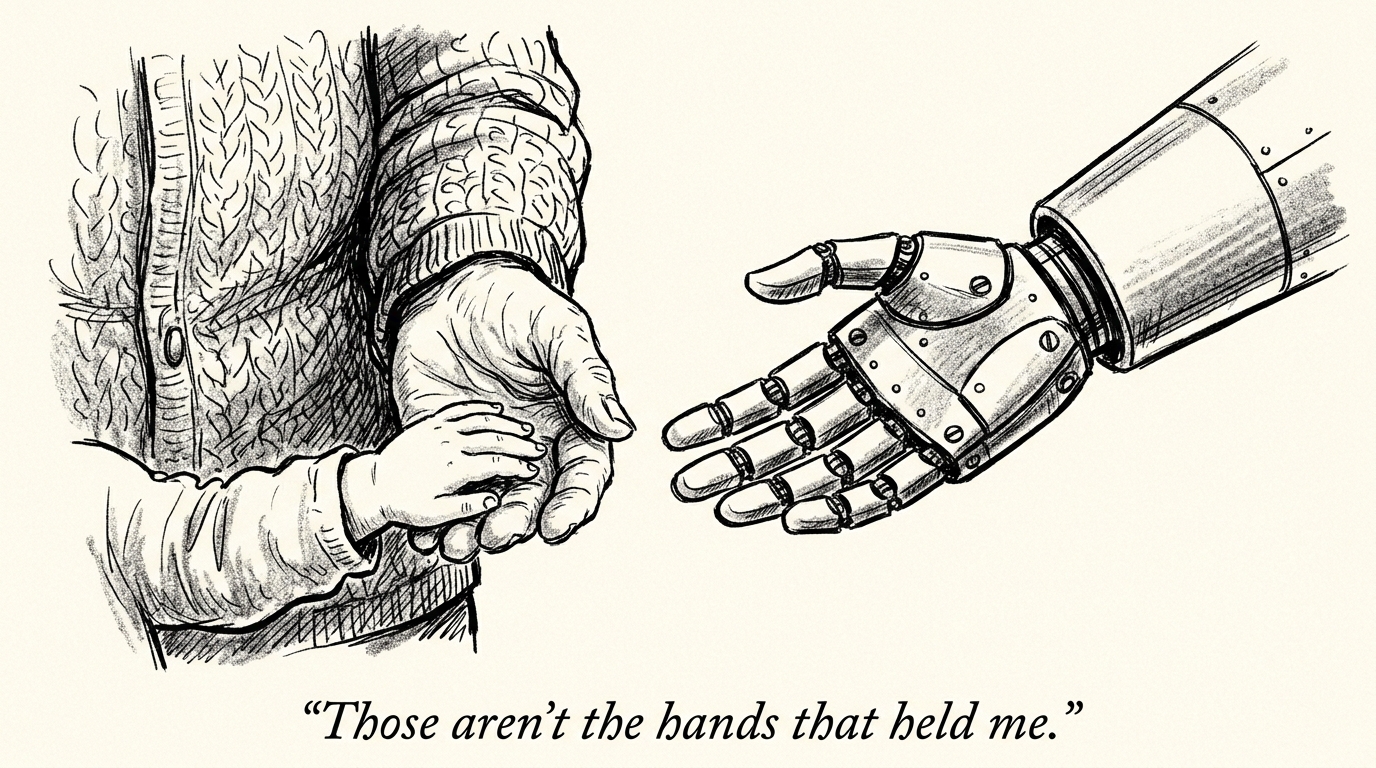
What has been missing from all of this is recognition. My great-grandmother with hearing aids, or with implants to give her back her sight, would still be herself, and I would know her. Her mind in a new body would not be the hands that held me when I was five. I would not recognize them, and recognition is what I would be looking for. It is not a test a mind passes. It is something someone else does, with a body they remember.
That matters more than it looks. If a mind ever moved into a body that does not age, the question of whether it is her will not be settled by an argument. It will be settled by how it feels, first to the people who loved her, and then, if she can say, to her. A small path, a hearing aid and then a better one and then something more, might feel like her continuing where a single transfer would not. That is a guess about feelings, and the piece leaves it open.
Two costs and an open question
Johnny's body was organic. Its room was fixed, so storing the data pushed out his own memories. A humanoid is not organic. Its storage is hardware and can grow. The cost of that body is elsewhere: energy. A robot has to stop and recharge, as my Roomba docks, and today's humanoids last a few hours.[3]
Two questions remain, and I cannot answer either.
Would it be her? If a mind could move into a body that does not age, would that be the same person continuing, or a copy that believes it is her? Nobody can test that today, and I will not argue it either way.
Would the felt part come through? My great-grandmother lived through an organic body: weather, hands, a farm. I will never know what that felt like, and I do not know whether a different body could carry it.
What I do know is what the loss looked like. A person who had a great deal to say, in a house full of people, could not reach any of them. The companies building humanoids have their reasons and I do not claim to know them. I know which problem I would have asked them to solve.
What to ask
The next time a company says it is building a robot shaped like a person, ask three things:
What is it for? If the job is moving parts to the right place in the right order, a rail has been doing that for years.
What does it cost to run? Not the price, the hours. Today the answer is a few hours between charges.
Who is it for? Not the factory, the person. The one who has the most left to give and the least way to give it.
This is the author's reading of the record. The sources are listed below. Where the sources disagree, or where the piece gives the author's opinion or memory, it says so.
Sources
Boston Dynamics, "Boston Dynamics Opens Robotics Metaplant Application Center to Train Humanoid Robots for Manufacturing Tasks," press release, September 21, 2026: https://bostondynamics.com/news/boston-dynamics-opens-robotics-metaplant-application-center-to-train-humanoid-robots-for-manufacturing-tasks/ (read in full; the quoted logistics and sequencing sentence, assembly by 2030, 25,000 units, a U.S. facility for 30,000 robots a year, and the "currently in development" description).
NVIDIA, "NVIDIA Omniverse Physical AI Operating System Expands to More Industries and Partners," press release, March 18, 2025: https://nvidianews.nvidia.com/news/nvidia-omniverse-physical-ai-operating-system-expands-to-more-industries-and-partners (read; Hyundai Motor Group simulating Boston Dynamics Atlas on its assembly lines; Mercedes-Benz simulating Apptronik's Apollo; Schaeffler and Accenture testing fleets of Agility Robotics' Digit). This release is from March 2025.
"The Humanoid Robot Bottleneck Is the Battery: Why Two Kilowatt-Hours Caps the Whole Industry," technologies.org: https://technologies.org/the-humanoid-robot-bottleneck-is-the-battery-why-two-kilowatt-hours-caps-the-whole-industry/ (read; an analysis essay, not manufacturer test data; under 2.5 kWh average pack, runtimes of two to four hours).
Sloan Speck, "What the xAI Acquisition Means for a SpaceX IPO," TaxProf Blog, March 21, 2026: https://taxprofblog.aals.org/2026/03/21/what-the-xai-acquisition-means-for-a-spacex-ipo/ (read; SpaceX acquired xAI in an all-stock deal in late January or early February 2026, valuing SpaceX at $1 trillion and xAI at $250 billion, with space-based data centers as the combined goal; the post notes the figures came without bank fairness opinions).
Tesla, Inc., "Q1 2026 Update," Exhibit 99.1 to Form 8-K, U.S. Securities and Exchange Commission: https://www.sec.gov/Archives/edgar/data/0001318605/000162828026026551/exhibit991.htm (read in full; the Optimus line designed for 1 million robots a year at Fremont, a second line designed for 10 million a year in Texas, and the SpaceX chip-fab partnership).
"Tesla (TSLA) Q3 2026 Earnings Call Transcript," The Motley Fool, October 22, 2026: https://www.fool.com/earnings/call-transcripts/2026/10/22/tesla-tsla-q3-2026-earnings-call-transcript/ (read; the 20,000-per-week target within about a year, and Musk's "shallow slope and is somewhat bumpy" remark).
"Foundation (Asimov novel)," Wikipedia: https://en.wikipedia.org/wiki/Foundation_(Asimov_novel) (read; the Encyclopedia Foundation established to preserve the Empire's knowledge; the novel's summary mentions no clones).
"Foundation (TV series)," Wikipedia: https://en.wikipedia.org/wiki/Foundation_(TV_series) (read; the Cleonic "genetic dynasty" of clones of Emperor Cleon, and Demerzel, "secretly a unique, ageless humanoid robot").
"Hari Seldon," Wikipedia: https://en.wikipedia.org/wiki/Hari_Seldon (read; Seldon appears as a prerecorded hologram and his prerecorded messages continue through the series).
"R. Daneel Olivaw," Wikipedia: https://en.wikipedia.org/wiki/R._Daneel_Olivaw (read; the first humanoid or "humaniform" robot, working with a New York police detective; in the later books he has survived for thousands of years and replaced much of his body with new hardware).
"Johnny Mnemonic (film)," Wikipedia: https://en.wikipedia.org/wiki/Johnny_Mnemonic_(film) (read; directed by Robert Longo, screenplay by William Gibson, 1995; Johnny carries data in a brain implant "at the cost of his childhood memories").
"Johnny Mnemonic (short story)," Wikipedia: https://en.wikipedia.org/wiki/Johnny_Mnemonic_(short_story) (read; Gibson's story, first published in Omni, May 1981).
"Nebula (Marvel Cinematic Universe)," Wikipedia: https://en.wikipedia.org/wiki/Nebula_(Marvel_Cinematic_Universe) (read; adoptive sister of Gamora; "After every loss, Thanos would have a piece of Nebula replaced with a cybernetic part, transforming her into a cyborg").
"Ship of Theseus," Wikipedia: https://en.wikipedia.org/wiki/Ship_of_Theseus (read; Plutarch's Life of Theseus, the Athenians replacing rotted timbers, and Thomas Hobbes's second ship in De Corpore, 1655).
"USS Constitution," Wikipedia: https://en.wikipedia.org/wiki/USS_Constitution (read; about 85 percent of the ship "renewed" by the March 1930 dry-dock restoration; the Navy detachment estimates 10 to 15 percent of her timber is original, from 1795 to 1797).
 Oluwadi