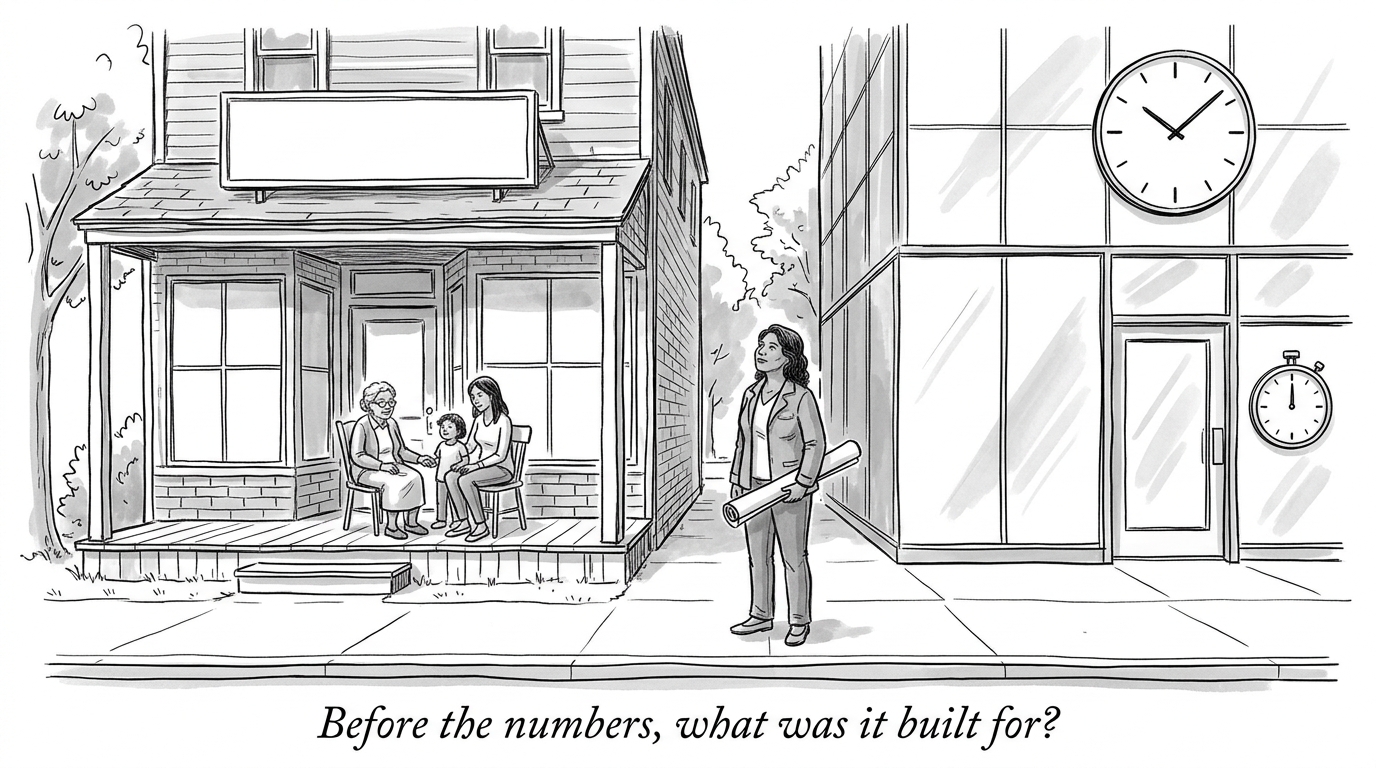
A company's numbers do not say what it was built to do. Revenue, margins and growth describe what it is doing now. They are silent on what it is for, and that silence is where a good many investments go wrong.
A company's numbers do not say what it was built to do. Revenue, margins and growth describe what it is doing now. They are silent on what it is for, and that silence is where a good many investments go wrong.
## Three kinds of company, sorted by purpose
Some businesses are built to be passed down. Wawa began in 1803 as an iron furnace started by David C. Wood in New Jersey, and the Wood family's investments later evolved into the dairy and the convenience stores, according to the Hagley Museum.[1] The Wood family still holds the land around its headquarters and dairy farm.[2] 84 Lumber was incorporated in 1956 by Joe Hardy, who named his daughter Maggie his heir apparent in 1991; she became president in the early 1990s (one account says 1993, another 1992).[3][4] Neither company stayed the same. What was meant to last was the family's hold on it.
Some are built to support the owner's life. One business glossary defines a lifestyle business as one built to support the founder's life and income rather than to maximize growth on outside investment, and says the term began inside venture capital as a dismissal for companies too small to return a fund, before founders reclaimed it as a deliberate choice.[5] That is one source's account, not a settled definition. The point survives either way: the owner is not trying to sell.
And some are built for investors who expect an exit. Private equity funds are typically limited partnerships with a fixed term of ten years, often with extensions.[6] A Canadian law firm describes the same shape for private equity and venture funds: ten years, with the general partner able to add one or more one-year extensions.[7] Venture funds are described as maturing in ten to twelve years, with a few years of extension possible.[8] A company backed by a fund like that is being asked, among other things, to be sellable by a date it did not choose.
## "Built to be passed down" is an intention, not a result
It is easy to read the first kind as safe. It is not. The statistic people quote, that 30 percent of family businesses reach the second generation and 13 percent the third, is, according to Family Business Magazine, wrong as usually told. It traces to John Ward's 1987 study of 200 randomly selected Illinois manufacturers listed between 1924 and 1984, and the magazine says it is often misquoted: Ward wrote that 13 percent last *through* three generations, and people repeat it as *to*, which cuts the life expectancy of those firms by at least thirty years.[9] The magazine also warns that the study cannot be stretched to all family businesses, in all industries, in all economic times.[9] So the honest summary is that being built to last is a purpose, and the evidence on how often it works is thinner than the folklore.
## Companies can change what they are for
A company can change purpose without anyone changing its name. In 2005, Eddie Lampert, who ran the hedge fund ESL Investments, took control of Sears through Kmart.[10][11] A year after the merger the Associated Press described him as the billionaire chairman of the combined company.[12] In October 2018 Sears Holdings filed for Chapter 11, and Lampert stepped down as chief executive, remaining chairman.[13] An investor's fund has its own ledger and its own clock, and a company inside it can find itself serving a purpose its founders never had in mind. That is my reading; the sources report the events.
Kodak shows the other way to miss. Its leaders were career people whose futures were bound to the company, and Kodak filed for Chapter 11 in January 2012.[14][15] I wrote about this earlier: the commitment pointed at the health of the business Kodak already had, not at the company's survival past it.[16] Kodak was built for something, and that something ended.
## Why this decides whether an investment makes sense
An investor has a purpose too: a fund's life, a family's generation, a retirement date. The question that matters is whether the two purposes line up. The philosopher James P. Carse distinguished finite games, played to win and so to end, from infinite games, played to continue the play.[17] A company built to be passed down is playing the infinite game. A company built for an exit is playing the finite one. Neither is wrong, but putting money into one while expecting the behavior of the other is how people get surprised. That fit is my inference, not a finding in the sources, and it is the part worth testing against your own case.
Three questions to ask before the financial ones:
1. What was this company built for: to be passed down, to support its owner, or to be sold?
2. Who holds it now, and what ends that holder's game?
3. Does the company's purpose and the holder's clock match what I am trying to do with my money?
The same idea, aimed at the person holding the company and not at the company itself, is in "What Ends Your Game?"[18]
*This is the author's account and is not investment advice.*
Before you ask what a company is worth, ask what it was built for.
 Oluwadi