 Oluwadi
Investigating the Overlooked
Region
What
Who For
Analysis
Oluwadi
Investigating the Overlooked
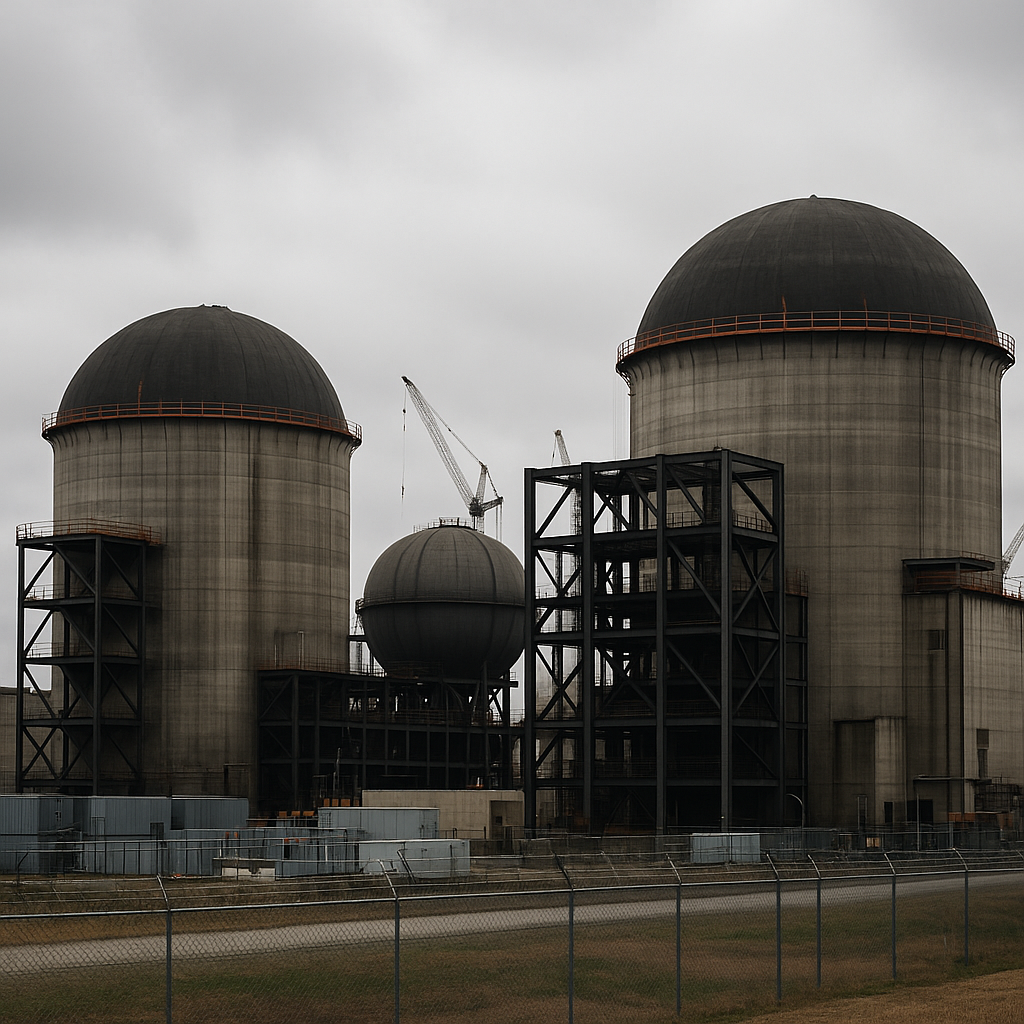
On July 31, 2017, the board of Santee Cooper, South Carolina's state-owned utility, voted unanimously to stop building. SCANA, the private utility that owned the other 55 percent of the project, announced the same decision the same day.[1] Between them, the two utilities had spent roughly $9 billion — SCE&G's share alone ran to $5.3 billion, Santee Cooper's to $4.7 billion — building two new nuclear reactors at the V.C. Summer plant near Jenkinsville.[2] Neither reactor ever produced a watt of power.
Construction on the first of the two AP1000 reactors began in March 2013, the first new nuclear construction start in the U.S. in over three decades.[3] By December 2011, the project was already announcing delays tied to design changes in the reactor modules.[4] The reactor design and construction firm, Westinghouse Electric — a subsidiary of Toshiba, and also the contractor on a nearly identical, equally troubled project in Georgia — filed for Chapter 11 bankruptcy on March 29, 2017, wiped out by cost overruns on both projects at once.[5] The bankruptcy eliminated the fixed-price protections the utilities thought they had. Santee Cooper's own revised estimate that summer put the cost to actually finish the plant at $11.4 billion, roughly 75 percent above the original projection.[2] Four months after Westinghouse collapsed, both owners walked away.
A 2007 South Carolina law, the Base Load Review Act, let SCE&G raise customer rates before the plant was finished, tied directly to construction costs — and once the state Public Service Commission approved a project under the law, it became structurally difficult to deny further rate increases regardless of how the project was actually going.[6] SCE&G used that law to raise rates nine separate times while the project was underway, ultimately collecting more than $1 billion in increases from over 753,000 customers.[7]
In August 2015, the two utilities hired an independent firm, Bechtel, to assess the project's real status. Bechtel's findings, delivered that October and formalized in a February 2016 report, documented serious engineering and oversight failures. SCANA did not disclose the review to investors, and executives later gave testimony about the report's purpose that state regulators said "does not appear to be true."[8] The motive wasn't only the rate increases. The project also needed to hit an in-service deadline to qualify for up to $2.2 billion in federal production tax credits — and executives who knew internally that deadline was unreachable kept telling regulators and investors otherwise, to keep both the rate increases and the tax credits alive.[9]
Kevin Marsh, SCANA's chairman and CEO, pleaded guilty in February 2021 to conspiracy to commit mail and wire fraud. He was sentenced to two years in federal prison, a $200,000 fine, and $5 million in forfeiture — plus a concurrent two-year state sentence for a related fraud charge.[10] Stephen Byrne, the company's chief operating officer and the executive who directly oversaw construction, pleaded guilty in July 2020 to the same conspiracy charge for lying to regulators about the project's status in 2016. He was originally sentenced to 15 months in prison in 2023; in January 2025, a federal judge converted that sentence to home detention instead.[11]
Two Westinghouse employees were convicted alongside them. Carl Churchman, the company's on-site director at V.C. Summer, pleaded guilty in June 2021 to lying to FBI investigators about relaying falsified schedule projections to the utilities' own executives; his sentence was reduced to probation and home detention in 2023, at age 72, in exchange for cooperation.[12] Jeffrey Benjamin, Westinghouse's senior vice president for new plants, was the last of the four sentenced, in November 2024 — one year and one day in federal prison, after pleading guilty to aiding and abetting the falsification of corporate records tied to the same tax-credit deadline.[13]
The corporate and civil reckoning ran on four separate, non-overlapping tracks. The SEC fined SCANA and SCE&G a combined $137.5 million for securities fraud in December 2020.[14] A separate shareholder class action settled for $192 million.[15] SCE&G's own ratepayers — a third, distinct group — got roughly $2 billion back through ongoing bill reductions, negotiated as part of Dominion Energy's $13.4 billion acquisition of SCANA, completed January 2019.[16][17] Santee Cooper's own ratepayers, who couldn't be compensated through a stock-based settlement since Santee Cooper has no shareholders, separately recovered $520 million, covering more than 1.65 million customers.[18]
None of that made the debt disappear. Santee Cooper still carries roughly $3.6 billion in V.C. Summer-related debt, and its customers are still paying it down — rates rose $11 a month in April 2025 and another $5 in July, and the legislature has authorized up to $570 million in additional Santee Cooper debt to be repaid over the next decade.[19] In 2019, facing pressure to sell the utility outright to help cover the loss, South Carolina lawmakers seriously considered privatizing Santee Cooper; NextEra Energy submitted the highest bid before withdrawing in April 2020, and the legislature ultimately chose reform over a sale.[20] Santee Cooper remains fully state-owned today.
In October 2025, Santee Cooper's board selected Brookfield Asset Management to take over completion of the two abandoned reactors — the same concrete and steel that sat untouched for eight years. Under the deal being negotiated, Santee Cooper would receive roughly $2.7 billion for the assets while keeping about 25 percent of the eventual output, a combined 2.2 gigawatts if both units are finished.[21] An agreement signed in December 2025 set a June 2026 deadline for Brookfield's own feasibility determination, with a final investment decision still 18 to 24 months out from there — this is a live negotiation, not a confirmed restart.[22] The renewed interest isn't nostalgia. It's the same demand driving nuclear revival attempts elsewhere in the country: AI data centers need enormous, reliable, carbon-free power, and two nearly-built reactors are a faster path to that power than starting over anywhere else.[23]
The mechanism here is unusually clean, as these things go. A state law let a utility collect money years before the thing it was building actually existed. Once collection depended on the project looking on schedule, the people running it had a direct, ongoing financial reason to say it was — right up until reality caught up anyway, in a bankruptcy neither company controlled. What makes V.C. Summer a genuinely rare case, rather than just an expensive failure, is what happened after: real criminal convictions, for real executives, with real prison time attached, not just a corporate fine absorbed and forgotten. And now, eight years after the walls went quiet, the same asset is being evaluated again — not because anything about the original failure has been resolved, but because the power itself, half-built and abandoned, is suddenly worth finishing.